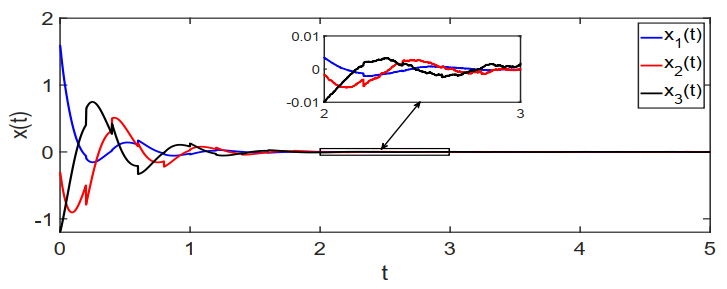
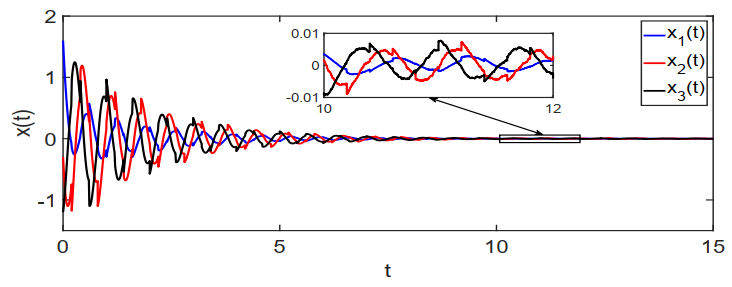
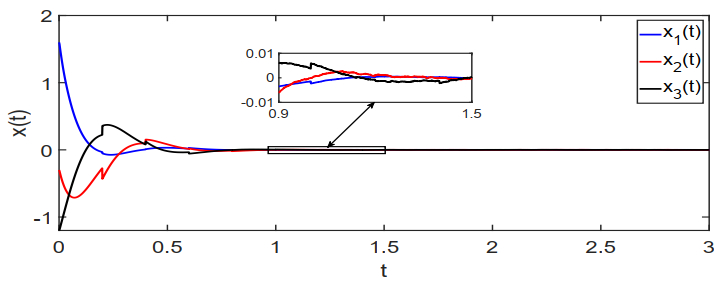
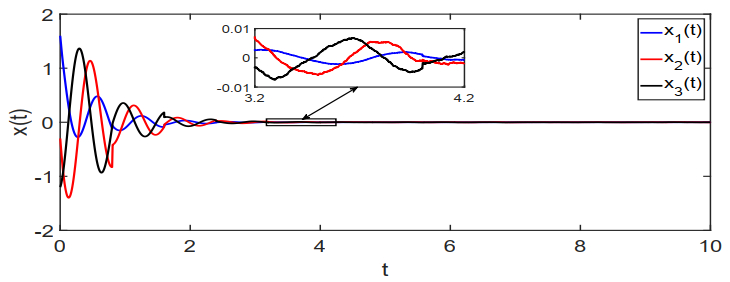
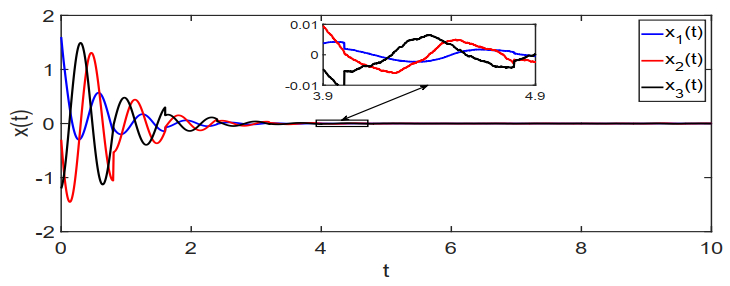
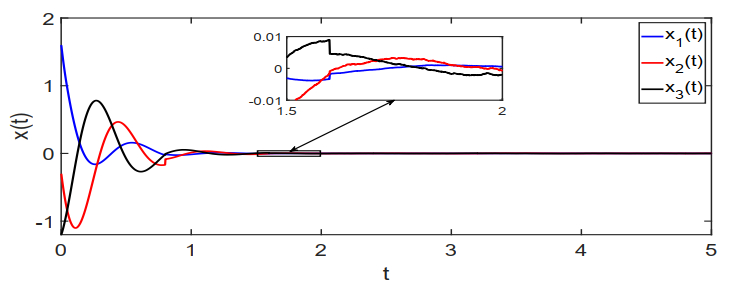
This paper proposes an intelligent regulation method for dynamically adjusting the convergence rate of nonlinear Chua's circuits subject to impulsive effects and stochastic disturbances, based on a Takagi-Sugeno (T-S) fuzzy model. First, an interval stability criterion for variable convergence rate is established through generalized pole assignment principle, constructing a unified analytical framework that simultaneously incorporates stability margin and dynamic convergence rate indicators. Second, a state feedback fuzzy controller with convergence rate constraints is designed. By constructing a constrained eigenvalue domain, the controller enables active regulation of the system's convergence rate. Furthermore, an intelligent convergence rate regulation algorithm is developed to achieve precise on-demand adjustment for Chua's circuit. Finally, simulation experiments conducted on the original system using the proposed fuzzy controller verify the effectiveness and practical utility of the control strategy.
Citation: Yining Zhang, Xinran Li, Tinglin Zhang, Huasheng Zhang. Variable convergence rate fuzzy control of chaotic Chua's circuit under impulsive and stochastic disturbances[J]. AIMS Mathematics, 2026, 11(2): 3703-3723. doi: 10.3934/math.2026150
This paper proposes an intelligent regulation method for dynamically adjusting the convergence rate of nonlinear Chua's circuits subject to impulsive effects and stochastic disturbances, based on a Takagi-Sugeno (T-S) fuzzy model. First, an interval stability criterion for variable convergence rate is established through generalized pole assignment principle, constructing a unified analytical framework that simultaneously incorporates stability margin and dynamic convergence rate indicators. Second, a state feedback fuzzy controller with convergence rate constraints is designed. By constructing a constrained eigenvalue domain, the controller enables active regulation of the system's convergence rate. Furthermore, an intelligent convergence rate regulation algorithm is developed to achieve precise on-demand adjustment for Chua's circuit. Finally, simulation experiments conducted on the original system using the proposed fuzzy controller verify the effectiveness and practical utility of the control strategy.

| [1] |
W. Zuo, Y. Zhang, J. Song, Y. Zhu, Z. Zhang, Bursting oscillations induced by the variable discontinuous boundary in Chua's circuit, IEEE Trans. Circuits Syst. I: Reg Papers, 72 (2025), 2768–2777. https://doi.org/10.1109/TCSI.2025.3553484 doi: 10.1109/TCSI.2025.3553484

|
| [2] |
F. A. Miranda-Villatoro, F. Casta$\tilde{n}$os, A. Franci, Equivalence of linear complementarity problems: theory and application to nonsmooth bifurcations, IEEE Trans. Autom. Control, 69 (2024), 4570–4582. https://doi.org/10.1109/TAC.2023.3338981 doi: 10.1109/TAC.2023.3338981
|
| [3] |
M. Shen, C. Wang, Q. G. Wang, Y. Sun, G. Zong, Synchronization of fractional reaction-diffusion complex networks with unknown couplings, IEEE Trans. Netw. Sci. Eng., 11 (2024), 4503–4512. https://doi.org/10.1109/TNSE.2024.3432997 doi: 10.1109/TNSE.2024.3432997
|
| [4] |
O. Kahouli, I. Zouak, M. A. Hammad, A. Ouannas, M. Ayari, On incommensurate chaotic fractional discrete model of a computer virus: Stabilization and synchronization, AIMS Math., 10 (2025), 19940–19957. https://doi.org/10.3934/math.2025890 doi: 10.3934/math.2025890
|
| [5] |
W. Xue, Y. Zhang, Q. Xu, H. Wu, M. Chen, Initial-condition-controlled synchronization behaviors in inductively coupled memristive Chua's circuits, Nonlinear Dyn., 112 (2024), 10417–10432. https://doi.org/10.1007/s11071-024-09587-8 doi: 10.1007/s11071-024-09587-8
|
| [6] |
S. Fu, L. Li, J. Feng, Strategy optimization of controlled evolutionary games on a two-layer coupled network using Lebesgue sampling, Nonlinear Anal-hybri., 56 (2025), 101570. https://doi.org/10.1016/j.nahs.2024.101570 doi: 10.1016/j.nahs.2024.101570
|
| [7] |
I. M. Kopp, I. Samuilik, Chaotic dynamics in Sprott's memristive artificial neural network: dynamic analysis, circuit implementation and synchronization, AIMS Math., 10 (2025), 19240–19266. https://doi.org/10.3934/math.2025860 doi: 10.3934/math.2025860
|
| [8] |
W. Chen, W. Xu, W. Zheng, Sliding-mode-based impulsive control for a class of time-delay systems with input disturbance, Automatica, 164 (2024), 111633. https://doi.org/10.1016/j.automatica.2024.111633 doi: 10.1016/j.automatica.2024.111633
|
| [9] |
T. Takagi, M. Sugeno, Fuzzy identification of systems and its applications to modeling and control, IEEE Trans. Syst. Man Cybern., 15 (1985), 116–132. https://doi.org/10.1109/TSMC.1985.6313399 doi: 10.1109/TSMC.1985.6313399
|
| [10] |
Z. Hu, X. Mu, J. Mu, Finite-time impulsive control for stochastic T-S fuzzy systems: A waiting-time-based event-triggered method, Fuzzy Sets Syst., 464 (2023), 108428. https://doi.org/10.1016/j.fss.2022.10.020 doi: 10.1016/j.fss.2022.10.020
|
| [11] |
S. Wang, J. Xia, X. Wang, W. Yang, L. Wang, Adaptive neural networks control for MIMO nonlinear systems with unmeasured states and unmodeled dynamics, Appl. Math. Comput., 408 (2021), 126369. https://doi.org/10.1016/j.amc.2021.126369 doi: 10.1016/j.amc.2021.126369
|
| [12] |
Y. Niu, K. Shi, X. Cai, S. Wen, Adaptive smooth sampled-data control for synchronization of T-S fuzzy reaction-diffusion neural networks with actuator saturation, AIMS Math., 10 (2025), 1142–1161. https://doi.org/10.3934/math.2025054 doi: 10.3934/math.2025054
|
| [13] |
L. Zhang, Z. Li, Y. Li, J. Dong, State and fault interval estimation for discrete-time takagi-sugeno fuzzy systems via intermediate observer base on zonotopic analysis, IEEE Trans. Fuzzy Syst., 32 (2024), 6588–6593. https://doi.org/10.1109/TFUZZ.2024.3459642 doi: 10.1109/TFUZZ.2024.3459642
|
| [14] |
L. Deng, X. Cao, J. Zhao, One-bit function perturbation impact on robust set stability of boolean networks with disturbances, Mathematics, 12 (2024), 2227–7390. https://doi.org/10.3390/math12142258 doi: 10.3390/math12142258
|
| [15] |
G. Li, C. Peng, Z. Cao, Finite-time bounded asynchronous sliding-mode control for T-S fuzzy time-delay systems via event-triggered scheme, Fuzzy Sets Syst., 514 (2025), 109400. https://doi.org/10.1016/j.fss.2025.109400 doi: 10.1016/j.fss.2025.109400
|
| [16] |
Y. Liu, S. Zhao, J. Lu, A new fuzzy impulsive control of chaotic systems based on T-S fuzzy model, IEEE Trans. Fuzzy Syst., 19 (2010), 393–398. https://doi.org/10.1109/TFUZZ.2010.2090162 doi: 10.1109/TFUZZ.2010.2090162
|
| [17] |
C. Liang, M. Ge, Z. Liu, X. Zhan, J. Park, Predefined-time stabilization of T-S fuzzy systems: A novel integral sliding mode-based approach, IEEE Trans. Fuzzy Syst., 30 (2022), 4423–4433. https://doi.org/10.1109/TFUZZ.2022.3152834 doi: 10.1109/TFUZZ.2022.3152834
|
| [18] |
H. Zhou, J. Zhou, Fixed-time synchronization of quaternion-valued memristive neural networks with time-varying delays and impulsive effect, AIMS Math., 10 (2025), 24093–24114. https://doi.org/10.3934/math.20251069 doi: 10.3934/math.20251069
|
| [19] |
M. Shen, C. Wang, Q. G. Wang, H. Yan, G. Zong, Z. H. Zhu, Fault-tolerant synchronization control of switched complex networks by a proportional-integral intermediate observer approach, IEEE Trans. Cybern., 55 (2025), 4689–4698. https://doi.org/10.1109/TCYB.2025.3591393 doi: 10.1109/TCYB.2025.3591393
|
| [20] |
M. Cheng, J. Zhao, X. Xie, Z. Sun, A novel finite-time stability criteria and controller design for nonlinear impulsive systems, Appl. Math. Comput., 479 (2024), 128876. https://doi.org/10.1016/j.amc.2024.128876 doi: 10.1016/j.amc.2024.128876
|
| [21] |
G. Liu, Y. Li, X. Yang, Existence and multiplicity of rotating periodic solutions for Hamiltonian systems with a general twist condition, J. Differ. Equations, 369 (2023), 229–252. https://doi.org/10.1016/j.jde.2023.06.001 doi: 10.1016/j.jde.2023.06.001
|
| [22] |
X. Liu, Y. M. Zeng, Analytic and numerical stability of delay differential equations with variable impulses, Appl. Math. Comput., 358 (2019), 293–304. https://doi.org/10.1016/j.amc.2019.04.051 doi: 10.1016/j.amc.2019.04.051
|
| [23] |
M. Zhang, Q. Zhu, Stabilization of unstable impulsive systems via stochastic discrete-time feedback control with Levy noise, Nonlinear Anal.-Hybri., 56 (2025), 101585. https://doi.org/10.1016/j.nahs.2025.101585 doi: 10.1016/j.nahs.2025.101585
|
| [24] |
X. Wang, H. Zhang, Intelligent control of convergence rate of impulsive dynamic systems affected by nonlinear disturbances under stabilizing impulses and its application in Chua's circuit, Chaos Soliton. Fract., 169 (2023), 113289. https://doi.org/10.1016/j.chaos.2023.113289 doi: 10.1016/j.chaos.2023.113289
|
| [25] |
C. Zhu, L. He, K. Zhang, Optimal timing fault tolerant control for switched stochastic systems with switched drift fault, Mathematics, 10 (2022), 1880. https://doi.org/10.3390/math10111880 doi: 10.3390/math10111880
|
| [26] | V. Anishchenko, M. Safonova, L. Chua, Stochastic resonance in Chua's circuit, Int. J. Bifurcat Chaos, 1992. https://doi.org/10.1142/9789812798855-0011 |
| [27] |
G. Chen, C. Fan, J. Sun, J. Xia, Mean square exponential stability analysis for It$\hat{o}$ stochastic systems with aperiodic sampling and multiple time-delays, IEEE Trans. Autom. Control, 67 (2022), 2473–2480. https://doi.org/10.1109/TAC.2021.3074848 doi: 10.1109/TAC.2021.3074848
|
| [28] |
G. Zhuang, J. Xia, J. Feng, Y. Wang, G. Chen, Dynamic compensator design and $H_{\infty}$ admissibilization for delayed singular jump systems via Moore-Penrose generalized inversion technique, Nonlinear Anal.-Hybri., 49 (2023), 101361. https://doi.org/10.1016/j.nahs.2023.101361 doi: 10.1016/j.nahs.2023.101361
|
| [29] |
M. Shen, X. Wang, J. H. Park, Y. Yi, W. W. Che, Extended disturbance-observer-based data-driven control of networked nonlinear systems with event-triggered output, IEEE Trans. Syst. Man Cybern.: Syst., 53 (2023), 3129–3140. https://doi.org/10.1109/TSMC.2022.3222491 doi: 10.1109/TSMC.2022.3222491
|
| [30] |
F. Prebianca, H. A. Albuquerque, M. W. Beims, Describing intrinsic noise in Chua's circuit, Phys. Lett. A, 382 (2018), 2420–2423. https://doi.org/10.1016/j.physleta.2018.05.054 doi: 10.1016/j.physleta.2018.05.054
|
| [31] |
G. Chen, J. Xia, J. H. Park, H. Shen, G. Zhuang, Robust sampled-data control for switched complex dynamical networks with actuators saturation, IEEE Trans. Cybern., 52 (2022), 10909–10923. https://doi.org/10.1109/TCYB.2021.3069813 doi: 10.1109/TCYB.2021.3069813
|
| [32] |
Z. Wang, D. Xu, Z. Li, A general configuration for nonlinear circuit employing current-controlled nonlinearity: Application in Chua's circuit, Chaos Soliton. Fract., 177 (2023), 114233. https://doi.org/10.1016/j.chaos.2023.114233 doi: 10.1016/j.chaos.2023.114233
|
| [33] |
J. Zhao, Y. Yuan, Z. Sun, X. Xie, Applications to the dynamics of the suspension system of fast finite time stability in probability of p-norm stochastic nonlinear systems, Appl. Math. Comput., 457 (2023), 128221. https://doi.org/10.1016/j.amc.2023.128221 doi: 10.1016/j.amc.2023.128221
|
| [34] |
X. Liu, M. Zhang, Z. W. Yang, Numerical threshold stability of a nonlinear age-structured reaction diffusion heroin transmission model, Appl. Numer. Math., 204 (2024), 291–311. https://doi.org/10.1016/j.apnum.2024.06.016 doi: 10.1016/j.apnum.2024.06.016
|
| [35] |
S. Gu, C. Qian, N. Zhang, Finite-time integral control for a class of nonlinear planar systems with non-vanishing uncertainties, Automatica, 136 (2022), 110016. https://doi.org/10.1016/j.automatica.2021.110016 doi: 10.1016/j.automatica.2021.110016
|
| [36] |
T. Zhang, H. Zhang, X. Xie, Region stability/stabilization and $H_{\infty}$ control for discrete-time impulsive takagi-sugeno fuzzy systems, IEEE Trans. Fuzzy Syst., 32 (2024), 3410–3419. https://doi.org/10.1109/TFUZZ.2024.3372936 doi: 10.1109/TFUZZ.2024.3372936
|
| [37] |
G. Zhuang, J. Xia, J. Feng, B. Zhang, J. Lu, Z. Wang, Admissibility analysis and stabilization for neutral descriptor hybrid systems with time-varying delays, Nonlinear Anal.-Hybri., 33 (2019), 311–321. https://doi.org/10.1016/j.nahs.2019.03.009 doi: 10.1016/j.nahs.2019.03.009
|
| [38] |
L. Xia, J. Wang, S. Fu, Control design to minimize the number of bankrupt players for networked evolutionary games with bankruptcy mechanism, AIMS Math., 9 (2024), 35702–35720. https://doi.org/10.3934/math.20241694 doi: 10.3934/math.20241694
|
| [39] |
Y. Deng, H. Zhang, J. Xia, $ H_ {\infty} $ control with convergence rate constraint for time-varying delay switched systems, IEEE Trans. Syst. Man Cybern: Syst., 53 (2023), 7354–7363. https://doi.org/10.1109/TSMC.2023.3298813 doi: 10.1109/TSMC.2023.3298813
|
| [40] | W. Zhang, L. Xie, B. Chen, Stochastic $H_{2}$/$H_{\infty}$ control-a nash game approach, CRC Press, 2017. https://doi.org/10.1201/9781315117706 |
| [41] |
W. Chen, J. Wang, Y. Tang, X. Lu, Robust $H_{\infty}$ control of uncertain linear impulsive stochastic systems, Int. J. Robust Nonlinear Control, 18 (2008), 1348–1371. https://doi.org/10.1002/rnc.1286 doi: 10.1002/rnc.1286
|
Figures(10) / Tables(2)

Yining Zhang, Xinran Li, Tinglin Zhang, Huasheng Zhang. Variable convergence rate fuzzy control of chaotic Chua's circuit under impulsive and stochastic disturbances[J]. AIMS Mathematics, 2026, 11(2): 3703-3723. doi: 10.3934/math.2026150





 DownLoad: