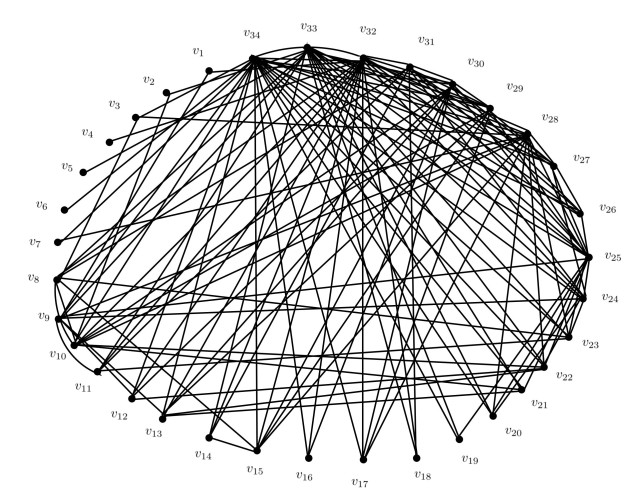
Let $ R $ be a finite commutative ring with unity. The zero-divisor graph $ \Gamma(R) $ is defined such that its vertex set comprises all nonzero zero-divisors of $ R $, with two distinct vertices being adjacent if and only if their product is zero. This study provides a closed-form expression for the $ n $-eccentricity of each vertex and computes the Steiner antipodal number of $ \Gamma(R) $ under the following conditions: (ⅰ) $ R = \mathbb{Z}_m $, (ⅱ) $ R $ is a reduced ring, and (ⅲ) $ R $ is a finite direct product of rings of the form $ \mathbb{Z}_m $. Moreover, we establish the existence of a zero-divisor graph with a Steiner antipodal number equal to some positive integer $ m $.
Citation: Gurusamy Rajendran, Sankari Alias Deepa Ramamoorthy, Arockiaraj Sonasalam, Grienggrai Rajchakit. The Steiner antipodal number of zero-divisor graphs of finite commutative rings[J]. AIMS Mathematics, 2026, 11(2): 3512-3533. doi: 10.3934/math.2026143
Let $ R $ be a finite commutative ring with unity. The zero-divisor graph $ \Gamma(R) $ is defined such that its vertex set comprises all nonzero zero-divisors of $ R $, with two distinct vertices being adjacent if and only if their product is zero. This study provides a closed-form expression for the $ n $-eccentricity of each vertex and computes the Steiner antipodal number of $ \Gamma(R) $ under the following conditions: (ⅰ) $ R = \mathbb{Z}_m $, (ⅱ) $ R $ is a reduced ring, and (ⅲ) $ R $ is a finite direct product of rings of the form $ \mathbb{Z}_m $. Moreover, we establish the existence of a zero-divisor graph with a Steiner antipodal number equal to some positive integer $ m $.

| [1] |
D. F. Anderson, P. S. Livingston, The zero-divisor graph of a commutative ring, J. Algebra, 217 (1999), 434–447. https://doi.org/10.1006/jabr.1998.7840 doi: 10.1006/jabr.1998.7840

|
| [2] |
S. Balamoorthy, T. Kavaskar, K. Vinothkumar, Wiener index of an ideal-based zero-divisor graph of commutative ring with unity, AKCE Int. J. Graphs Comb., 21 (2024), 111–119. https://doi.org/10.1080/09728600.2023.2263040 doi: 10.1080/09728600.2023.2263040
|
| [3] |
S. Chattopadhyay, K. L. Patra, B. K. Sahoo, Laplacian eigenvalues of the zero divisor graph of the ring $\mathbb{Z}_n$, Linear Algebra Appl., 584 (2020), 267–286. https://doi.org/10.1016/j.laa.2019.08.015 doi: 10.1016/j.laa.2019.08.015
|
| [4] |
A. N. A. Koam, A. Ahmad, A. Haider, Radio number associated with zero divisor graph, Mathematics, 8 (2020), 2187. https://doi.org/10.3390/math8122187 doi: 10.3390/math8122187
|
| [5] |
K. Selvakumar, P. Gangaeswari, G. Arunkumar, The Wiener index of the zero-divisor graph of a finite commutative ring with unity, Discrete Appl. Math., 311 (2022), 72–84. https://doi.org/10.1016/j.dam.2022.01.012 doi: 10.1016/j.dam.2022.01.012
|
| [6] |
R. Singleton, There is no irregular Moore graph, Am. Math. Mon., 75 (1968), 42–43. https://doi.org/10.2307/2315106 doi: 10.2307/2315106
|
| [7] |
S. Arockiaraj, R. Gurusamy, K. M. Kathiresan, On the Steiner antipodal number of graphs, Electron. J. Graph Theory Appl., 7 (2019), 225–233. https://doi.org/10.5614/ejgta.2019.7.2.3 doi: 10.5614/ejgta.2019.7.2.3
|
| [8] |
R. Gurusamy, A. Meena Kumari, R. Rathajeyalakshmi, Steiner antipodal number of graphs obtained from some graph operations, Math. Stat., 11 (2023), 441–445. https://doi.org/10.13189/ms.2023.110301 doi: 10.13189/ms.2023.110301
|
| [9] | P. Gangaeswari, K. Selvakumar, G. Arunkumar, A note on topological indices and the twin classes of graphs, arXiv, 2023. https://doi.org/10.48550/arXiv.2303.12491 |
| [10] |
M. Young, Adjacency matrices of zero-divisor graphs of integers modulo $n$, Involve, 8 (2015), 753–761. https://doi.org/10.2140/involve.2015.8.753 doi: 10.2140/involve.2015.8.753
|
Figures(5) / Tables(2)

Gurusamy Rajendran, Sankari Alias Deepa Ramamoorthy, Arockiaraj Sonasalam, Grienggrai Rajchakit. The Steiner antipodal number of zero-divisor graphs of finite commutative rings[J]. AIMS Mathematics, 2026, 11(2): 3512-3533. doi: 10.3934/math.2026143





 DownLoad: