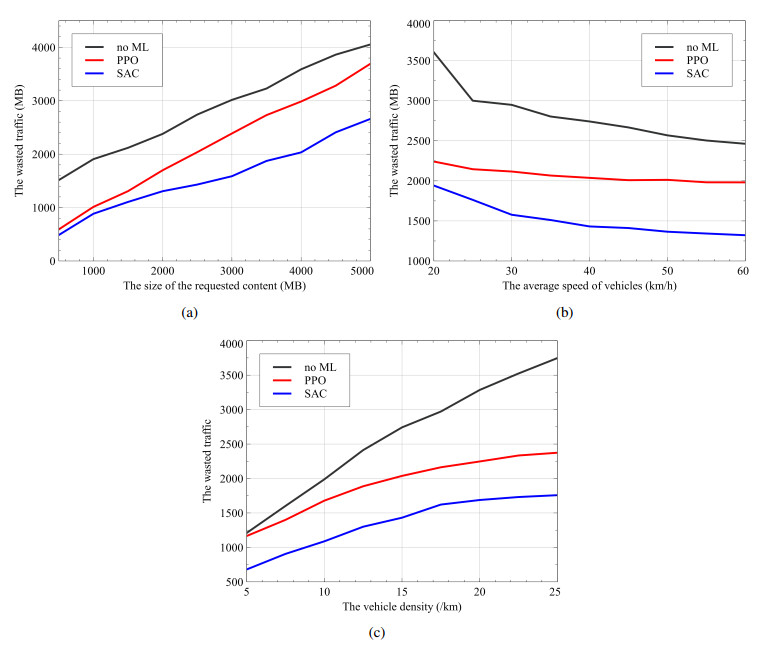
The rapid development of the Internet of Vehicles and the increasing demand for mobile content services have significantly increased network traffic, leading to congestion and delays. To address these challenges, Content-centric IoV has emerged by integrating IoV with Content-Centric Networking, enabling efficient mobile content delivery. However, CIoV still faces limitations in outage zones where roadside unit coverage is restricted, hindering content transmission. To overcome this issue, we propose a SAC-based Precaching Vehicle Selection scheme that dynamically selects optimal precaching vehicles and determines appropriate content sizes to facilitate content delivery in outage zones. SAC-PVS operates on a snapshot-based inference model, which is specifically designed to optimize precaching decisions at the exact moment of a request without relying on continuous time-series monitoring. It leverages the SAC algorithm to handle continuous action spaces, enabling precise determination of both the optimal caching vehicles and the corresponding content quantities. A hierarchical reward structure penalizes excessive caching and traffic waste while rewarding successful content delivery in outage zones. Simulation results demonstrate that SAC-PVS outperforms both a comparable machine learning approach and a non-machine-learning baseline by reducing content delivery latency and minimizing traffic waste under dynamic vehicular conditions. The proposed SAC-PVS scheme improves the Quality of Service for vehicle users and optimizes network resource utilization for content delivery, offering a scalable and efficient solution for next-generation CIoV content services.
Citation: Youngju Nam, Yongje Shin, Hyeonseok Choi, Euisin Lee. Precaching vehicle selection based on soft actor-critic in CIoV[J]. AIMS Mathematics, 2026, 11(2): 3314-3348. doi: 10.3934/math.2026135
The rapid development of the Internet of Vehicles and the increasing demand for mobile content services have significantly increased network traffic, leading to congestion and delays. To address these challenges, Content-centric IoV has emerged by integrating IoV with Content-Centric Networking, enabling efficient mobile content delivery. However, CIoV still faces limitations in outage zones where roadside unit coverage is restricted, hindering content transmission. To overcome this issue, we propose a SAC-based Precaching Vehicle Selection scheme that dynamically selects optimal precaching vehicles and determines appropriate content sizes to facilitate content delivery in outage zones. SAC-PVS operates on a snapshot-based inference model, which is specifically designed to optimize precaching decisions at the exact moment of a request without relying on continuous time-series monitoring. It leverages the SAC algorithm to handle continuous action spaces, enabling precise determination of both the optimal caching vehicles and the corresponding content quantities. A hierarchical reward structure penalizes excessive caching and traffic waste while rewarding successful content delivery in outage zones. Simulation results demonstrate that SAC-PVS outperforms both a comparable machine learning approach and a non-machine-learning baseline by reducing content delivery latency and minimizing traffic waste under dynamic vehicular conditions. The proposed SAC-PVS scheme improves the Quality of Service for vehicle users and optimizes network resource utilization for content delivery, offering a scalable and efficient solution for next-generation CIoV content services.

| [1] |
Q. Yuan, H. Zhou, J. Li, Z. Liu, F. Yang, X. S. Shen, Toward efficient content delivery for automated driving services: An edge computing solution, IEEE Network, 32 (2018), 80–86. https://doi.org/10.1109/MNET.2018.1700105 doi: 10.1109/MNET.2018.1700105

|
| [2] | Ericsson mobility report, Available online: https://www.ericsson.com/en/reports-and-papers/mobility-report/dataforecasts/mobile-traffic-forecast/ (Accessed: February 3, 2026). |
| [3] |
P. K. Singh, S. K. Nandi, S. Nandi, A tutorial survey on vehicular communication state of the art, and future research directions, Veh. Commun., 18 (2019), 100164. https://doi.org/10.1016/j.vehcom.2019.100164 doi: 10.1016/j.vehcom.2019.100164
|
| [4] | D. Reichardt, M. Miglietta, L. Moretti, P. Morsink, W. Schulz, CarTALK 2000: Safe and comfortable driving based upon inter–vehicle–communication, In: Intelligent Vehicle Symposium, 2002. IEEE, Versailles, France, 2 (2002), 545–550. https://doi.org/10.1109/IVS.2002.1188007 |
| [5] |
Z. Li, Y. Chen, D. Liu, X. Li, Performance analysis for an enhanced architecture of IoV via content–centric networking, EURASIP J. Wirel. Comm., 2017 (2017), 124. https://doi.org/10.1186/s13638-017-0905-4 doi: 10.1186/s13638-017-0905-4
|
| [6] |
M. T. R. Khan, Y. Z. Jembre, M. M. Saad, S. H. Bouk, S. H. Ahmed, D. Kim, Proactive content retrieval based on value of popularity in content-centric internet of vehicles, IEEE T. Intell. Transp., 25 (2024), 8514–8526. https://doi.org/10.1109/TITS.2024.3378669 doi: 10.1109/TITS.2024.3378669
|
| [7] |
S. Ahmed, D. Mu, D. Kim, Improving bivious relay selection in vehicular delay tolerant networks, IEEE T. Intell. Transp., 19 (2018), 987–995. https://doi.org/10.1109/TITS.2018.2791925 doi: 10.1109/TITS.2018.2791925
|
| [8] |
R. Wang, Z. Kan, Y. Cui, D. Wu, Y. Zhen, Cooperative caching strategy with content request prediction in internet of vehicles, IEEE Internet Things, 8 (2021), 8964–89751. https://doi.org/10.1109/JIOT.2021.3056084 doi: 10.1109/JIOT.2021.3056084
|
| [9] | T. Guo, C. Li, Z. Miao, W. Dong, X. Su, Prefetching-based content download for highway vehicular ad hoc networks, In: 2017 IEEE/CIC International Conference on Communications in China (ICCC), Qingdao, China, 2017, 1–6. https://doi.org/10.1109/ICCChina.2017.8330346 |
| [10] |
Y. Wang, Y. Liu, J. Zhang, H. Ye, Z. Tan, Cooperative Store–Carry–Forward scheme for intermittently connected vehicular networks, IEEE T. Veh. Technol., 66 (2017), 777–784. https://doi.org/10.1109/TVT.2016.2536059 doi: 10.1109/TVT.2016.2536059
|
| [11] |
Y. Nam, J. Bang, H. Choi, Y. Shin, S. Oh, E. Lee, Multiple precaching vehicle selection scheme based on set ranking in intermittently connected vehicular networks, Sensors, 23 (2023), 5800. https://doi.org/10.3390/s23135800 doi: 10.3390/s23135800
|
| [12] |
Y. Zhang, R. Wang, Y. Wang, M. Chen, M. Guizani, Diversity-driven proactive caching for mobile networks, IEEE T. Mobile Comput., 23 (2024), 7878–7894. https://doi.org/10.1109/TMC.2023.3340733 doi: 10.1109/TMC.2023.3340733
|
| [13] |
G. Chen, J. Sun, Y. Zhou, Q. Zeng, F. Shen, A novel proactive cache decision algorithm based on prior knowledge and aerial cloud assistance in internet of vehicles, IEEE T. Netw. Sci. Eng., 11 (2024), 5280–5297. https://doi.org/10.1109/TNSE.2024.3433544 doi: 10.1109/TNSE.2024.3433544
|
| [14] | V. Jacobson, D. K. Smetters, J. D. Thornton, M. F. Plass, N. H. Briggs, R. L. Braynard, Networking named content, In: Proceedings of the 5th international conference on Emerging networking experiments and technologies, Rome, Italy, 2009, 1–12. https://doi.org/10.1145/1658939.1658941 |
| [15] |
L. Zhang, A. Afanasyev, J. Burke, V. Jacobson, K. Claffy, P. Crowley, et al., Named data networking, ACM SIGCOMM Comp. Com., 44 (2014), 66–73. https://doi.org/10.1145/2656877.2656887 doi: 10.1145/2656877.2656887
|
| [16] | M. Amadeo, C. Campolo, A. Molinaro, Content–centric vehicular networking: An evaluation study, In: 2012 Third International Conference on The Network of the Future (NOF), Tunis, Tunisia, 2012, 1–5. https://doi.org/10.1109/NOF.2012.6463994 |
| [17] |
Z. Su, Y. Hui, Q. Yang, The next generation vehicular networks: A content-centric framework, IEEE Wirel. Commun., 24 (2017), 60–66. https://doi.org/10.1109/MWC.2017.1600195WC doi: 10.1109/MWC.2017.1600195WC
|
| [18] |
X. Wang, X. Wang, Vehicular content–centric networking framework, IEEE Syst. J., 13 (2019), 519–529. https://doi.org/10.1109/JSYST.2018.2875918 doi: 10.1109/JSYST.2018.2875918
|
| [19] |
I. U. Din, B. Ahmad, A. Almogren, H. Almajed, I. Mohiuddin, J. J. P. C. Rodrigues, Left–right–front caching strategy for vehicular networks in ICN–based internet of things, IEEE Access, 9 (2021), 595–605. https://doi.org/10.1109/ACCESS.2020.3046887 doi: 10.1109/ACCESS.2020.3046887
|
| [20] | G. Ahani, D. Yuan, On optimal proactive and retention–aware caching with user mobility, In: 2018 IEEE 88th Vehicular Technology Conference (VTC-Fall), Chicago, IL, USA, 2018, 1–5. https://doi.org/10.1109/VTCFall.2018.8691020 |
| [21] | C. Liang, F. R. Yu, N. Dao, G. Senarath, H. Farmanbar, Enabling adaptive data prefetching in 5G mobile networks with edge caching, In: 2018 IEEE Global Communications Conference (GLOBECOM), Abu Dhabi, United Arab Emirates, 2018, 1–6. https://doi.org/10.1109/GLOCOM.2018.8647443 |
| [22] | L. Yao, Z. Li, W. Peng, B. Wu, W. Sun, A pre-caching mechanism of video stream based on hidden Markov model in vehicular content centric network, In: 2020 3rd International Conference on Hot Information-Centric Networking (HotICN), Hefei, China, 2020, 53–58. https://doi.org/10.1109/HotICN50779.2020.9350830 |
| [23] |
Z. Zhang, C. H. Lung, M. S. Hilaire, I. Lambadaris, Smart proactive caching: Empower the video delivery for autonomous vehicles in ICN-based networks, IEEE T. Veh. Technol., 69 (2020), 7955–7965. https://doi.org/10.1109/TVT.2020.2994181 doi: 10.1109/TVT.2020.2994181
|
| [24] |
A. Mahmood, C. E. Casetti, C. F. Chiasserini, P. Giaccone, J. Härri, The RICH prefetching in edge caches for in-order delivery to connected cars, IEEE T. Veh. Technol., 68 (2019), 4–18. https://doi.org/10.1109/TVT.2018.2879850 doi: 10.1109/TVT.2018.2879850
|
| [25] | N. Abani, T. Braun, M. Gerla, Proactive caching with mobility prediction under uncertainty in information-centric networks, In: Proceedings of the 4th ACM Conference on Information-Centric Networking, Berlin, Germany, 2017, 88–97. https://doi.org/10.1145/3125719.3125728 |
| [26] | W. Zhao, C. Wu, R. Zhong, K. Shi, X. Xu, Edge computing and caching optimization based on PPO for task offloading in RSU-assisted IoV, In: 2023 IEEE 9th World Forum on Internet of Things (WF-IoT), Aveiro, Portugal, 2023, 01–06. https://doi.org/10.1109/WF-IoT58464.2023.10539436 |
| [27] | S. Wang, Q. Zhu, H. Huang, Y. Lei, W. Zhan, H. Duan, Deep reinforcement learning based real-time proactive edge caching in intelligent transportation system, In: 2023 8th International Conference on Cloud Computing and Big Data Analytics (ICCCBDA), Chengdu, China, 2023,162–166. https://doi.org/10.1109/ICCCBDA56900.2023.10154769 |
| [28] |
B. Feng, C. Feng, D. Feng, Y. Wu, X. G. Xia, Proactive content caching scheme in urban vehicular networks, IEEE Trans. Commun., 71 (2023), 4165–4180. https://doi.org/10.1109/TCOMM.2023.3277530 doi: 10.1109/TCOMM.2023.3277530
|
| [29] | A. Azzalini, A. Capitanio, The skew–normal and related families, Cambridge University Press, 2013. |
| [30] | L. Breslau, P. Cao, L. Fan, G. Phillips, S. Shenker, Web caching and Zipf–like distributions: Evidence and implications, In: IEEE INFOCOM '99. Conference on Computer Communications. Proceedings. Eighteenth Annual Joint Conference of the IEEE Computer and Communications Societies. The Future is Now (Cat. No.99CH36320), New York, USA, 1999,126–134. https://doi.org/10.1109/INFCOM.1999.749260 |
| [31] | A. Raffin, A. Hill, A. Gleave, A. Kanervisto, M. Ernestus, N. Dormann, Stable-baselines3: Reliable reinforcement learning implementations, J. Mach. Learn. Res., 22 (2021), 1–8. |
| [32] |
B. Liu, Y. Cai, D. Li, K. Lin, G. Xu, A hybrid ARO algorithm and key point retention strategy trajectory optimization for UAV path planning, Drones, 8 (2024), 644. https://doi.org/10.3390/drones8110644 doi: 10.3390/drones8110644
|
| [33] | P. A. Lopez, M. Behrisch, L. B. Walz, J. Erdmann, Y. Flötteröd, R. Hilbrich, et al., Microscopic traffic simulation using SUMO, In: 2018 21st International Conference on Intelligent Transportation Systems (ITSC), Maui, HI, USA, 2018, 2575–2582. https://doi.org/10.1109/ITSC.2018.8569938 |
| [34] |
F. M. Harper, J. A. Konstan, The MovieLens datasets: History and context, ACM T. Interact. Intel., 5 (2015), 1–19. https://doi.org/10.1145/2827872 doi: 10.1145/2827872
|
Figures(13) / Tables(2)

Youngju Nam, Yongje Shin, Hyeonseok Choi, Euisin Lee. Precaching vehicle selection based on soft actor-critic in CIoV[J]. AIMS Mathematics, 2026, 11(2): 3314-3348. doi: 10.3934/math.2026135





 DownLoad: