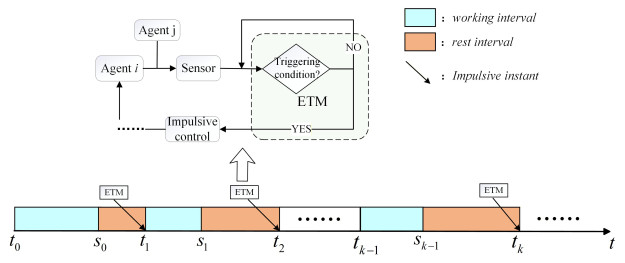
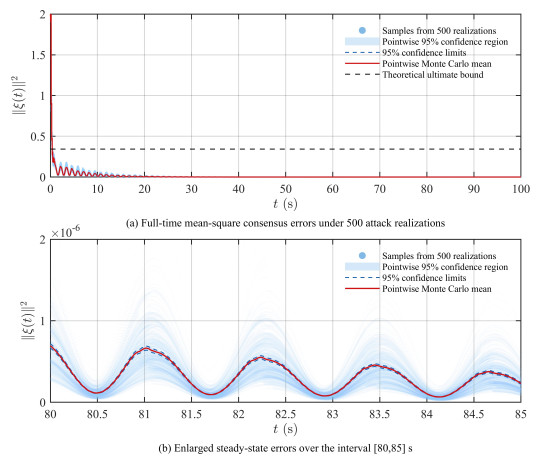
This paper focus on the mean-square quasiconsensus issue in delayed leader-following multi-agent systems. An event-triggered intermittent impulsive control is developed to ensure consensus for systems facing deception attacks. First, a closed-loop intermittent control scheme is developed. In this framework, the working intervals are determined by a Lyapunov-based event-triggered mechanism (ETM), which adjusts the control activation according to real-time system states. Furthermore, a newly proposed delayed differential inequality featuring piecewise characteristics is constructed to address these analytical challenges arising from the integration of state-based intermittent control, state delay, deception attacks, and impulsive control. The proposed inequality further leads to a sufficient criterion under which the considered systems achieve mean-square quasiconsensus. Simulation results are reported to show that the proposed conditions are applicable.
Citation: Chen Liu, Mengting Wang, Qing Chen, Yihao Chu. Intermittent event-triggered impulsive control for consensus of delayed multi-agent systems subject to deception attacks[J]. AIMS Mathematics, 2026, 11(8): 27203-27230. doi: 10.3934/math.20261089
This paper focus on the mean-square quasiconsensus issue in delayed leader-following multi-agent systems. An event-triggered intermittent impulsive control is developed to ensure consensus for systems facing deception attacks. First, a closed-loop intermittent control scheme is developed. In this framework, the working intervals are determined by a Lyapunov-based event-triggered mechanism (ETM), which adjusts the control activation according to real-time system states. Furthermore, a newly proposed delayed differential inequality featuring piecewise characteristics is constructed to address these analytical challenges arising from the integration of state-based intermittent control, state delay, deception attacks, and impulsive control. The proposed inequality further leads to a sufficient criterion under which the considered systems achieve mean-square quasiconsensus. Simulation results are reported to show that the proposed conditions are applicable.

| [1] |
Y. S. Zheng, J. Y. Ma, L. Wang, Consensus of hybrid multi-agent systems, IEEE Trans. Neural Netw. Learn. Syst., 29 (2018), 1359–1365. https://doi.org/10.1109/TNNLS.2017.2651402 doi: 10.1109/TNNLS.2017.2651402

|
| [2] |
X. W. Dong, B. C. Yu, Z. Y. Shi, Y. S. Zhong, Time-varying formation control for unmanned aerial vehicles: theories and applications, IEEE Trans. Control Syst. Technol., 23 (2015), 340–348. https://doi.org/10.1109/tcst.2014.2314460 doi: 10.1109/tcst.2014.2314460
|
| [3] |
R. Z. Homod, Z. M. Yaseen, A. K. Hussein, A. Almusaed, O. A. Alawi, M. W. Falah, et al., Deep clustering of cooperative multi-agent reinforcement learning to optimize multi chiller HVAC systems for smart buildings energy management, J. Build. Eng., 65 (2023), 105689. https://doi.org/10.1016/j.jobe.2022.105689 doi: 10.1016/j.jobe.2022.105689
|
| [4] |
L. Schenato, F. Fiorentin, Average TimeSynch: a consensus-based protocol for clock synchronization in wireless sensor networks, Automatica, 47 (2011), 1878–1886. https://doi.org/10.1016/j.automatica.2011.06.012 doi: 10.1016/j.automatica.2011.06.012
|
| [5] |
Z. W. Yan, L. Han, X. D. Li, X. W. Dong, Q. D. Li, Z. Ren, Event-triggered formation control for time-delayed discrete-time multi-agent system applied to multi-UAV formation flying, J. Franklin Inst., 360 (2023), 3677–3699. https://doi.org/10.1016/j.jfranklin.2023.01.036 doi: 10.1016/j.jfranklin.2023.01.036
|
| [6] |
O. P. Mahela, M. Khosravy, N. Gupta, B. Khan, H. H. Alhelou, R. Mahla, et al., Comprehensive overview of multi-agent systems for controlling smart grids, CSEE J. Power Energy Syst., 8 (2022), 115–131. https://doi.org/10.17775/cseejpes.2020.03390 doi: 10.17775/cseejpes.2020.03390
|
| [7] |
J. Y. Xu, J. X. Dong, Global prescribed performance bipartite consensus for linear multi-agent systems: a time-varying BLF-based gain method, J. Franklin Inst., 362 (2025), 108102. https://doi.org/10.1016/j.jfranklin.2025.108102 doi: 10.1016/j.jfranklin.2025.108102
|
| [8] |
Z. Y. Yu, H. J. Jiang, C. Hu, Second-order consensus for multiagent systems via intermittent sampled-data control, IEEE Trans. Syst. Man Cybernet. Syst., 48 (2018), 1986–2002. https://doi.org/10.1109/tsmc.2017.2687944 doi: 10.1109/tsmc.2017.2687944
|
| [9] |
S. C. He, X. D. Liu, P. L. Lu, C. K. Du, H. K. Liu, Distributed finite-time consensus algorithm for multiagent systems via aperiodically intermittent protocol, IEEE Trans. Circuits Syst. II Express Briefs, 69 (2022), 3229–3233. https://doi.org/10.1109/tcsii.2021.3135866 doi: 10.1109/tcsii.2021.3135866
|
| [10] |
Y. Guo, Y. Qian, P. F. Wang, Leader-following consensus of delayed multi-agent systems with aperiodically intermittent communications, Neurocomputing, 466 (2021), 49–57. https://doi.org/10.1016/j.neucom.2021.09.014 doi: 10.1016/j.neucom.2021.09.014
|
| [11] |
J. F. Wang, Z. Tang, D. Ding, J. W. Feng, Aperiodically intermittent saturation consensus on multi-agent systems with discontinuous dynamics, ISA Trans., 133 (2023), 66–74. https://doi.org/10.1016/j.isatra.2022.06.031 doi: 10.1016/j.isatra.2022.06.031
|
| [12] |
J. R. Xiao, Y. F. Hu, X. Y. Liu, J. D. Cao, Bipartite consensus of second-order delayed unknown multi-agent systems via aperiodically intermittent control, Asian J. Control, 27 (2025), 2530–2540. https://doi.org/10.1002/asjc.3605 doi: 10.1002/asjc.3605
|
| [13] |
L. Ding, Q. L. Han, X. H. Ge, X. M. Zhang, An overview of recent advances in event-triggered consensus of multiagent systems, IEEE Trans. Cybernet., 48 (2018), 1110–1123. https://doi.org/10.1109/tcyb.2017.2771560 doi: 10.1109/tcyb.2017.2771560
|
| [14] |
D. V. Dimarogonas, E. Frazzoli, K. H. Johansson, Distributed event-triggered control for multi-agent systems, IEEE Trans. Autom. Control, 57 (2012), 1291–1297. https://doi.org/10.1109/tac.2011.2174666 doi: 10.1109/tac.2011.2174666
|
| [15] |
D. S. Xie, S. Y. Xu, Y. M. Chu, Y. Zou, Event-triggered average consensus for multi-agent systems with nonlinear dynamics and switching topology, J. Franklin Inst., 352 (2015), 1080–1098. https://doi.org/10.1016/j.jfranklin.2014.11.004 doi: 10.1016/j.jfranklin.2014.11.004
|
| [16] |
M. Zhao, C. Peng, W. L. He, Y. Song, Event-triggered communication for leader-following consensus of second-order multiagent systems, IEEE Trans. Cybernet., 48 (2018), 1888–1897. https://doi.org/10.1109/tcyb.2017.2716970 doi: 10.1109/tcyb.2017.2716970
|
| [17] | L. C. Zhang, Y. R. Li, C. K. Ahn, H. J. Liang, Adaptive temporal partitioning for communication-efficient consensus in nonlinear multiagent systems, IEEE Trans. Ind. Inform., 2026, 1–12. https://doi.org/10.1109/TII.2026.3709625 |
| [18] |
Y. N. Pan, Y. L. Chen, H. J. Liang, Event-triggered predefined-time control for full-state constrained nonlinear systems: a novel command filtering error compensation method, Sci. China Technol. Sci., 67 (2024), 2867–2880. https://doi.org/10.1007/s11431-023-2607-8 doi: 10.1007/s11431-023-2607-8
|
| [19] |
A. H. Hu, J. H. Park, M. F. Hu, Consensus of nonlinear multiagent systems with intermittent dynamic event-triggered protocols, Nonlinear Dyn., 104 (2021), 1299–1313. https://doi.org/10.1007/s11071-021-06321-6 doi: 10.1007/s11071-021-06321-6
|
| [20] |
H. J. Liang, Z. Y. Chang, C. K. Ahn, Hybrid event-triggered intermittent control for nonlinear multi-agent systems, IEEE Trans. Netw. Sci. Eng., 10 (2023), 1975–1984. https://doi.org/10.1109/tnse.2023.3237256 doi: 10.1109/tnse.2023.3237256
|
| [21] |
C. Liu, L. Liu, Z. J. Wu, Intermittent event-triggered optimal control for second-order delayed multiagent systems with input constraints, IEEE Trans. Syst. Man Cybernet. Syst., 54 (2024), 2698–2710. https://doi.org/10.1109/tsmc.2023.3346949 doi: 10.1109/tsmc.2023.3346949
|
| [22] |
X. F. Zhu, Z. Tang, J. W. Feng, J. H. Park, Aperiodically intermittent event-triggered pinning control on cluster synchronization of directed complex networks, ISA Trans., 138 (2023), 281–290. https://doi.org/10.1016/j.isatra.2023.02.027 doi: 10.1016/j.isatra.2023.02.027
|
| [23] |
B. Liu, T. Liu, P. Xiao, Dynamic event-triggered intermittent control for stabilization of delayed dynamical systems, Automatica, 149 (2023), 110847. https://doi.org/10.1016/j.automatica.2022.110847 doi: 10.1016/j.automatica.2022.110847
|
| [24] |
Z. H. Ma, D. Ding, Z. Tang, Containment control for non-linear multi-agent systems under distributed event-triggering intermittent schemes, Int. J. Robust Nonlinear Control, 35 (2025), 3751–3762. https://doi.org/10.1002/rnc.7879 doi: 10.1002/rnc.7879
|
| [25] |
T. D. Ma, K. Li, Z. L. Zhang, B. Cui, Impulsive consensus of one-sided Lipschitz nonlinear multi-agent systems with semi-Markov switching topologies, Nonlinear Anal. Hybrid Syst., 40 (2021), 101020. https://doi.org/10.1016/j.nahs.2021.101020 doi: 10.1016/j.nahs.2021.101020
|
| [26] |
W. Y. Tang, C. J. Liang, J. Wu, Y. F. Xie, Distributed impulsive control consensus for a class of unknown nonlinear multi-agent systems based on event-triggered scheme, Nonlinear Anal. Hybrid Syst., 49 (2023), 101352. https://doi.org/10.1016/j.nahs.2023.101352 doi: 10.1016/j.nahs.2023.101352
|
| [27] |
X. Wang, S. D. Wang, J. Liu, Y. B. Wu, C. Y. Sun, Bipartite finite-time consensus of multi-agent systems with intermittent communication via event-triggered impulsive control, Neurocomputing, 598 (2024), 127970. https://doi.org/10.1016/j.neucom.2024.127970 doi: 10.1016/j.neucom.2024.127970
|
| [28] |
K. P. Wang, D. Ding, Z. Tang, J. W. Feng, Leader-following consensus of nonlinear multi-agent systems with hybrid delays: distributed impulsive pinning strategy, Appl. Math. Comput., 424 (2022), 127031. https://doi.org/10.1016/j.amc.2022.127031 doi: 10.1016/j.amc.2022.127031
|
| [29] |
Y. L. Wang, J. D. Cao, H. J. Wang, Event-based impulsive consensus for delayed multi-agent systems, Asian J. Control, 24 (2022), 771–781. https://doi.org/10.1002/asjc.2646 doi: 10.1002/asjc.2646
|
| [30] |
F. H. Zhang, C. L. Zhan, T. W. Huang, Z. G. Zeng, Synchronization of delayed complex networks via event-triggered intermittent impulsive control, J. Franklin Inst., 362 (2025), 108109. https://doi.org/10.1016/j.jfranklin.2025.108109 doi: 10.1016/j.jfranklin.2025.108109
|
| [31] |
W. L. He, W. Y. Xu, X. H. Ge, Q. L. Han, W. L. Du, F. Qian, Secure control of multiagent systems against malicious attacks: a brief survey, IEEE Trans. Ind. Inform., 18 (2022), 3595–3608. https://doi.org/10.1109/tii.2021.3126644 doi: 10.1109/tii.2021.3126644
|
| [32] |
G. D. Zong, H. Z. Xie, D. Yang, X. D. Zhao, Y. Yi, Adaptive fuzzy tracking control for switched nonlinear systems under FDI attacks and input saturation: a flexible transient performance approach, IEEE Trans. Cybernet., 54 (2024), 7479–7488. https://doi.org/10.1109/TCYB.2024.3463689 doi: 10.1109/TCYB.2024.3463689
|
| [33] |
T. T. Yin, Z. Gu, J. H. Park, Event-based intermittent formation control of multi-UAV systems under deception attacks, IEEE Trans. Neural Netw. Learn. Syst., 35 (2024), 8336–8347. https://doi.org/10.1109/tnnls.2022.3227101 doi: 10.1109/tnnls.2022.3227101
|
| [34] |
Z. W. Liu, Y. L. Shi, H. C. Yan, B. X. Han, Z. H. Guan, Secure consensus of multiagent systems via impulsive control subject to deception attacks, IEEE Trans. Circuits Syst. II Express Briefs, 70 (2023), 166–170. https://doi.org/10.1109/tcsii.2022.3196042 doi: 10.1109/tcsii.2022.3196042
|
| [35] |
C. Zhao, X. Z. Liu, S. M. Zhong, K. B. Shi, D. X. Liao, Q. S. Zhong, Secure consensus of multi-agent systems with redundant signal and communication interference via distributed dynamic event-triggered control, ISA Trans., 112 (2021), 89–98. https://doi.org/10.1016/j.isatra.2020.11.030 doi: 10.1016/j.isatra.2020.11.030
|
| [36] |
X. T. Zhou, J. Q. Tan, L. L. Li, Y. Yao, H. H. Zhang, Secure synchronization of stochastic neural networks under deception attacks: an event-based intermittent impulsive approach, Neurocomputing, 654 (2025), 131271. https://doi.org/10.1016/j.neucom.2025.131271 doi: 10.1016/j.neucom.2025.131271
|
| [37] |
Y. N. Wang, C. D. Li, H. J. Wu, H. Deng, Stabilization of nonlinear delayed systems subject to impulsive disturbance via aperiodic intermittent control, J. Franklin Inst., 361 (2024), 106675. https://doi.org/10.1016/j.jfranklin.2024.106675 doi: 10.1016/j.jfranklin.2024.106675
|
| [38] |
X. G. Tan, J. D. Cao, X. D. Li, Consensus of leader-following multiagent systems: a distributed event-triggered impulsive control strategy, IEEE Trans. Cybernet., 49 (2019), 792–801. https://doi.org/10.1109/tcyb.2017.2786474 doi: 10.1109/tcyb.2017.2786474
|
| [39] |
E. N. Sanchez, J. P. Perez, Input-to-state stability (ISS) analysis for dynamic neural networks, IEEE Trans. Circuits Syst. I Fundam. Theory Appl., 46 (1999), 1395–1398. https://doi.org/10.1109/81.802844 doi: 10.1109/81.802844
|
| [40] |
J. Bebernes, Differential equations stability, oscillations, time lags (A. Halanay), SIAM Rev., 10 (1968), 93–94. https://doi.org/10.1137/1010009 doi: 10.1137/1010009
|
| [41] |
C. D. Li, X. F. Liao, T. W. Huang, Exponential stabilization of chaotic systems with delay by periodically intermittent control, Chaos, 17 (2007), 013103. https://doi.org/10.1063/1.2430394 doi: 10.1063/1.2430394
|
| [42] |
W. L. He, X. Y. Gao, W. M. Zhong, F. Qian, Secure impulsive synchronization control of multi-agent systems under deception attacks, Inform. Sci., 459 (2018), 354–368. https://doi.org/10.1016/j.ins.2018.04.020 doi: 10.1016/j.ins.2018.04.020
|
| [43] |
Y. Zhai, P. F. Wang, H. Su, Stabilization of stochastic complex networks with delays based on completely aperiodically intermittent control, Nonlinear Anal. Hybrid Syst., 42 (2021), 101074. https://doi.org/10.1016/j.nahs.2021.101074 doi: 10.1016/j.nahs.2021.101074
|
Figures(9) / Tables(5)

Chen Liu, Mengting Wang, Qing Chen, Yihao Chu. Intermittent event-triggered impulsive control for consensus of delayed multi-agent systems subject to deception attacks[J]. AIMS Mathematics, 2026, 11(8): 27203-27230. doi: 10.3934/math.20261089





 DownLoad: