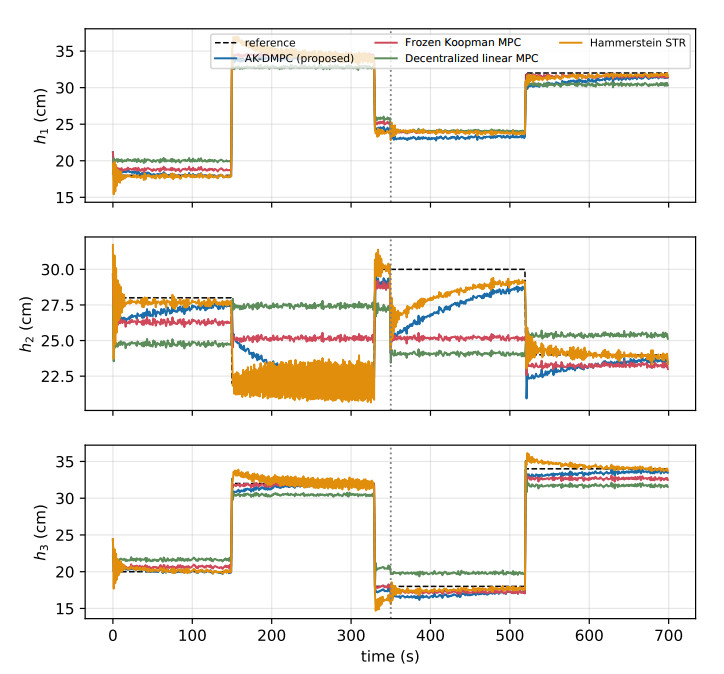
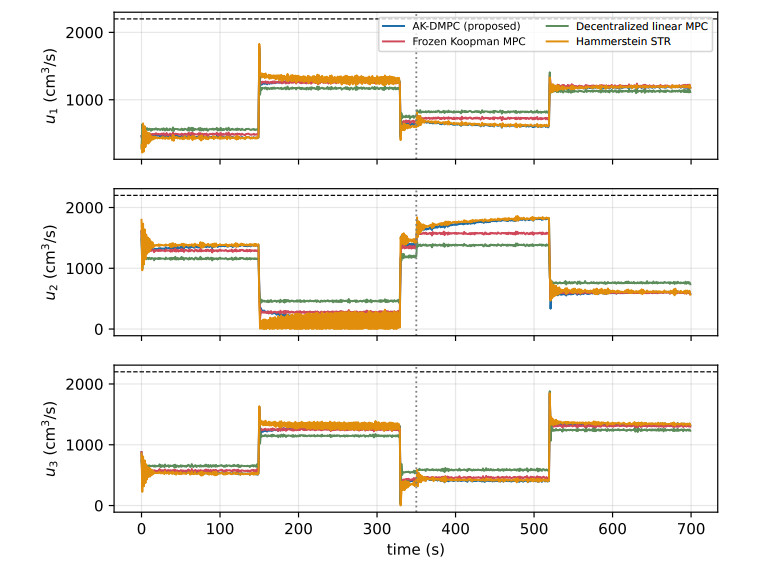
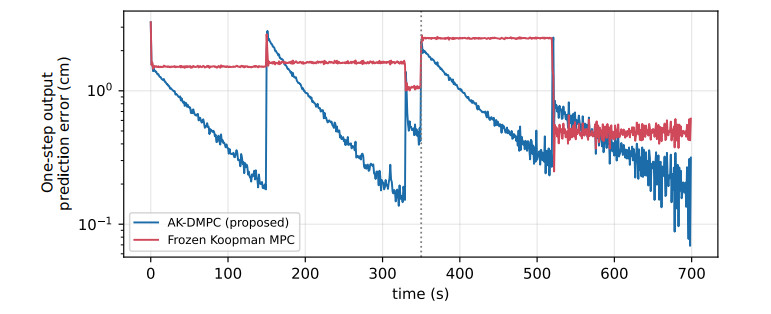
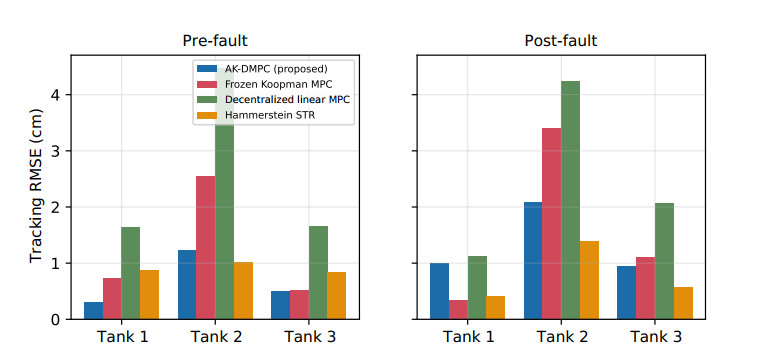
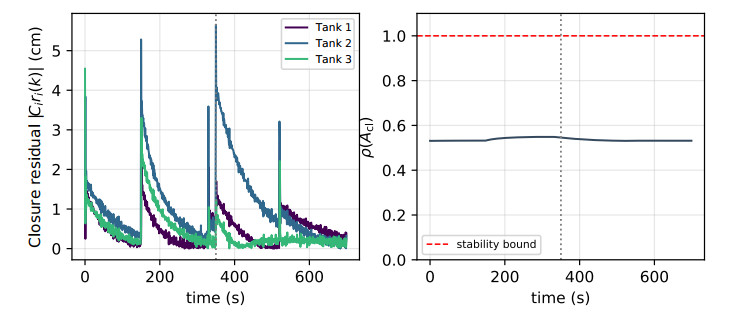
Large-scale processes in the energy and process industries are networks of interconnected nonlinear subsystems with uncertain and slowly drifting dynamics. Block-oriented self-tuning schemes, such as Hammerstein-based regulators, handle this uncertainty recursively but tie the controller to a restrictive model structure. In this study, the identified block-oriented model is replaced by Koopman linear predictors estimated online, one per subsystem, in a lifted observable space through a recursive least-squares law with forgetting and bounded covariance. These adaptive predictors are integrated into a distributed, input-constrained Koopman model predictive controller, denoted AK-DMPC, whose local problems are convex quadratic programs solved in parallel with a single neighbor communication per sampling instant. Three results are established: (i) The identifier has bounded covariance, and its parameter error does not vanish but decays exponentially to a residual set whose radius is set by the lifting (closure) error and the parameter drift; (ii) the multistep prediction error is bounded by the estimation and closure errors propagated through the interconnection; and (iii) under a verifiable small-gain condition on the interconnection, the closed loop is input-to-state stable on an explicit region of the state space with respect to these errors. The network tracking error is therefore governed by the dictionary richness. Abrupt parameter jumps, which violate the slow-drift premise, are covered by a dwell-time corollary quantifying the excursion and the geometric recovery. Recursive feasibility is proved under standard terminal ingredients. On three interconnected nonlinear tanks with an abrupt valve fault, AK-DMPC lowers the network tracking error by $ 28\% $ and $ 58\% $ against a frozen Koopman controller and a decentralized linear controller, and it matches an adaptive Hammerstein self-tuning regulator in accuracy with threefold smoother control and a closed-loop stability certificate ($ \rho(A_{\mathrm{cl}})\approx0.54 $).
Citation: Tawfik Guesmi, Mourad Elloumi, Khalid Alqunun, Omar Naifar. Adaptive Koopman predictive control of large-scale interconnected nonlinear systems: A recursive lifting approach with small-gain guarantees[J]. AIMS Mathematics, 2026, 11(8): 27164-27202. doi: 10.3934/math.20261088
Large-scale processes in the energy and process industries are networks of interconnected nonlinear subsystems with uncertain and slowly drifting dynamics. Block-oriented self-tuning schemes, such as Hammerstein-based regulators, handle this uncertainty recursively but tie the controller to a restrictive model structure. In this study, the identified block-oriented model is replaced by Koopman linear predictors estimated online, one per subsystem, in a lifted observable space through a recursive least-squares law with forgetting and bounded covariance. These adaptive predictors are integrated into a distributed, input-constrained Koopman model predictive controller, denoted AK-DMPC, whose local problems are convex quadratic programs solved in parallel with a single neighbor communication per sampling instant. Three results are established: (i) The identifier has bounded covariance, and its parameter error does not vanish but decays exponentially to a residual set whose radius is set by the lifting (closure) error and the parameter drift; (ii) the multistep prediction error is bounded by the estimation and closure errors propagated through the interconnection; and (iii) under a verifiable small-gain condition on the interconnection, the closed loop is input-to-state stable on an explicit region of the state space with respect to these errors. The network tracking error is therefore governed by the dictionary richness. Abrupt parameter jumps, which violate the slow-drift premise, are covered by a dwell-time corollary quantifying the excursion and the geometric recovery. Recursive feasibility is proved under standard terminal ingredients. On three interconnected nonlinear tanks with an abrupt valve fault, AK-DMPC lowers the network tracking error by $ 28\% $ and $ 58\% $ against a frozen Koopman controller and a decentralized linear controller, and it matches an adaptive Hammerstein self-tuning regulator in accuracy with threefold smoother control and a closed-loop stability certificate ($ \rho(A_{\mathrm{cl}})\approx0.54 $).

| [1] | K. J. Åström, B. Wittenmark, Adaptive control, 2 Eds., Dover Publications, Mineola, NY, 2008. |
| [2] | G. C. Goodwin, K. S. Sin, Adaptive filtering prediction and control, Prentice Hall, Englewood Cliffs, NJ, 1984. |
| [3] | P. A. Ioannou, J. Sun, Robust adaptive control, Prentice Hall, Upper Saddle River, NJ, 1996. |
| [4] |
M. Elloumi, S. Kamoun, Parametric estimation of interconnected nonlinear systems described by input-output mathematical models, Int. J. Autom. Comput., 13 (2016), 364–381. https://doi.org/10.1007/s11633-016-0956-8 doi: 10.1007/s11633-016-0956-8

|
| [5] |
M. Elloumi, S. Kamoun, Design of self-tuning regulator for large-scale interconnected Hammerstein systems, J. Control Sci. Eng., 2016 (2016), 6769714. https://doi.org/10.1155/2016/6769714 doi: 10.1155/2016/6769714
|
| [6] |
M. Elloumi, S. Kamoun, Adaptive control scheme for large-scale interconnected systems described by Hammerstein models, Asian J. Control, 19 (2017), 1075–1088. https://doi.org/10.1002/asjc.1443 doi: 10.1002/asjc.1443
|
| [7] |
B. O. Koopman, Hamiltonian systems and transformation in Hilbert space, P. Natl. A. Sci., 17 (1931), 315–318. https://doi.org/10.1073/pnas.17.5.315 doi: 10.1073/pnas.17.5.315
|
| [8] |
I. Mezić, Spectral properties of dynamical systems, model reduction and decompositions, Nonlinear Dynam., 41 (2005), 309–325. https://doi.org/10.1007/s11071-005-2824-x doi: 10.1007/s11071-005-2824-x
|
| [9] |
M. O. Williams, I. G. Kevrekidis, C. W. Rowley, A data-driven approximation of the Koopman operator: Extending dynamic mode decomposition, J. Nonlinear Sci., 25 (2015), 1307–1346. https://doi.org/10.1007/s00332-015-9258-5 doi: 10.1007/s00332-015-9258-5
|
| [10] |
P. J. Schmid, Dynamic mode decomposition of numerical and experimental data, J. Fluid Mech., 656 (2010), 5–28. https://doi.org/10.1017/S0022112010001217 doi: 10.1017/S0022112010001217
|
| [11] |
J. H. Tu, C. W. Rowley, D. M. Luchtenburg, S. L. Brunton, J. N. Kutz, On dynamic mode decomposition: Theory and applications, J. Comput. Dynam., 1 (2014), 391–421. https://doi.org/10.3934/jcd.2014.1.391 doi: 10.3934/jcd.2014.1.391
|
| [12] |
M. Korda, I. Mezić, On convergence of extended dynamic mode decomposition to the Koopman operator, J. Nonlinear Sci., 28 (2018), 687–710. https://doi.org/10.1007/s00332-017-9423-0 doi: 10.1007/s00332-017-9423-0
|
| [13] |
M. J. Colbrook, A. Townsend, Rigorous data-driven computation of spectral properties of Koopman operators for dynamical systems, Commun. Pure Appl. Math., 77 (2024), 221–283. https://doi.org/10.1002/cpa.22125 doi: 10.1002/cpa.22125
|
| [14] |
S. L. Brunton, M. Budišić, E. Kaiser, J. N. Kutz, Modern Koopman theory for dynamical systems, SIAM Rev., 64 (2022), 229–340. https://doi.org/10.1137/21M1401243 doi: 10.1137/21M1401243
|
| [15] | M. Budišić, R. Mohr, I. Mezić, Applied Koopmanism, Chaos: An Interd. J. Nonlinear Sci., 22 (2012), 047510. https://doi.org/10.1063/1.4772195 |
| [16] | A. Mauroy, I. Mezić, Y. Susuki (eds.), The Koopman operator in systems and control: Concepts, methodologies, and applications, Lecture Notes in Control and Information Sciences, Springer, International Publishing, Cham, 2020. https://doi.org/10.1007/978-3-030-35713-9 |
| [17] |
S. L. Brunton, B. W. Brunton, J. L. Proctor, J. N. Kutz, Koopman invariant subspaces and finite linear representations of nonlinear dynamical systems for control, PLoS One, 11 (2016), e0150171. https://doi.org/10.1371/journal.pone.0150171 doi: 10.1371/journal.pone.0150171
|
| [18] |
E. Kaiser, J. N. Kutz, S. L. Brunton, Data-driven discovery of Koopman eigenfunctions for control, Mach. Learn.-Sci. Techn., 2 (2021), 035023. https://doi.org/10.1088/2632-2153/abf0f5 doi: 10.1088/2632-2153/abf0f5
|
| [19] |
A. Mauroy, J. Goncalves, Koopman-based lifting techniques for nonlinear systems identification, IEEE T. Automat. Contr., 65 (2020), 2550–2565. https://doi.org/10.1109/TAC.2019.2941433 doi: 10.1109/TAC.2019.2941433
|
| [20] |
M. Haseli, J. Cortés, Learning Koopman eigenfunctions and invariant subspaces from data: Symmetric subspace decomposition, IEEE T. Automat. Contr., 67 (2022), 3442–3457. https://doi.org/10.1109/TAC.2021.3105318 doi: 10.1109/TAC.2021.3105318
|
| [21] |
B. Lusch, J. N. Kutz, S. L. Brunton, Deep learning for universal linear embeddings of nonlinear dynamics, Nat. Commun., 9 (2018), 4950. https://doi.org/10.1038/s41467-018-07210-0 doi: 10.1038/s41467-018-07210-0
|
| [22] |
S. E. Otto, C. W. Rowley, Linearly recurrent autoencoder networks for learning dynamics, SIAM J. Appl. Dynam. Syst., 18 (2019), 558–593. https://doi.org/10.1137/18M1177846 doi: 10.1137/18M1177846
|
| [23] |
H. Shi, M. Q. H. Meng, Deep Koopman operator with control for nonlinear systems, IEEE Robot. Autom. Lett., 7 (2022), 7700–7707. https://doi.org/10.1109/LRA.2022.3184036 doi: 10.1109/LRA.2022.3184036
|
| [24] |
M. Korda, I. Mezić, Linear predictors for nonlinear dynamical systems: Koopman operator meets model predictive control, Automatica, 93 (2018), 149–160. https://doi.org/10.1016/j.automatica.2018.03.046 doi: 10.1016/j.automatica.2018.03.046
|
| [25] |
S. Peitz, S. Klus, Koopman operator-based model reduction for switched-system control of PDEs, Automatica, 106 (2019), 184–191. https://doi.org/10.1016/j.automatica.2019.05.016 doi: 10.1016/j.automatica.2019.05.016
|
| [26] |
S. Peitz, S. E. Otto, C. W. Rowley, Data-driven model predictive control using interpolated Koopman generators, SIAM J. Appl. Dynam. Syst., 19 (2020), 2162–2193. https://doi.org/10.1137/20M1325678 doi: 10.1137/20M1325678
|
| [27] |
V. Cibulka, M. Korda, T. Haniš, Dictionary-free Koopman model predictive control with nonlinear input transformation, SIAM J. Appl. Dynam. Syst., 24 (2025), 94–130. https://doi.org/10.1137/23M1597174 doi: 10.1137/23M1597174
|
| [28] |
M. Wang, X. Lou, W. Wu, B. Cui, Koopman-based MPC with learned dynamics: Hierarchical neural network approach, IEEE T. Neur. Net. Lear., 35 (2024), 3630–3639. https://doi.org/10.1109/TNNLS.2022.3194958 doi: 10.1109/TNNLS.2022.3194958
|
| [29] |
M. Ławryńczuk, Koopman operator-based multi-model for predictive control, Nonlinear Dynam., 112 (2024), 9955–9982. https://doi.org/10.1007/s11071-024-09615-7 doi: 10.1007/s11071-024-09615-7
|
| [30] |
F. M. Philipp, M. Schaller, K. Worthmann, S. Peitz, F. Nüske, Error analysis of kernel EDMD for prediction and control in the Koopman framework, J. Nonlinear Sci., 35 (2025), 92. https://doi.org/10.1007/s00332-025-10182-3 doi: 10.1007/s00332-025-10182-3
|
| [31] |
T. Chen, J. Shan, Koopman-operator-based attitude dynamics and control on SO(3), J. Guid. Control Dynam., 43 (2020), 2112–2126. https://doi.org/10.2514/1.G005006 doi: 10.2514/1.G005006
|
| [32] | Y. Wang, T. Chen, S. He, Z. Wei, Z. Yin, J. Tayebi, Koopman-operator-based model predictive control of test mass capturing for drag-free satellite, Space-Sci. Tech., 2026, 0568. https://doi.org/10.34133/space.0568 |
| [33] |
J. C. Willems, P. Rapisarda, I. Markovsky, B. L. M. De Moor, A note on persistency of excitation, Syst. Control Lett., 54 (2005), 325–329. https://doi.org/10.1016/j.sysconle.2004.09.003 doi: 10.1016/j.sysconle.2004.09.003
|
| [34] | J. Coulson, J. Lygeros, F. Dörfler, Data-enabled predictive control: In the shallows of the DeePC, In: 2019 18th European Control Conference (ECC), 2019,307–312. https://doi.org/10.23919/ECC.2019.8795639 |
| [35] |
J. Berberich, J. Köhler, M. A. Müller, F. Allgöwer, Data-driven model predictive control with stability and robustness guarantees, IEEE T. Automat. Contr., 66 (2021), 1702–1717. https://doi.org/10.1109/TAC.2020.3000182 doi: 10.1109/TAC.2020.3000182
|
| [36] |
H. Zhang, C. W. Rowley, E. A. Deem, L. N. Cattafesta, Online dynamic mode decomposition for time-varying systems, SIAM J. Appl. Dynam. Syst., 18 (2019), 1586–1609. https://doi.org/10.1137/18M1192329 doi: 10.1137/18M1192329
|
| [37] | O. Sayed, S. Lucia, Recursive least squares-based identification for multi-step Koopman operators, In: 2024 European Control Conference (ECC), 2024,941–946. https://doi.org/10.23919/ECC64448.2024.10591201 |
| [38] |
Z. Zeng, H. Wang, Y. Shan, Data-driven Koopman operator-based model predictive control with adaptive dictionary learning for nonlinear industrial process optimization, Mathematics, 14 (2026), 1320. https://doi.org/10.3390/math14081320 doi: 10.3390/math14081320
|
| [39] | A. Dittmer, B. Sharan, H. Werner, Data-driven adaptive model predictive control for wind farms: A Koopman-based online learning approach, In: 2022 IEEE 61st Conference on Decision and Control (CDC), 2022, 1999–2004. https://doi.org/10.1109/CDC51059.2022.9992829 |
| [40] |
K. Loya, P. Tallapragada, Online learning of Koopman operator using streaming data from different dynamical regimes, IFAC-PapersOnLine, 58 (2024), 90–95. https://doi.org/10.1016/j.ifacol.2024.12.016 doi: 10.1016/j.ifacol.2024.12.016
|
| [41] | T. de Jong, V. Breschi, M. Schoukens, M. Lazar, Koopman data-driven predictive control with robust stability and recursive feasibility guarantees, In: 2024 IEEE 63rd Conference on Decision and Control (CDC), 2024,140–145. https://doi.org/10.1109/CDC56724.2024.10885975 |
| [42] |
P. D. Christofides, R. Scattolini, D. Muñoz de la Peña, J. Liu, Distributed model predictive control: A tutorial review and future research directions, Comput. Chem. Eng., 51 (2013), 21–41. https://doi.org/10.1016/j.compchemeng.2012.05.011 doi: 10.1016/j.compchemeng.2012.05.011
|
| [43] |
R. Scattolini, Architectures for distributed and hierarchical model predictive control–-a review, J. Process Contr., 19 (2009), 723–731. https://doi.org/10.1016/j.jprocont.2009.02.003 doi: 10.1016/j.jprocont.2009.02.003
|
| [44] |
B. T. Stewart, A. N. Venkat, J. B. Rawlings, S. J. Wright, G. Pannocchia, Cooperative distributed model predictive control, Syst. Control Lett., 59 (2010), 460–469. https://doi.org/10.1016/j.sysconle.2010.06.005 doi: 10.1016/j.sysconle.2010.06.005
|
| [45] | L. Ljung, System identification: Theory for the user, 2 Eds., Prentice Hall, Upper Saddle River, NJ, 1999. |
| [46] | Z. P. Jiang, A. R. Teel, L. Praly, Small-gain theorem for ISS systems and applications, Math. Control Signals Syst., 7 (1994), 95–120. |
| [47] |
S. N. Dashkovskiy, B. S. Rüffer, F. R. Wirth, Small gain theorems for large scale systems and construction of ISS Lyapunov functions, SIAM J. Control Optim., 48 (2010), 4089–4118. https://doi.org/10.1137/090746483 doi: 10.1137/090746483
|
| [48] |
T. Liu, D. J. Hill, Z. P. Jiang, Lyapunov formulation of ISS cyclic-small-gain in continuous-time dynamical networks, Automatica, 47 (2011), 2088–2093. https://doi.org/10.1016/j.automatica.2011.06.018 doi: 10.1016/j.automatica.2011.06.018
|
| [49] |
E. D. Sontag, Smooth stabilization implies coprime factorization, IEEE T. Automat. Contr., 34 (1989), 435–443. https://doi.org/10.1109/9.28018 doi: 10.1109/9.28018
|
| [50] |
Z. P. Jiang, Y. Wang, Input-to-state stability for discrete-time nonlinear systems, Automatica, 37 (2001), 857–869. https://doi.org/10.1016/S0005-1098(01)00028-0 doi: 10.1016/S0005-1098(01)00028-0
|
| [51] | A. Mironchenko, Input-to-state stability: Theory and applications, Communications and Control Engineering, Springer International Publishing, Cham, 2023. https://doi.org/10.1007/978-3-031-14674-9 |
| [52] |
K. H. Johansson, The quadruple-tank process: A multivariable laboratory process with an adjustable zero, IEEE T. Contr. Syst. T., 8 (2000), 456–465. https://doi.org/10.1109/87.845876 doi: 10.1109/87.845876
|
| [53] | D. S. Aponte, D. Tellez-Castro, Koopman-based MPC for the quadruple tank system: An experimental comparison, In: 2025 IEEE 7th Colombian Conference on Automatic Control (CCAC), 2025, 1–6. https://doi.org/10.1109/CCAC64704.2025.11259347 |
| [54] |
J. L. Proctor, S. L. Brunton, J. N. Kutz, Generalizing Koopman theory to allow for inputs and control, SIAM J. Appl. Dynam. Syst., 17 (2018), 909–930. https://doi.org/10.1137/16M1062296 doi: 10.1137/16M1062296
|
| [55] |
S. Klus, F. Nüske, P. Koltai, H. Wu, I. Kevrekidis, C. Schütte, F. Noé, Data-driven model reduction and transfer operator approximation, J. Nonlinear Sci., 28 (2018), 985–1010. https://doi.org/10.1007/s00332-017-9437-7 doi: 10.1007/s00332-017-9437-7
|
| [56] |
S. Aranovskiy, R. Ushirobira, D. Efimov, J. Wang, Accelerated convergence with improved robustness for discrete-time parameter estimation, Syst. Control Lett., 168 (2022), 105344. https://doi.org/10.1016/j.sysconle.2022.105344 doi: 10.1016/j.sysconle.2022.105344
|
| [57] |
D. Q. Mayne, J. B. Rawlings, C. V. Rao, P. O. M. Scokaert, Constrained model predictive control: Stability and optimality, Automatica, 36 (2000), 789–814. https://doi.org/10.1016/S0005-1098(99)00214-9 doi: 10.1016/S0005-1098(99)00214-9
|
| [58] | J. B. Rawlings, D. Q. Mayne, M. Diehl, Model Predictive Control: Theory, Computation, and Design, 2 Eds., Nob Hill Publishing, Santa Barbara, CA, 2017. |
| [59] |
D. Q. Mayne, Model predictive control: Recent developments and future promise, Automatica, 50 (2014), 2967–2986. https://doi.org/10.1016/j.automatica.2014.10.128 doi: 10.1016/j.automatica.2014.10.128
|
| [60] |
A. Bemporad, M. Morari, V. Dua, E. N. Pistikopoulos, The explicit linear quadratic regulator for constrained systems, Automatica, 38 (2002), 3–20. https://doi.org/10.1016/S0005-1098(01)00174-1 doi: 10.1016/S0005-1098(01)00174-1
|
| [61] |
P. Schmitz, T. Faulwasser, K. Worthmann, Willems' fundamental lemma for linear descriptor systems and its use for data-driven output-feedback MPC, IEEE Contr. Syst. Lett., 6 (2022), 2443–2448. https://doi.org/10.1109/LCSYS.2022.3161054 doi: 10.1109/LCSYS.2022.3161054
|
| [62] |
T. Faulwasser, R. Ou, G. Pan, P. Schmitz, K. Worthmann, Behavioral theory for stochastic systems? A data-driven journey from Willems to Wiener and back again, Annu. Rev. Control, 55 (2023), 92–117. https://doi.org/10.1016/j.arcontrol.2023.03.005 doi: 10.1016/j.arcontrol.2023.03.005
|
Figures(5) / Tables(7)

Tawfik Guesmi, Mourad Elloumi, Khalid Alqunun, Omar Naifar. Adaptive Koopman predictive control of large-scale interconnected nonlinear systems: A recursive lifting approach with small-gain guarantees[J]. AIMS Mathematics, 2026, 11(8): 27164-27202. doi: 10.3934/math.20261088





 DownLoad: