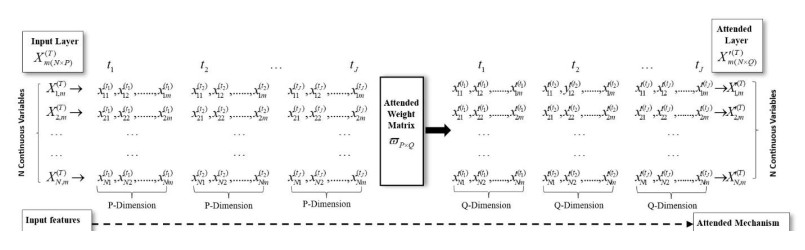
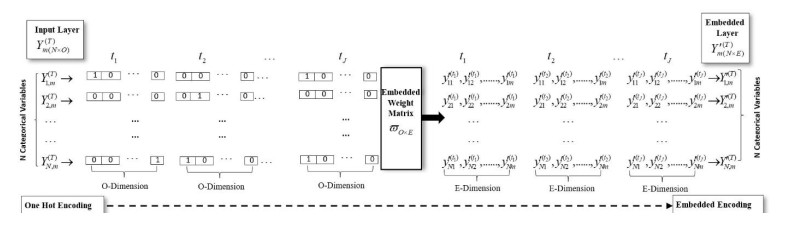
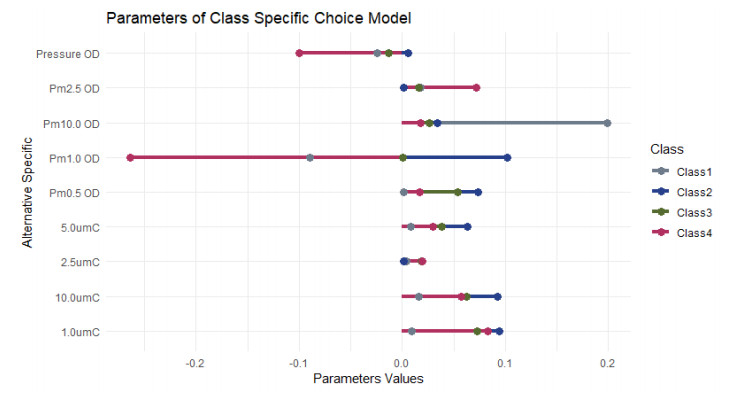
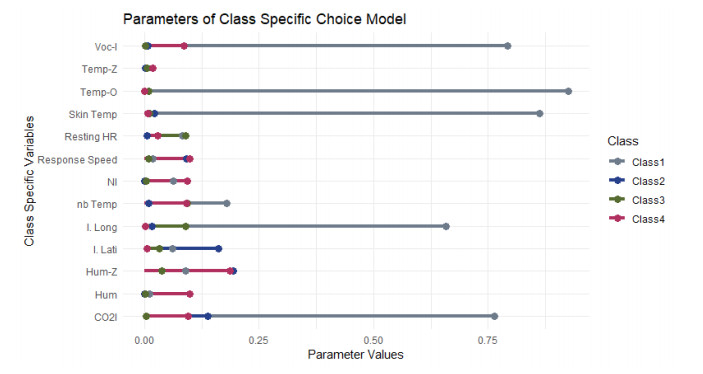
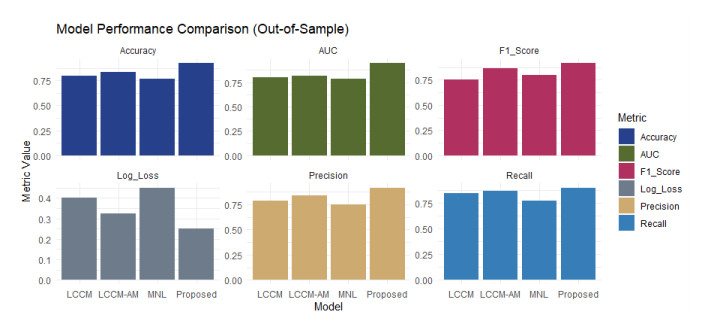
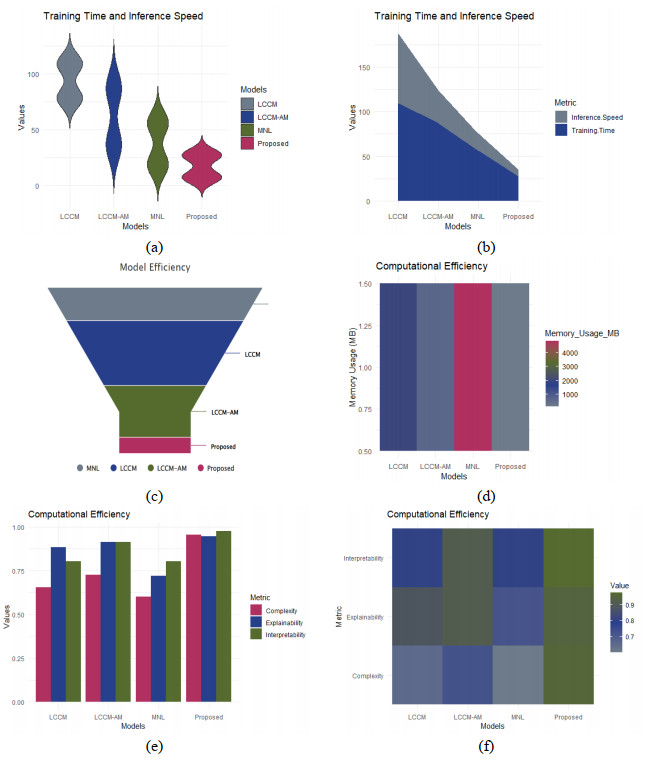
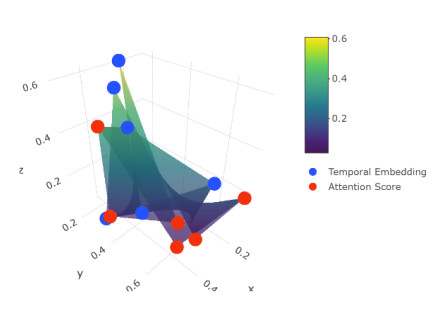
The paper presents a new latent class choice model (LCCM) based on an embedded neural architecture with attention mechanisms that accepts both categorical and continuous inputs. The model incorporates both discrete and continuous input convolution operations and temporal attention mechanisms, thereby introducing a latent function to enhance its utility. Based on the results of the ENTH experiment, a large-scale survey conducted at the National University of Singapore, we discuss longitudinal individual preferences for thermal comfort. With 17 participants and 1400 responses, the dataset covers both indoor and outdoor environments and is monitored using smartwatches and specialized smartphone applications. Using aspects such as body presence, clothing, and environmental considerations, our LCCM classifies participants into four latent classes: outdoor comfort enthusiasts, indoor comfort seekers, dynamic comfort adapters, and neutral comfort responders. The model's parameters demonstrate the complex associations between the environment and clothing selection. The findings highlight the model's strengths in predictability and efficiency relative to other benchmark models, providing useful insights into personalized thermal comfort dynamics. The proposed model is much better than current models, offering greater computational efficiency and predictive power. The scores of temporal embedding and attention also indicate that the model can be trained to capture subtle temporal relationships in sequential data. The study contributes to personalized modeling of comfort by providing a powerful instrument for understanding and predicting personal thermal preferences.
Citation: Mashail M. AL Sobhi. Temporal dynamics and embedded neural network in a hybrid Latent class choice model with application[J]. AIMS Mathematics, 2026, 11(8): 27131-27163. doi: 10.3934/math.20261087
The paper presents a new latent class choice model (LCCM) based on an embedded neural architecture with attention mechanisms that accepts both categorical and continuous inputs. The model incorporates both discrete and continuous input convolution operations and temporal attention mechanisms, thereby introducing a latent function to enhance its utility. Based on the results of the ENTH experiment, a large-scale survey conducted at the National University of Singapore, we discuss longitudinal individual preferences for thermal comfort. With 17 participants and 1400 responses, the dataset covers both indoor and outdoor environments and is monitored using smartwatches and specialized smartphone applications. Using aspects such as body presence, clothing, and environmental considerations, our LCCM classifies participants into four latent classes: outdoor comfort enthusiasts, indoor comfort seekers, dynamic comfort adapters, and neutral comfort responders. The model's parameters demonstrate the complex associations between the environment and clothing selection. The findings highlight the model's strengths in predictability and efficiency relative to other benchmark models, providing useful insights into personalized thermal comfort dynamics. The proposed model is much better than current models, offering greater computational efficiency and predictive power. The scores of temporal embedding and attention also indicate that the model can be trained to capture subtle temporal relationships in sequential data. The study contributes to personalized modeling of comfort by providing a powerful instrument for understanding and predicting personal thermal preferences.

| [1] | D. A. Gopinath, Modeling heterogeneity in discrete choice proceses: Application to travel demand, Massachusetts Institute of Technology, 1995. |
| [2] | S. Hess, M. Ben-Akiva, D. Gopinath, J. L. Walker, Taste heterogeneity, correlation, and elasticities in latent class choice models, In: Transportation research board 88th annual meeting, 2009. |
| [3] | S. Hess, Latent class structures: Taste heterogeneity and beyond, In: Handbook of choice modelling, Edward Elgar Publishing, 2024,372–391. |
| [4] |
M. Wong, B. Farooq, Reslogit: A residual neural network logit model for data-driven choice modelling, Transp. Res. Part C Emerg. Technol., 126 (2021), 103050. https://doi.org/10.1016/j.trc.2021.103050 doi: 10.1016/j.trc.2021.103050

|
| [5] | D. McFadden, Conditional logit analysis of qualitative choice behavior, 1974. |
| [6] |
Sajjad, I. A. Nafisah, M. M. A. Almazah, O. A. Alamri, J. G. Dar, A symmetrical analysis of decision making: Introducing the gaussian negative binomial mixture with a latent class choice model, Symmetry, 16 (2024), 908. https://doi.org/10.3390/sym16070908 doi: 10.3390/sym16070908
|
| [7] | P. J. Brockwell, R. A. Davis, Introduction to time series and forecasting, Cham: Springer, 2016. https://doi.org/10.1007/978-3-319-29854-2 |
| [8] | Y. Bengio, R. Ducharme, P. Vincent, C. Jauvin, A neural probabilistic language model, J. Mach. Learn. Res., 3 (2003), 1137–1155. |
| [9] |
J. Walker, M. Ben-Akiva, Generalized random utility model, Math. Soc. Sci., 43 (2002), 303–343. https://doi.org/10.1016/S0165-4896(02)00023-9 doi: 10.1016/S0165-4896(02)00023-9
|
| [10] | D. McFadden, K. Train, Mixed MNL models for discrete response, J. Appl. Econom., 15 (2000), 447–470. |
| [11] |
R. Hurtubia, M. H. Nguyen, A. Glerum, M. Bierlaire, Integrating psychometric indicators in latent class choice models, Transp. Res. Part A Policy Pract., 64 (2014), 135–146. https://doi.org/10.1016/j.tra.2014.03.010 doi: 10.1016/j.tra.2014.03.010
|
| [12] | W. James, The principles of psychology, Dover Publications, 1950. |
| [13] |
S. V. Cranenburgh, S. Wang, A. Vij, F. Pereira, J. Walker, Choice modelling in the age of machine learning-discussion paper, J. Choice Model., 42 (2022), 100340. https://doi.org/10.1016/j.jocm.2021.100340 doi: 10.1016/j.jocm.2021.100340
|
| [14] |
J. Camacho-Collados, M. T. Pilehvar, From word to sense embeddings: A survey on vector representations of meaning, J. Artif. Intell. Res., 63 (2018), 743–788. https://doi.org/10.1613/jair.1.11259 doi: 10.1613/jair.1.11259
|
| [15] | K. E. Train, Discrete choice methods with simulation, Cambridge University Press, 2012. https://doi.org/10.1017/CBO9780511805271 |
| [16] | M. Paredes, E. Hemberg, U. M. O'Reilly, C. Zegras, Machine learning or discrete choice models for car ownership demand estimation and prediction?, In: 2017 5th IEEE international conference on models and technologies for intelligent transportation systems (MT-ITS), Italy: IEEE, 2017,780–785. https://doi.org/10.1109/MTITS.2017.8005618 |
| [17] | P. Foudeh, N. Salim, An ontology-based, fully probabilistic, scalable method for human activity recognition, arXiv: 2109.02902, 2021. https://doi.org/10.48550/arXiv.2109.02902 |
| [18] | C. S. Perone, R. Silveira, T. S. Paula, Evaluation of sentence embeddings in downstream and linguistic probing tasks, arXiv: 1806.06259, 2018. https://doi.org/10.48550/arXiv.1806.06259 |
| [19] | Bordes, N. Usunier, A. Garcia-Duran, J. Weston, O. Yakhnenko, Translating embeddings for modeling multi-relational data, In: Proceedings of the 27th international conference on neural information processing systems, 2 (2013), 2787–2795. |
| [20] |
Y. Motoaki, R. A. Daziano, A hybrid-choice latent-class model for the analysis of the effects of weather on cycling demand, Transp. Res. Part A Policy Pract., 75 (2015), 217–230. https://doi.org/10.1016/j.tra.2015.03.017 doi: 10.1016/j.tra.2015.03.017
|
| [21] | Grover, J. Leskovec, node2vec: Scalable feature learning for networks, In: Proceedings of the 22nd ACM SIGKDD international conference on knowledge discovery and data mining, 2016,855–864. https://doi.org/10.1145/2939672.2939754 |
| [22] | A. de Brébisson, É. Simon, A. Auvolat, P. Vincent, Y. Bengio, Artificial neural networks applied to taxi destination prediction, arXiv: 1508.00021, 2015. https://doi.org/10.48550/arXiv.1508.00021 |
| [23] |
I. Sajjad, M. Malik, A hierarchical Bayesian discrete–continuous mixture model with nested Dirichlet processes, Statistics, 2026, 1–34. https://doi.org/10.1080/02331888.2026.2654459 doi: 10.1080/02331888.2026.2654459
|
| [24] | L. Verwimp, J. Pelemans, H. V. hamme, P. Wambacq, Expanding n-gram training data for language models based on morpho-syntactic transformations, Comput. Linguist. Neth. J., 5 (2015), 49–64. |
| [25] | Z. Wang, H. Li, R. Rajagopal, Urban2Vec: Incorporating street view imagery and POIs for multi-modal urban neighborhood embedding, arXiv: 2001.11101, 2020. https://doi.org/10.48550/arXiv.2001.11101 |
| [26] |
Z. Wang, D. Xiao, F. Fang, R. Govindan, C. C. Pain, Y. Guo, Model identification of reduced order fluid dynamics systems using deep learning, Int. J. Numer. Methods Fluids, 86 (2018), 255–268. https://doi.org/10.1002/fld.4416 doi: 10.1002/fld.4416
|
| [27] | S. Feng, G. Cong, B. An, Y. M. Chee, Poi2vec: Geographical latent representation for predicting future visitors, Proc. AAAI Conf. Artif. Intell., 31 (2017), 1. |
| [28] |
B. Wang, K. Shaaban, I. Kim, Revealing the hidden features in traffic prediction via entity embedding, Pers. Ubiquit. Comput., 25 (2021), 21–31. https://doi.org/10.1007/s00779-019-01333-x doi: 10.1007/s00779-019-01333-x
|
| [29] |
P. Dempster, N. M. Laird, D. B. Rubin, Maximum likelihood from incomplete data via the EM algorithm, J. R. Stat. Soc. Ser. B Stat. Methodol., 39 (1977), 1–22. https://doi.org/10.1111/j.2517-6161.1977.tb01600.x doi: 10.1111/j.2517-6161.1977.tb01600.x
|
| [30] | R. Likert, A technique for the measurement of attitudes, Arch. Psychol., 22 (1932), 55. |
| [31] |
E. Train, EM algorithms for nonparametric estimation of mixing distributions, J. Choice Model., 1 (2008), 40–69. https://doi.org/10.1016/S1755-5345(13)70022-8 doi: 10.1016/S1755-5345(13)70022-8
|
| [32] |
I. A. Nafisah, I. Sajjad, M. A. Alshahrani, O. A. Alamri, M. M. Almazah, J. G. Dar, Statistical predictive hybrid choice modeling: Exploring embedded neural architecture, Mathematics, 12 (2024), 3115. https://doi.org/10.3390/math12193115 doi: 10.3390/math12193115
|
Figures(13) / Tables(15)

Mashail M. AL Sobhi. Temporal dynamics and embedded neural network in a hybrid Latent class choice model with application[J]. AIMS Mathematics, 2026, 11(8): 27131-27163. doi: 10.3934/math.20261087





 DownLoad: