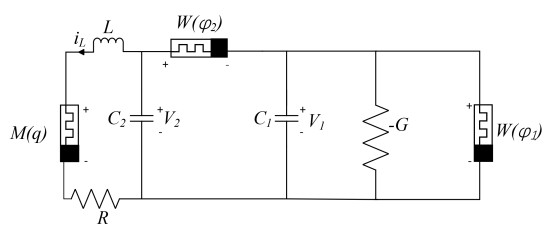
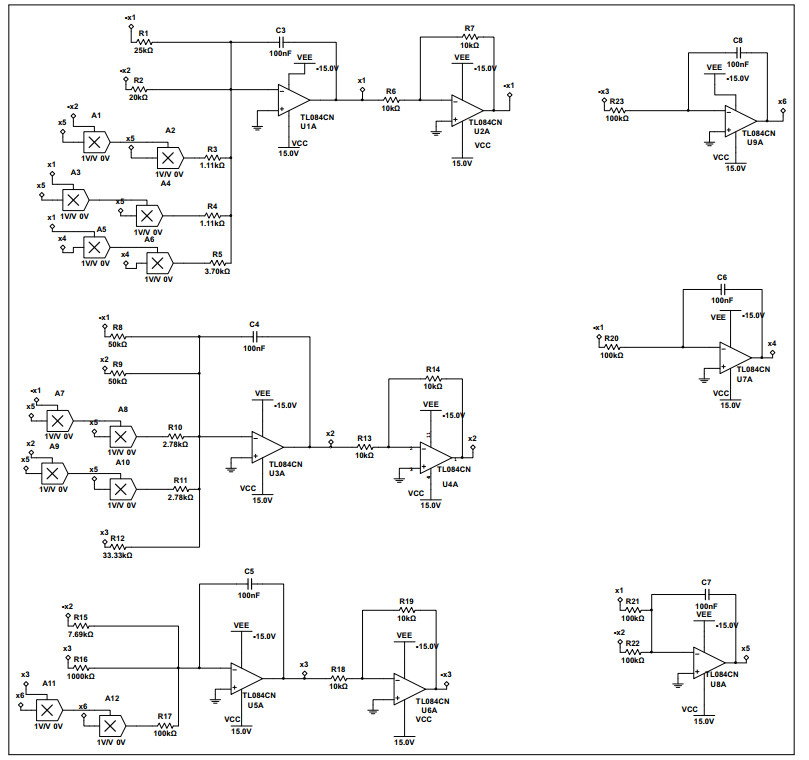
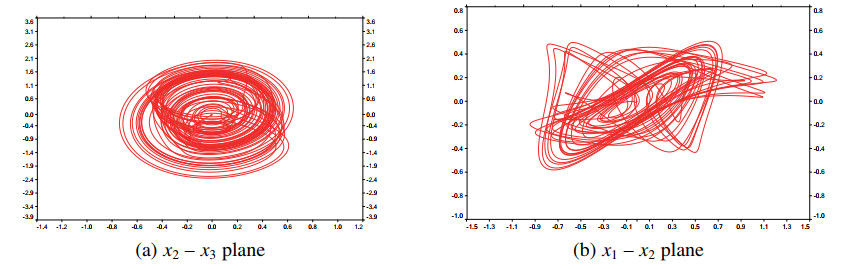
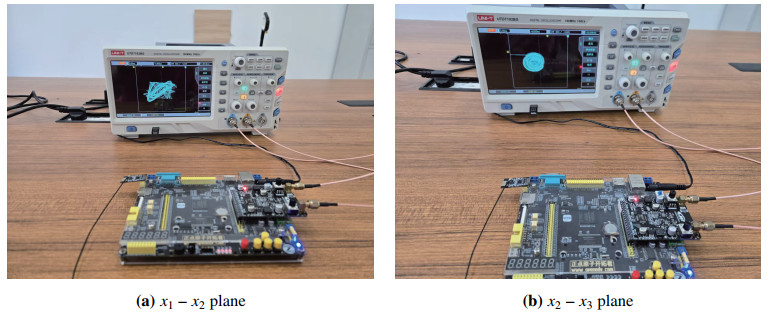
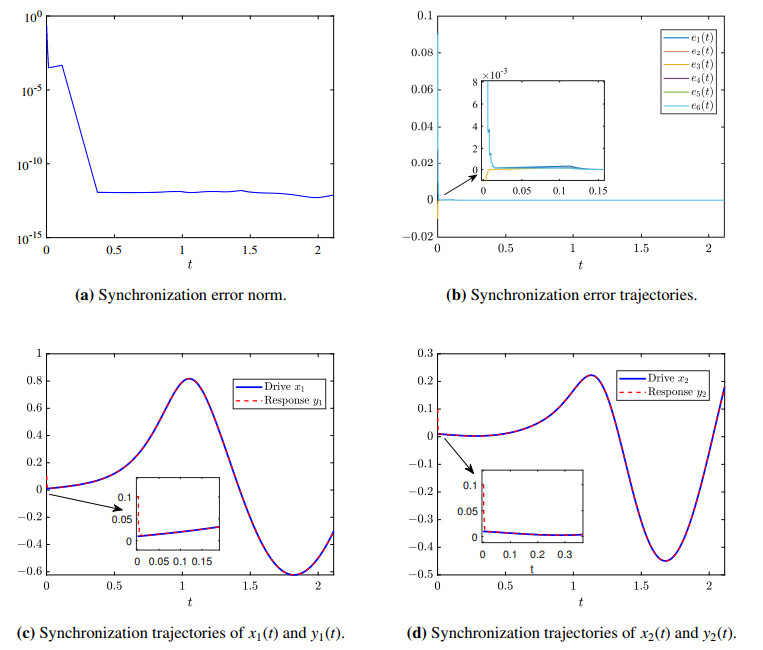
Memristors possess memory and nonlinear characteristics. Constructing high-dimensional nonlinear circuit systems using memristors can enhance the nonlinear coupling relationships among state variables and generate more complex dynamic behaviors. However, as the system's dimensions and nonlinear coupling relationships increase, synchronization control of high-dimensional hyperchaotic systems becomes more difficult. Meanwhile, synchronization control methods for high-dimensional hyperchaotic systems often suffer from complex controller structures, model dependence, and an uncertain convergence time. Therefore, this paper designs a six-dimensional hyperchaotic circuit using memristors and circuit components to enhance the nonlinear characteristics and dynamic complexity of the system. By applying Kirchhoff's current law and Kirchhoff's voltage law, the dynamic equations of the circuit state variables are established. Furthermore, the dynamic analysis, Multisim circuit simulation, and FPGA (Field Programmable Gate Array) hardware implementation results verify that the system exhibits hyperchaotic behavior. In addition, this paper proposes a finite-time synchronization control scheme with a simple structure and an explicit convergence time estimate, which enables the synchronization of hyperchaotic systems within a finite time. Based on Lyapunov stability theory and matrix inequalities, sufficient conditions for finite-time synchronization are derived. Numerical simulations further verify the effectiveness and feasibility of the proposed scheme.
Citation: Zhongmeng Yuan, Yuming Feng. Dynamic analysis and finite-time control of a memristor-based six-dimensional hyperchaotic system[J]. AIMS Mathematics, 2026, 11(7): 23450-23489. doi: 10.3934/math.2026946
Memristors possess memory and nonlinear characteristics. Constructing high-dimensional nonlinear circuit systems using memristors can enhance the nonlinear coupling relationships among state variables and generate more complex dynamic behaviors. However, as the system's dimensions and nonlinear coupling relationships increase, synchronization control of high-dimensional hyperchaotic systems becomes more difficult. Meanwhile, synchronization control methods for high-dimensional hyperchaotic systems often suffer from complex controller structures, model dependence, and an uncertain convergence time. Therefore, this paper designs a six-dimensional hyperchaotic circuit using memristors and circuit components to enhance the nonlinear characteristics and dynamic complexity of the system. By applying Kirchhoff's current law and Kirchhoff's voltage law, the dynamic equations of the circuit state variables are established. Furthermore, the dynamic analysis, Multisim circuit simulation, and FPGA (Field Programmable Gate Array) hardware implementation results verify that the system exhibits hyperchaotic behavior. In addition, this paper proposes a finite-time synchronization control scheme with a simple structure and an explicit convergence time estimate, which enables the synchronization of hyperchaotic systems within a finite time. Based on Lyapunov stability theory and matrix inequalities, sufficient conditions for finite-time synchronization are derived. Numerical simulations further verify the effectiveness and feasibility of the proposed scheme.

| [1] |
L. Chua, Memristor-The missing circuit element, IEEE T. Circ. Theor., 18 (1971), 507–519. https://doi.org/10.1109/TCT.1971.1083337 doi: 10.1109/TCT.1971.1083337

|
| [2] |
D. B. Strukov, G. S. Snider, D. R. Stewart, R. S. Williams, The missing memristor found, Nature, 453 (2008), 80–83. https://doi.org/10.1038/nature06932 doi: 10.1038/nature06932
|
| [3] |
Y. Wang, K. Li, Exponential synchronization of fractional order fuzzy memristor neural networks with time-varying delays and impulses, Mathe. Model. Control, 5 (2025), 164–179. https://doi.org/10.3934/mmc.2025012 doi: 10.3934/mmc.2025012
|
| [4] |
S. Gao, Z. Zhang, Q. Li, S. Ding, H. H. C. Iu, Y. Cao, et al., Encrypt a story: A video segment encryption method based on the discrete sinusoidal memristive rulkov neuron, IEEE T. Depend. Secure, 22 (2025), 8011–8024. https://doi.org/10.1109/TDSC.2025.3603570 doi: 10.1109/TDSC.2025.3603570
|
| [5] |
R. Lin, G. Shi, F. Qiao, C. Wang, S. Wu, Research progress and applications of memristor emulator circuits, Microelectron. J., 133 (2023), 105702. https://doi.org/10.1016/j.mejo.2023.105702 doi: 10.1016/j.mejo.2023.105702
|
| [6] |
X. Jiang, J. Li, B. Li, W. Yin, L. Sun, X. Chen, Bifurcation, chaos, and circuit realisation of a new four-dimensional memristor system, Int. J. Nonlinear Sci. Num., 24 (2023), 2639–2648. https://doi.org/10.1515/ijnsns-2021-0393 doi: 10.1515/ijnsns-2021-0393
|
| [7] |
S. Gao, H. H. C. Iu, U. Erkan, C. Simsek, A. Toktas, Y. Cao, et al., A 3D memristive cubic map with dual discrete memristors: Design, implementation, and application in image encryption, IEEE T. Circ. Syst. Vid., 35 (2025), 7706–7718. https://doi.org/10.1109/TCSVT.2025.3545868 doi: 10.1109/TCSVT.2025.3545868
|
| [8] |
E. N. Lorenz, Deterministic nonperiodic flow, J. Atmos. Sci., 20 (1963), 130–141. https://doi.org/10.1175/1520-0469(1963)020<0130:DNF>2.0.CO;2 doi: 10.1175/1520-0469(1963)020<0130:DNF>2.0.CO;2
|
| [9] |
J. He, W. Qiu, J. Cai, Synchronization of hyperchaotic systems based on intermittent control and its application in secure communication, J. Adv. Comput. Intell., 27 (2023), 292–303. https://doi.org/10.20965/jaciii.2023.p0292 doi: 10.20965/jaciii.2023.p0292
|
| [10] |
L. Hu, Z. Guo, L. Gong, Color image encryption and authentication algorithm integrating computational ghost imaging with quaternion multi-parameter discrete fractional angular transform, Expert Syst. Appl., 301 (2026), 130442. https://doi.org/10.1016/j.eswa.2025.130442 doi: 10.1016/j.eswa.2025.130442
|
| [11] |
Y. Lin, Y. Wei, D. Chen, Y. Li, U. Erkan, et al., Cryptanalysis and improvement of a video cryptosystem via chaos and S-box, ACM T. Multim. Comput., 22 (2026), 1–28. https://doi.org/10.1145/3808699 doi: 10.1145/3808699
|
| [12] |
F. Yu, L. Li, B. He, L. Liu, S. Qian, Z. Zhang, et al., Pseudorandom number generator based on a 5D hyperchaotic four-wing memristive system and its FPGA implementation, Eur. Phys. J. Spec. Top., 230 (2021), 1763–1772. https://doi.org/10.1140/epjs/s11734-021-00132-x doi: 10.1140/epjs/s11734-021-00132-x
|
| [13] |
S. Ding, F. Shi, U. Erkan, A. Toktas, Q. Li, C. Wang, et al., Design of a three-dimensional logistic map and its application to seafood image encryption, J. Supercomput., 82 (2026), 225. https://doi.org/10.1007/s11227-025-08196-5 doi: 10.1007/s11227-025-08196-5
|
| [14] |
B. Zhang, N. R. Zhou, S. Zhou, M. M. Wang, Novel 4D chaotic system based on memristor and its application in secure color image encryption, Digit. Signal Process., 170 (2026), 105791. https://doi.org/10.1016/j.dsp.2025.105791 doi: 10.1016/j.dsp.2025.105791
|
| [15] |
J. Zhang, J. Zuo, Y. Guo, J. Hou, Q. Xie, Nonlinear analysis, circuit implementation, and application in image encryption of a four-dimensional multi-scroll hyper-chaotic system, Integration, 95 (2024), 102126. https://doi.org/10.1016/j.vlsi.2023.102126 doi: 10.1016/j.vlsi.2023.102126
|
| [16] |
P. Ding, W. Hu, P. Geng, J. Zhang, J. Zhu, A new multi-wing hyperchaotic system and its application in image encryption, J. Supercomput., 81 (2025), 1201. https://doi.org/10.1007/s11227-025-07670-4 doi: 10.1007/s11227-025-07670-4
|
| [17] |
A. Hassan, L. Zhou, A novel 6D four-wing memristive hyperchaotic system: Generalized fixed-time synchronization and its application in secure image encryption, Chaos Soliton. Fract., 192 (2025), 115986. https://doi.org/10.1016/j.chaos.2024.115986 doi: 10.1016/j.chaos.2024.115986
|
| [18] |
Z. Lei, J. Yang, H. Qiu, X. Zhang, J. Liu, Color image encryption based on a novel fourth-direction hyperchaotic system, Electronics, 13 (2024), 2229. https://doi.org/10.3390/electronics13122229 doi: 10.3390/electronics13122229
|
| [19] | B. Bao, An introduction to chaotic Ccircuits, Beijing: Science Press, 2013. |
| [20] |
W. Wang, Y. C. Zeng, R. T. Sun, Research on a six-order chaotic circuit with three memristors, Acta Phys. Sin., 66 (2017), 040502. https://doi.org/10.7498/aps.66.040502 doi: 10.7498/aps.66.040502
|
| [21] |
L. Borah, K. Dehingia, A. Phukan, H. K. Sarmah, S. Boulaaras, Study on a hyper-chaotic financial system with synchronization, Math. Comp. Model. Dyn., 31 (2025), 2495916. https://doi.org/10.1080/13873954.2025.2495916 doi: 10.1080/13873954.2025.2495916
|
| [22] |
M. Haripriya, A. Manivannan, S. Dhanasekar, S. Lakshmanan, Finite-time synchronization of delayed complex dynamical networks via sampled-data controller, Math. Model. Control, 5 (2025), 73–84. https://doi.org/10.3934/mmc.2025006 doi: 10.3934/mmc.2025006
|
| [23] |
H. Zheng, Y. Tian, Exponential stability of time-delay systems with highly nonlinear impulses involving delays, Math. Model. Control, 5 (2025), 103–120 https://doi.org/10.3934/mmc.2025008 doi: 10.3934/mmc.2025008
|
| [24] |
W. Zhou, K. Wang, W. Zhu, Synchronization for discrete coupled fuzzy neural networks with uncertain information via observer-based impulsive control, Math. Model. Control, 4 (2024), 17–31. https://doi.org/10.3934/mmc.2024003 doi: 10.3934/mmc.2024003
|
| [25] |
X. Li, C. Lu, T. Wei, M. Wang, A novel exponential stability result for impulsive systems With estimation of the attraction domain, IEEE T. Automat. Contr., 71 (2026), 3411–3415. https://doi.org/10.1109/TAC.2025.3637989 doi: 10.1109/TAC.2025.3637989
|
| [26] |
G. Jiang, L. Wang, X. Zong, Q. Xiao, G. Zhang, J. Hu, Practically predefined-time stabilization of stochastic fuzzy memristive neural networks under deception attacks, IEEE T. Cybernetics, 56 (2026), 1071–1082. https://doi.org/10.1109/TCYB.2025.3621274 doi: 10.1109/TCYB.2025.3621274
|
| [27] |
W. Gao, K. He, Z. P. Jiang, A systematic review of learning-based control: Theory and applications, Artif. Intell. Sci. Eng., 2 (2026), 85–100. https://doi.org/10.23919/AISE.2026.000006 doi: 10.23919/AISE.2026.000006
|
| [28] |
C. Li, W. Wang, Optimal impulse control and impulse game for continuous-time deterministic systems: A review, Artif. Intell. Sci. Eng., 1 (2025), 208–219. https://doi.org/10.23919/AISE.2025.000014 doi: 10.23919/AISE.2025.000014
|
| [29] |
Y. Feng, C. Li, T. Huang, W. Zhao, Alternate control systems, Adv. Differ. Equ., 2014 (2014), 305. https://doi.org/10.1186/1687-1847-2014-305 doi: 10.1186/1687-1847-2014-305
|
| [30] |
S. Shanmugam, R. Vadivel, S. Sabarathinam, P. Hammachukiattikul, N. Gunasekaran, Enhancing synchronization criteria for fractional-order chaotic neural networks via intermittent control: An extended dissipativity approach, Math. Model. Control, 5 (2025), 31–47. https://doi.org/10.3934/mmc.2025003 doi: 10.3934/mmc.2025003
|
| [31] |
S. Zhu, Q. Lu, Y. Feng, D. Yan, A 4D entangled memristor hyperchaotic system and its new predefined-time sliding mode synchronization control, IEEE Access, 12 (2024), 145483–145495. https://doi.org/10.1109/ACCESS.2024.3472123 doi: 10.1109/ACCESS.2024.3472123
|
| [32] |
C. Liao, D. Tu, Y. Feng, W. Zhang, Z. Wang, B. O. Onasanya, A sandwich control system with dual stochastic impulses, IEEE/CAA J. Automatic., 9 (2022), 741–744. https://doi.org/10.1109/JAS.2022.105482 doi: 10.1109/JAS.2022.105482
|
| [33] |
W. Ao, T. Ma, R. V. Sanchez, H. Gan, Finite-time and fixed-time impulsive synchronization of chaotic systems, J. Franklin I., 357 (2020), 11545–11557. https://doi.org/10.1016/j.jfranklin.2019.07.023 doi: 10.1016/j.jfranklin.2019.07.023
|
| [34] |
S. Yan, G. You, J. Zhang, H. Zhang, J. Jiang, A hyperchaotic conservative system with loop synchronisation control of DNA strand displacement, Phys. Scr., 100 (2025), 095233. https://doi.org/10.1088/1402-4896/ae06d9 doi: 10.1088/1402-4896/ae06d9
|
| [35] |
J. Yang, J. Xiong, J. Cen, W. He, Finite-time generalized synchronization of non-identical fractional order chaotic systems and its application in speech secure communication, PLoS One, 17 (2022), e0263007. https://doi.org/10.1371/journal.pone.0263007 doi: 10.1371/journal.pone.0263007
|
| [36] |
Y. Liu, L. Li, Y. Feng, Finite-time synchronization for high-dimensional chaotic systems and its application to secure communication, J. Computat. Nonlinear Dynam., 11 (2016), 051028. https://doi.org/10.1115/1.4033686 doi: 10.1115/1.4033686
|
| [37] |
J. Mostafaee, S. Mobayen, B. Vaseghi, M. Vahedi, Finite-time synchronization of a new five-dimensional hyper-chaotic system via terminal sliding mode control, Sci. Iran., 30 (2023), 167–182. https://doi.org/10.24200/sci.2021.56313.4657 doi: 10.24200/sci.2021.56313.4657
|
| [38] |
C. Wang, Adaptive terminal sliding-mode synchronization control with chattering elimination for a fractional-order chaotic system, Fractal Fract., 8 (2024), 188. https://doi.org/10.3390/fractalfract8040188 doi: 10.3390/fractalfract8040188
|
| [39] |
K. Tian, H. P. Ren, C. Bai, Synchronization of hyperchaos with time delay using impulse control, IEEE Access, 8 (2020), 72570–72576. https://doi.org/10.1109/ACCESS.2020.2986786 doi: 10.1109/ACCESS.2020.2986786
|
| [40] |
H. Tang, K. Liu, Z. Zhang, Finite-time anti-synchronization of a 6D Lorenz systems, AIMS Math., 9 (2024), 35931–35948. https://doi.org/10.3934/math.20241703 doi: 10.3934/math.20241703
|
| [41] |
S. Zhao, L. Zhao, S. Wen, L. Cheng, Secure synchronization control of markovian jump neural networks under dos attacks with memory-based adaptive event-triggered mechanism, Artif. Intell. Sci. Eng., 1 (2025), 64–78. https://doi.org/10.23919/AISE.2025.000006 doi: 10.23919/AISE.2025.000006
|
| [42] |
T. Shi, C. Hu, J. Yu, Fixed-time synchronization of spatiotemporal networks via quantized boundary control, Intell. Control, 1 (2025), 3. https://doi.org/10.53941/ic.2025.100003 doi: 10.53941/ic.2025.100003
|
| [43] |
O. Rossler, An equation for hyperchaos, Phys. Lett. A, 71 (1979), 155–157. https://doi.org/10.1016/0375-9601(79)90150-6 doi: 10.1016/0375-9601(79)90150-6
|
| [44] |
A. Wolf, J. B. Swift, H. L. Swinney, J. A. Vastano, Determining Lyapunov exponents from a time series, Physica D, 16 (1985), 285–317. https://doi.org/10.1016/0167-2789(85)90011-9 doi: 10.1016/0167-2789(85)90011-9
|
| [45] |
Q. Lu, Y. Feng, A fixed-time sliding mode control scheme for synchronizing memristor-based four-dimensional hyperchaotic systems, Phys. Scr., 101 (2026), 205214. https://doi.org/10.1088/1402-4896/ae694f doi: 10.1088/1402-4896/ae694f
|
| [46] |
J. Mei, M. Jiang, Z. Wu, X. Wang, Periodically intermittent controlling for finite-time synchronization of complex dynamical networks, Nonlinear Dyn., 79 (2015), 295–305. https://doi.org/10.1007/s11071-014-1664-y doi: 10.1007/s11071-014-1664-y
|
| [47] |
Q. Song, Exponential stability of recurrent neural networks with both time-varying delays and general activation functions via LMI approach, Neurocomputing, 71 (2008), 2823–2830. https://doi.org/10.1016/j.neucom.2007.08.024 doi: 10.1016/j.neucom.2007.08.024
|
| [48] | R. A. Horn, C. R. Johnson, Matrix analysis, Cambridge University Press, 1985. |
| [49] | H. K. Khalil, J. W. Grizzle, Nonlinear systems, Upper Saddle River, 2002. |
| [50] |
P. A. Daltzis, C. K. Volos, H. E. Nistazakis, A. D. Tsigopoulos, G. S. Tombras, Analysis, synchronization and circuit design of a 4D hyperchaotic hyperjerk system, Computation, 6 (2018), 14. https://doi.org/10.3390/computation6010014 doi: 10.3390/computation6010014
|
| [51] |
G. Dou, Y. Song, X. Zhang, Y. Bai, L. Wang, D. Chen, et al., A memristive hyperchaotic system with multiple butterfly-shaped attractors: Modeling, analysis and hardware implementation, Chaos Soliton. Fract., 208 (2026), 118345. https://doi.org/10.1016/j.chaos.2026.118345 doi: 10.1016/j.chaos.2026.118345
|
| [52] |
E. Ozpolat, V. Celik, A. Gulten, A novel four-dimensional hyperchaotic system: Design, dynamic analysis, synchronization, and image encryption, IEEE Access, 12 (2024), 126063–126073. https://doi.org/10.1109/ACCESS.2024.3454820 doi: 10.1109/ACCESS.2024.3454820
|
| [53] |
M. D. Johansyah, S. M. Hamidzadeh, K. Benkouider, S. Vaıdyanathan, A. Sambas, M. A. Mohamed, et al., A novel hyperchaotic financial system with sinusoidal hyperbolic nonlinearity: From theoretical analysis to adaptive neural fuzzy controller method, Chaos Theor. Appl., 6 (2024), 26–40. https://doi.org/10.51537/chaos.1336838 doi: 10.51537/chaos.1336838
|
| [54] |
S. Gao, R. Wu, H. H. C. Iu, U. Erkan, Y. Cao, Q. Li, et al., Chaos-based video encryption techniques: A review, Comput. Sci. Rev., 58 (2025), 100816. https://doi.org/10.1016/j.cosrev.2025.100816 doi: 10.1016/j.cosrev.2025.100816
|
| [55] |
S. Ding, X. Wang, P. Zhu, U. Erkan, A. Toktas, Q. Li, et al., SRA: A sine-based reconstruction approach to improve 2D chaotic map performance, Eur. Phys. J. Plus, 141 (2026), 182. https://doi.org/10.1140/epjp/s13360-026-07421-1 doi: 10.1140/epjp/s13360-026-07421-1
|

Figures(23) / Tables(2)

Zhongmeng Yuan, Yuming Feng. Dynamic analysis and finite-time control of a memristor-based six-dimensional hyperchaotic system[J]. AIMS Mathematics, 2026, 11(7): 23450-23489. doi: 10.3934/math.2026946





 DownLoad: