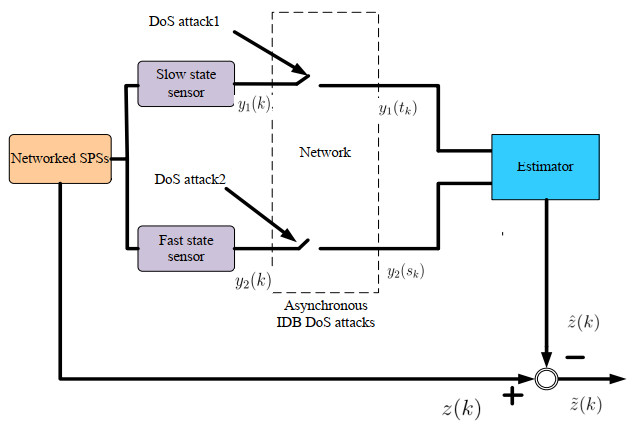
This article was dedicated to constructing an $ H_\infty $ state estimator for networked interval type-2 (IT2) fuzzy singularly perturbed systems (SPSs) subject to denial-of-service (DoS) attacks. The challenges lied in designing an asynchronous DoS attack model for SPSs with two-time-scale characteristics to attack the important data and providing a defense strategy to resist this attack. This work presented three major contributions: (1) An asynchronous important-data-based (IDB) DoS attack model was proposed to attack the critical data information of slow and fast sensors separately. (2) Then, an IT2 fuzzy composite resilient estimator was designed to resist the asynchronous IDB DoS attacks. (3) Finally, sufficient conditions were determined to ensure the error dynamics' asymptotic stability. A DC motor example was provided to highlight the applicability of our method.
Citation: Yue Hu, Chaoqun Guo, Oh-Min Kwon, Seung Hoon Lee. State estimation for interval type-2 fuzzy singularly perturbed systems with important-data-based DoS attacks: the dual-scale channels case[J]. AIMS Mathematics, 2026, 11(7): 23210-23233. doi: 10.3934/math.2026936
This article was dedicated to constructing an $ H_\infty $ state estimator for networked interval type-2 (IT2) fuzzy singularly perturbed systems (SPSs) subject to denial-of-service (DoS) attacks. The challenges lied in designing an asynchronous DoS attack model for SPSs with two-time-scale characteristics to attack the important data and providing a defense strategy to resist this attack. This work presented three major contributions: (1) An asynchronous important-data-based (IDB) DoS attack model was proposed to attack the critical data information of slow and fast sensors separately. (2) Then, an IT2 fuzzy composite resilient estimator was designed to resist the asynchronous IDB DoS attacks. (3) Finally, sufficient conditions were determined to ensure the error dynamics' asymptotic stability. A DC motor example was provided to highlight the applicability of our method.

| [1] |
Q. Lin, L. Ding, Z. M. Kong, Z.-W. Yu, X. Li, H. J. Wang, Multi-time scale model predictive control-based demand side management for a microgrid, IEEE T. Smart Grid, 16 (2025), 1181–1193. https://doi.org/10.1109/TSG.2024.3493958 doi: 10.1109/TSG.2024.3493958

|
| [2] |
L. H. Zhong, F. W. Li, J. W. Zhang, B. Z. Yuan, J. Chen, W. J. Yang, et al., Multi-time scale coordinated dispatch of integrated electricity-hydrogen-heat microgrids with waste heat recovery, Int. J. Elec. Power, 175 (2026), 111634. https://doi.org/10.1016/j.ijepes.2026.111634 doi: 10.1016/j.ijepes.2026.111634
|
| [3] |
Y. S. Liu, W. Wang, J. B. Zhu, X. Y. Ma, Y. B. Che, Multiple time scale control scheme for the power distribution network with DC energy balancing interconnection, IEEE T. Ind. Appl., 62 (2026), 2002–2012. https://doi.org/10.1109/TIA.2025.3601067 doi: 10.1109/TIA.2025.3601067
|
| [4] |
H. Shen, C. J. Peng, H. C. Yan, S. Y. Xu. Data-driven near optimization for fast sampling singularly perturbed systems, IEEE T. Automat. Contr., 69 (2024), 4689–4694. https://doi.org/10.1109/TAC.2024.3352703 doi: 10.1109/TAC.2024.3352703
|
| [5] |
Q. Li, Z. H. Jin, L. Y. Qiao, A. C. Du, G. Liu, Distributed optimization of nonlinear singularly perturbed multi-agent systems via a small-gain approach and sliding mode control, AIMS Mathematics, 9 (2024), 20865–20886. https://doi.org/10.3934/math.20241015 doi: 10.3934/math.20241015
|
| [6] |
M. Tang, M. Krsti$\acute{c}$, J. I. Poveda, Fixed-time input-to-state stability for singularly perturbed systems via composite lyapunov functions, IEEE T. Automat. Contr., 71 (2026), 2644–2651. https://doi.org/10.1109/TAC.2025.3631559 doi: 10.1109/TAC.2025.3631559
|
| [7] |
W. H. Qi, N. Zhang, G. D. Zong, C. K. Ahn, SMC for discrete semi-Markov switching slow sampling singularly perturbed models with applications, IEEE T. Circuits-I, 71 (2024), 1910–1919. https://doi.org/10.1109/TCSI.2024.3355445 doi: 10.1109/TCSI.2024.3355445
|
| [8] |
J. Wang, J. C. Wu, H. Shen, J. D. Cao, L. Rutkowski, Fuzzy $H_\infty$ control of discrete-time nonlinear Markov jump systems via a novel hybrid reinforcement Q-learning method, IEEE T. Cybernetics, 53 (2023), 7380–7391. https://doi.org/ 10.1109/TCYB.2022.3220537 doi: 10.1109/TCYB.2022.3220537
|
| [9] |
Y. Y. Wang, P. Shi, H. C. Yan, Reliable control of fuzzy singularly perturbed systems and its application to electronic circuits, IEEE T. Circuits-I, 65 (2018), 3519–3528. https://doi.org/ 10.1109/TCSI.2018.2834481 doi: 10.1109/TCSI.2018.2834481
|
| [10] |
T. C. Zhang, W. X. Fang, L. Y. Wang, Y. L. Lu, Finite-time stability of fractional-order fuzzy inertial neural networks via a new finite-time inequality, AIMS Mathematics, 11 (2026), 5936–5953. https://doi.org/10.3934/math.2026245 doi: 10.3934/math.2026245
|
| [11] |
Y. H. Zhao, L. K. Wang, X. P. Xie, H.-K. Lam, Finite-time asynchronous switching control for fuzzy Markov jump systems by applying polynomial membership functions, IEEE T. Circuits-I, 71 (2024), 5607–5617. https://doi.org/10.1109/TCSI.2024.3448629 doi: 10.1109/TCSI.2024.3448629
|
| [12] |
T. T. Zhang, H. S. Zhang, X. P. Xie, Region stability/stabilization and $H_\infty$ control for discrete-time impulsive Takagi-Sugeno fuzzy systems, IEEE T. Fuzzy Syst., 32 (2024), 3410–3419. https://doi.org/10.1109/TFUZZ.2024.3372936 doi: 10.1109/TFUZZ.2024.3372936
|
| [13] |
W. H. Qi, R. K. Li, J. H. Park, Z.-G. Wu, H. C. Yan, Observer-based stabilization of networked IT2 fuzzy semi-Markov jump models with redundant channels and applications to tunnel circuit model, IEEE T. Circuits-I, 71 (2024), 6316–6326. https://doi.org/10.1109/TCSI.2024.3400536 doi: 10.1109/TCSI.2024.3400536
|
| [14] |
R. Sakthivel, R. Kavikumar, A. Mohammadzadeh, O.-M. Kwon, B. Kaviarasan, Fault estimation for mode-dependent IT2 fuzzy systems with quantized output signals, IEEE T. Fuzzy Syst., 29 (2021), 298–309. https://doi.org/10.1109/TFUZZ.2020.3018509 doi: 10.1109/TFUZZ.2020.3018509
|
| [15] |
R. Kavikumar, O.-M. Kwon, B. Kaviarasan, R. Sakthivel, Antidisturbance control design for interval type-2 fuzzy stochastic systems with input quantization, IEEE T. Fuzzy Syst., 31 (2023), 1806–1818. https://doi.org/10.1109/TFUZZ.2022.3215277 doi: 10.1109/TFUZZ.2022.3215277
|
| [16] |
Y. Hu, O.-M. Kwon, S.-H. Lee, $H_\infty$ Control for interval type-2 fuzzy singularly perturbed systems with multi-node round-robin protocol and packet dropouts, Fuzzy Set. Syst., 500 (2025), 109202. https://doi.org/10.1016/j.fss.2024.109202 doi: 10.1016/j.fss.2024.109202
|
| [17] |
Y. Hu, C. X. Cai, H. Lin, O.-M. Kwon, Fuzzy-model-based $H_\infty$ control for networked singularly perturbed systems: The asynchronous weighted try-once-discard protocol case, IEEE T. Fuzzy Syst., 32 (2024), 2713–2724. https://doi.org/10.1109/TFUZZ.2024.3359287 doi: 10.1109/TFUZZ.2024.3359287
|
| [18] |
J. Wang, X. M. Liu, J. W. Xia, H. Shen, J. H. Park, Quantized interval type-2 fuzzy control for persistent dwell-time switched nonlinear systems with singular perturbations, IEEE T. Cybernetics, 52 (2022), 6638–6648, https://doi.org/10.1109/TCYB.2021.3049459 doi: 10.1109/TCYB.2021.3049459
|
| [19] |
H. Shen, G. Q. Wang, J. W. Xia, J. H. Park, X.-P. Xie, Interval type-2 fuzzy $H_\infty$ filtering for nonlinear singularly perturbed jumping systems: A semi-Markov kernel method, Fuzzy Set. Syst., 505 (2025), 109264. https://doi.org/10.1016/j.fss.2025.109264 doi: 10.1016/j.fss.2025.109264
|
| [20] |
C. L. Ye, G. Z. Zhang, F. Li, J. Wang, H. Shen, $H_\infty$ control for interval type-2 fuzzy singularly perturbed nonlinear systems with Markov jumping parameters, Int. J. Fuzzy Syst., 25 (2023), 2712–2721. https://doi.org/10.1007/s40815-023-01520-2 doi: 10.1007/s40815-023-01520-2
|
| [21] |
J. G. Zhu, G. M. Zhuang, G. L. Chen, X. P. Xie, Static output feedback quantized dissipative security control of singular hybrid systems subject to multiple cyber attacks: A dynamic-memory event-triggered strategy, Commun. Nonlinear Sci., 128 (2024), 107652. https://doi.org/10.1016/j.cnsns.2023.107652 doi: 10.1016/j.cnsns.2023.107652
|
| [22] |
G. M. Zhuang, Q. Y. Zhu, X.-P. Xie, J. W. Xia, Event-based $H_\infty$ fuzzy control for implicit hybrid AVS systems embedding acceleration characteristic under random deception and DoS attacks, IEEE T. Autom. Sci. Eng., 22 (2025), 6154–6167. https://doi.org/10.1109/TASE.2024.3439705 doi: 10.1109/TASE.2024.3439705
|
| [23] |
E. G. Tian, H. Chen, C. S. Wang, L. C. Wang, Security-ensured state of charge estimation of lithium-ion batteries subject to malicious attacks, IEEE T. Smart Grid, 14 (2023), 2250–2261. https://doi.org/10.1109/TSG.2022.3202811 doi: 10.1109/TSG.2022.3202811
|
| [24] |
L. C. Wang, E. G. Tian, C. S. Wang, S. Liu, Secure estimation against malicious attacks for lithium-ion batteries under cloud environments, IEEE T. Circuits-I, 69 (2022), 4237–4247. https://doi.org/10.1109/TCSI.2022.3187725 doi: 10.1109/TCSI.2022.3187725
|
| [25] |
F. Y. Yang, X. P. Xie, E. G. Tian, J. Y. Sun, Co-design of improved fuzzy switching-type state-FDI estimation and resilient control for DC microgrids under malicious attacks, IEEE T. Autom. Sci. Eng., 22 (2025), 2671–2681. https://doi.org/10.1109/TASE.2024.3382755 doi: 10.1109/TASE.2024.3382755
|
| [26] |
H. Louati, R. Arooj, A. U. K. Niazi, M. E. Dalam, M. M. A. Almazah, A. Smerat, Finite-time fuzzy control strategy for nonlinear MASs with actuator faults and deception attacks, AIMS Mathematics, 10 (2025), 20113–20139. https://doi.org/10.3934/math.2025899 doi: 10.3934/math.2025899
|
| [27] |
S. Han, H. Zhu, L. F. Hua, K. B. Shi, Z. N. Peng, H. Cheng, Adaptive hierarchical event-triggered $H_\infty$ output tracking of IT2 fuzzy heterogeneous multiagent systems under multiple-channel DoS attacks, IEEE T. Cybernetics, 56 (2026), 3187–3199. https://doi.org/10.1109/TCYB.2026.3650819 doi: 10.1109/TCYB.2026.3650819
|
| [28] |
X. K. Tang, J. Cheng, B. Zhang, L. Rutkowski, W. T. Huang, Security control for fuzzy singularly perturbation systems under DoS attacks, IEEE T. Autom. Sci. Eng., 22 (2025), 19685–19693. https://doi.org/10.1109/TASE.2025.3596508 doi: 10.1109/TASE.2025.3596508
|
| [29] |
J. Cheng, Y. Y. Wang, J. H. Park, J. D. Cao, K. B. Shi, Static output feedback quantized control for fuzzy Markovian switching singularly perturbed systems with deception attacks, IEEE T. Fuzzy Syst., 30 (2022), 1036–1047. https://doi.org/10.1109/TFUZZ.2021.3052104 doi: 10.1109/TFUZZ.2021.3052104
|
| [30] |
L. Ma, Y. Zhang, C. Y. Yang, L. N. Zhou, Security control for two-time-scale cyber physical systems with multiple transmission channels under DoS attacks: The input-to-state stability, J. Franklin I., 358 (2021), 6309–6325. https://doi.org/10.1016/j.jfranklin.2021.05.017 doi: 10.1016/j.jfranklin.2021.05.017
|
| [31] |
D. T. Wang, Y. Q. Wang, G. M. Zhuang, J. Chen, Dynamic event-triggered asynchronous and resilient dissipative filtering for discrete-time Markov jump singularly perturbed systems with hybrid cyber attacks, Nonlinear Dyn., 112 (2024), 15461–15482. https://doi.org/10.1007/s11071-024-09820-4 doi: 10.1007/s11071-024-09820-4
|
| [32] |
L. Ma, H. Y. Liu, L. N. Zhou, C. Y. Yang, W. Dai, G. Q. Wang, Security control for multi-time-scale CPSs under DoS attacks: An improved dynamic event-triggered mechanism, IEEE T. Netw. Sci. Eng., 9 (2022), 1813–1826. https://doi.org/10.1109/TNSE.2022.3153489 doi: 10.1109/TNSE.2022.3153489
|
| [33] |
Y. Zhang, L. Ma, G. Q. Wang, C. Y. Yang, L. N. Zhou, W. Dai, Observer-based control for the two-time-scale cyber-physical systems: The dual-scale DoS attacks case, IEEE T. Netw. Sci. Eng., 8 (2021), 3369–3379. https://doi.org/ 10.1109/TNSE.2021.3112809 doi: 10.1109/TNSE.2021.3112809
|
| [34] |
X. Wang, E. G. Tian, W. X. Zheng, X. P. Xie, Important-data-based DoS attack mechanism and resilient $H_\infty$ filter design for networked T-S fuzzy systems, IEEE T. Cybernetics, 54 (2024), 3352–3362. https://doi.org/10.1109/TCYB.2023.3285526 doi: 10.1109/TCYB.2023.3285526
|
| [35] |
E. G. Tian, M. G. Fan, L. F. Ma, D. Yue, Stochastic important-data-based attack power allocation against remote state estimation in sensor networks, IEEE T. Automat. Contr., 70 (2025), 2012–2019. https://doi.org/10.1109/TAC.2024.3477009 doi: 10.1109/TAC.2024.3477009
|
| [36] |
J. Cheng, S. Liu, H.-K. Lam, H. C. Yan, D. Zhang, Sliding mode control for fuzzy singularly perturbed systems with improved protocol, IEEE T. Circuits-II, 70 (2023), 3039–3043. https://doi.org/10.1109/TCSII.2023.3255400 doi: 10.1109/TCSII.2023.3255400
|
| [37] |
J. X. Liu, C. W. Wu, Z. H. Wang, L. G. Wu, Reliable filter design for sensor networks using type-2 fuzzy framework, IEEE T. Ind. Inform., 13 (2017), 1742–1752. https://doi.org/10.1109/TII.2017.2654323 doi: 10.1109/TII.2017.2654323
|
| [38] |
Z. N. Zhang, S.-F. Su, Y. G. Niu, Dynamic event-triggered control for interval type-2 fuzzy systems under fading channel, IEEE T. Cybernetics, 51 (2021), 5342–5351. https://doi.org/ 10.1109/TCYB.2020.2996296 doi: 10.1109/TCYB.2020.2996296
|
| [39] |
H. Kando, T. Iwazumt, Multirate digital control design of anoptimal regulator via singular perturbation theory, Int. J. Control, 44 (1986), 1555–1578. https://doi.org/10.1080/00207178608933686 doi: 10.1080/00207178608933686
|
Figures(7)

Yue Hu, Chaoqun Guo, Oh-Min Kwon, Seung Hoon Lee. State estimation for interval type-2 fuzzy singularly perturbed systems with important-data-based DoS attacks: the dual-scale channels case[J]. AIMS Mathematics, 2026, 11(7): 23210-23233. doi: 10.3934/math.2026936





 DownLoad: