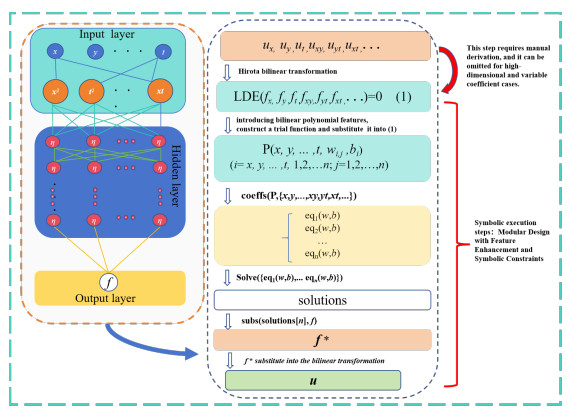
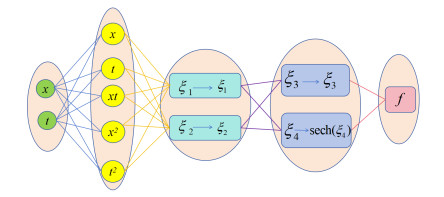
The fifth-order dispersion nonlinear wave (1+1)-dimensional Caudrey–Dodd–Gibbon equation is a classic model describing soliton phenomena in fields such as plasma magnetosonic waves and optical fiber light pulses, and its exact solution is of great importance for revealing the laws of nonlinear wave motion. In this paper, an integrated framework combining bilinear polynomial feature enhancement, symbolic computation constraints, and neural network learning is proposed. Bilinear polynomial features such as $ x^2 $, $ t^2 $, and $ xt $ are introduced to break through the input limitation of original variables, broaden the boundary of the model in capturing nonlinear interactions between variables, and reduce errors caused by insufficient feature information. Symbolic computation is applied to the bilinear transformation derivation and conservation law analysis of the (1+1)-dimensional Caudrey–Dodd–Gibbon Equation to provide mathematical structure constraints for the neural network, and a collaborative mechanism of "symbolic reasoning guiding numerical learning" is constructed to improve the interpretability of the model. This framework breaks down the barriers between traditional numerical and pure neural network methods, realizes efficient and accurate solution of the (1+1)-dimensional Caudrey–Dodd–Gibbon equation, and provides a new path for the study of exact solutions of high-dimensional, variable-coefficient, and strongly nonlinear partial differential equations.
Citation: Xia Li, Jianglong Shen, Jingbin Liang, Yu Gao. Bilinear feature-enhanced symbolic computation neural network method for solving the (1+1)-dimensional Caudrey–Dodd–Gibbon equation[J]. AIMS Mathematics, 2026, 11(2): 3193-3218. doi: 10.3934/math.2026128
The fifth-order dispersion nonlinear wave (1+1)-dimensional Caudrey–Dodd–Gibbon equation is a classic model describing soliton phenomena in fields such as plasma magnetosonic waves and optical fiber light pulses, and its exact solution is of great importance for revealing the laws of nonlinear wave motion. In this paper, an integrated framework combining bilinear polynomial feature enhancement, symbolic computation constraints, and neural network learning is proposed. Bilinear polynomial features such as $ x^2 $, $ t^2 $, and $ xt $ are introduced to break through the input limitation of original variables, broaden the boundary of the model in capturing nonlinear interactions between variables, and reduce errors caused by insufficient feature information. Symbolic computation is applied to the bilinear transformation derivation and conservation law analysis of the (1+1)-dimensional Caudrey–Dodd–Gibbon Equation to provide mathematical structure constraints for the neural network, and a collaborative mechanism of "symbolic reasoning guiding numerical learning" is constructed to improve the interpretability of the model. This framework breaks down the barriers between traditional numerical and pure neural network methods, realizes efficient and accurate solution of the (1+1)-dimensional Caudrey–Dodd–Gibbon equation, and provides a new path for the study of exact solutions of high-dimensional, variable-coefficient, and strongly nonlinear partial differential equations.

| [1] |
E. Hussain, A. H. Tedjani, K. Farooq, Beenish, Modeling and exploration of localized wave phenomena in optical fibers using the generalized Kundu–Eckhaus equation for femtosecond pulse transmission, Axioms, 14 (2025), 513. https://doi.org/10.3390/axioms14070513 doi: 10.3390/axioms14070513

|
| [2] |
M. A. S. Murad, F. S. Alshammari, M. S. Salih, K. Farooq, Optical soliton structures in the nonlinear conformable Schrödinger equation with quadratic–cubic nonlinearity, Nonlinear Dynam., 113 (2025), 32669–32687. https://doi.org/10.1007/s11071-025-11775-z doi: 10.1007/s11071-025-11775-z
|
| [3] |
K. Farooq, A. H. Tedjani, Z. Li, E. Hussain, Soliton dynamics of the nonlinear Kodama equation with M-truncated derivative via two innovative schemes: The generalized Arnous method and the Kudryashov method, Fractal Fract., 9 (2025), 436. https://doi.org/10.3390/fractalfract9070436 doi: 10.3390/fractalfract9070436
|
| [4] |
R. F. Zhang, M. C. Li, M. Albishari, F. C. Zheng, Z. Z. Lan, Generalized lump solutions, classical lump solutions and rogue waves of the (2+1)-dimensional Caudrey-Dodd-Gibbon-Kotera-Sawada-like equation, Appl. Math. Comput., 403 (2021), 126201. https://doi.org/10.1016/j.amc.2021.126201 doi: 10.1016/j.amc.2021.126201
|
| [5] |
L. Gai, W. Wu, T. Ding, Y. Qian, Lump wave solutions, lump-stripe soliton inelastic collision phenomena and rogue-type wave solutions for a generalized breaking soliton system in (3+1)-dimensions, Wave Motion, 124 (2024), 103243. https://doi.org/10.1016/j.wavemoti.2023.103243 doi: 10.1016/j.wavemoti.2023.103243
|
| [6] |
Z. H. Zhang, J. G. Liu, A fourth-order nonlinear equation studied by using a multivariate bilinear neural network method, Nonlinear Dynam., 112 (2024), 10229–10237. https://doi.org/10.1007/s11071-024-09567-y doi: 10.1007/s11071-024-09567-y
|
| [7] |
X. S. Wu, J. G. Liu, Solving the variable coefficient nonlinear partial differential equations based on the bilinear residual network method, Nonlinear Dynam., 112 (2024), 8329–8340. https://doi.org/10.1007/s11071-024-09472-4 doi: 10.1007/s11071-024-09472-4
|
| [8] |
X. Hao, Y. Liu, X. Tang, Z. Li, A Maple package for finding interaction solutions of nonlinear evolution equations, Comput. Math. Appl., 72 (2016), 2450–2461. https://doi.org/10.1016/j.camwa.2016.09.006 doi: 10.1016/j.camwa.2016.09.006
|
| [9] | R. Hirota, The direct method in soliton theory, Cambridge University Press, 2004. https://doi.org/10.1017/CBO9780511543043 |
| [10] |
V. Kumar, A. K. Pandey, D. S. Bisht, Multisoliton solutions and interaction of solitons for the (3+1)-dimensional Calogero-Degasperis-Gibbon equation, Chinese Phys. B, 31 (2022), 100203 https://doi.org/10.1088/1674-1056/ac8cbe doi: 10.1088/1674-1056/ac8cbe
|
| [11] |
J. Singh, A. Gupta, D. Baleanu, On the analysis of an analytical approach for fractional Caudrey-Dodd-Gibbon equations, Alex. Eng. J., 61 (2022), 5073–5082. https://doi.org/10.1016/j.aej.2021.09.053 doi: 10.1016/j.aej.2021.09.053
|
| [12] |
G. F. Deng, Y. T. Gao, J. J. Su, C. C. Ding, T. T. Jia, Solitons and periodic waves for the (2+1)-dimensional generalized Caudrey–Dodd–Gibbon–Kotera–Sawada equation in fluid mechanics, Nonlinear Dynam., 99 (2020), 1039–1052. https://doi.org/10.1007/s11071-019-05328-4 doi: 10.1007/s11071-019-05328-4
|
| [13] |
A. Yusuf, T. A. Sulaiman, M. Inc, M. Bayram, Breather wave, lump-periodic solutions and some other interaction phenomena to the Caudrey–Dodd–Gibbon equation, Eur. Phys. J. Plus, 563 (2020), 135. https://doi.org/10.1140/epjp/s13360-020-00566-7 doi: 10.1140/epjp/s13360-020-00566-7
|
| [14] |
M. M. A. Khater, S. H. Alfalqi, Analytical solutions of the Caudrey–Dodd–Gibbon equation using Khater Ⅱ and variational iteration methods, Sci. Rep., 14 (2024), 27946. https://doi.org/10.1038/s41598-024-75969-y doi: 10.1038/s41598-024-75969-y
|
| [15] |
A. Yokuş, H. Durur, K. A. Abro, Symbolic computation of Caudrey–Dodd–Gibbon equation subject to periodic trigonometric and hyperbolic symmetries, Eur. Phys. J. Plus, 358 (2021), 136. https://doi.org/10.1140/epjp/s13360-021-01350-x doi: 10.1140/epjp/s13360-021-01350-x
|
| [16] | A. K. M. K. S. Hossain, M. A. Akbar, M. I. Hossain, Modified simple equation technique for first-extended fifth-order nonlinear equation, medium equal width equation and Caudrey–Dodd–Gibbon equation, J. Umm Al-Qura Univ. Appl. Sci., 11 (2025), 623–632. |
| [17] |
H. Ma, Y. Wang, A. Deng, Soliton molecules and some novel mixed solutions for the extended Caudrey-Dodd-Gibbon equation, J. Geom. Phys., 168 (2021), 104309. https://doi.org/10.1016/j.geomphys.2021.104309 doi: 10.1016/j.geomphys.2021.104309
|
| [18] |
A. F. Şahinkaya, A. Kurt, İ. Yalçınkaya, Investigating the new perspectives of Caudrey–Dodd–Gibbon equation arising in quantum field theory, Opt. Quant. Electron., 56 (2024), 813. https://doi.org/10.1007/s11082-024-06636-9 doi: 10.1007/s11082-024-06636-9
|
| [19] |
S. A. Abdelhafeez, A. A. M. Arafa, Y. H. Zahran, I. S. I. Osman, M. Ramadan, Adapting Laplace residual power series approach to the Caudrey Dodd Gibbon equation, Sci. Rep., 14 (2024), 9772. https://doi.org/10.1038/s41598-024-57780-x doi: 10.1038/s41598-024-57780-x
|
| [20] |
D. Fathima, R. A. Alahmadi, A. Khan, A. Akhter, A. H. Ganie, An efficient analytical approach to investigate fractional Caudrey–Dodd–Gibbon equations with non-singular Kernel derivatives, Symmetry, 15 (2023), 850. https://doi.org/10.3390/sym15040850 doi: 10.3390/sym15040850
|
| [21] |
Q. Ding, A. J. Hao, Differential invariants for CDG equation and coupled KDV-MKDV equations, Acta Phys. Sin., 63 (2014), 110503. https://doi.org/10.7498/aps.63.110503 doi: 10.7498/aps.63.110503
|
| [22] |
S. Sakovich, A note on lax pairs of the Sawada-Kotera equation, J. Math., 4 (2014), 906165. https://doi.org/10.1155/2014/906165 doi: 10.1155/2014/906165
|
| [23] |
M. Raissi, G. E. Karniadakis, Hidden fluid mechanics: Learning velocity and pressure fields from flow visualization, Science, 367 (2020), 1026–1030. https://doi.org/10.1126/science.aaw4741 doi: 10.1126/science.aaw4741
|
| [24] | S. Wang, B. Li, Y. Chen, P. Perdikaris, Piratenets: Physics-informed deep learning with residual adaptive networks, J. Mach. Learn. Res., 25 (2024), 1–51. http://jmlr.org/papers/v25/24-0313.html |
| [25] |
J. L. Shen, R. F. Zhang, J. W. Huang, J. B. Liang, Neural network-based symbolic computation algorithm for solving (2+1)-dimensional Yu-Toda-Sasa-Fukuyama equation, Mathematics, 13 (2025), 3006. https://doi.org/10.3390/math13183006 doi: 10.3390/math13183006
|
| [26] |
M. Raissi, P. Perdikaris, G. E. Karniadakis, Physics-informed neural networks: A deep learning framework for solving forward and inverse problems involving nonlinear partial differential equations, J. Comput. Phys., 378 (2019), 686–707. https://doi.org/10.1016/j.jcp.2018.10.045 doi: 10.1016/j.jcp.2018.10.045
|
| [27] |
L. Lu, X. Meng, Z. Mao, G. E. Karniadakis, DeepXDE: A deep learning library for solving differential equations, SIAM Rev., 63 (2021), 208–228. https://doi.org/10.1137/19M1274067 doi: 10.1137/19M1274067
|
| [28] |
G. E. Karniadakis, I. G. Kevrekidis, L. Lu, P. Perdikaris, S. F. Wang, L. Yang, Physics-informed machine learning, Nat. Rev. Phys., 3 (2021), 422–440. https://doi.org/10.1038/s42254-021-00314-5 doi: 10.1038/s42254-021-00314-5
|
| [29] |
W. Hussain, J. M. Merigó, J. Gil-Lafuente, H. H. Gao, Complex nonlinear neural network prediction with IOWA layer, Soft Comput., 27 (2023), 4853–4863. https://doi.org/10.1007/s00500-023-07899-2 doi: 10.1007/s00500-023-07899-2
|
| [30] |
X. Q. Huang, W. L. Shi, X. T. Gao, X. R. Wei, J. Zhang, J. Bian, et al., LordNet: An efficient neural network for learning to solve parametric partial differential equations without simulated data, Neural Networks, 176 (2024), 106354. https://doi.org/10.1016/j.neunet.2024.106354 doi: 10.1016/j.neunet.2024.106354
|
| [31] |
S. Chen, S. Xiong, Y. Liu, Chebyshev-Sobolev physics-informed neural networks for general PDE solutions, Int. J. Appl. Comput. Math., 11 (2025), 169. https://doi.org/10.1007/s40819-025-01988-6 doi: 10.1007/s40819-025-01988-6
|
| [32] |
J. L. Shen, X. Y. Wu, Periodic-soliton and periodic-type solutions of the (3+1)-dimensional Boiti–Leon–Manna–Pempinelli equation by using BNNM, Nonlinear Dynam., 106 (2021), 831–840. https://doi.org/10.1007/s11071-021-06848-8 doi: 10.1007/s11071-021-06848-8
|
| [33] |
M. Qasim, F. Yao, M. Z. Baber, U. Younas, Investigating the higher dimensional Kadomtsev–Petviashvili–Sawada–Kotera–Ramaniequation: Exploring the modulation instability, Jacobi elliptic and soliton solutions, Phys. Scripta, 100 (2025), 025215. https://doi.org/10.1088/1402-4896/ada20c doi: 10.1088/1402-4896/ada20c
|
| [34] |
L. Ying, M. Li, Y. Shi, New exact solutions and related dynamic behaviors of a (3+1)-dimensional generalized Kadomtsev–Petviashvili equation, Nonlinear Dynam., 112 (2024), 11349–11372. https://doi.org/10.1007/s11071-024-09539-2 doi: 10.1007/s11071-024-09539-2
|
| [35] |
Z. Liu, Y. Liu, X. Yan, W. Liu, H. Nie, S. Guo, et al., Automatic network structure discovery of physics informed neural networks via knowledge distillation, Nat. Commun., 16 (2025), 9558. https://doi.org/10.1038/s41467-025-64624-3 doi: 10.1038/s41467-025-64624-3
|
| [36] |
S. F. Sun, S. F. Tian, B. Li, The data-driven rogue waves of the Hirota equation by using Mix-training PINNs approach, Physica D, 465 (2024), 134202. https://doi.org/10.1016/j.physd.2024.134202 doi: 10.1016/j.physd.2024.134202
|
| [37] |
J. L. Shen, M. Liu, J. B. Liang, R. F. Zhang, New solutions to the (3+1)-dimensional HB equation using bilinear neural networks method and symbolic ansatz method using neural network architecture, AIMS Math., 10 (2025), 30307–30330. https://doi.org/10.3934/math.20251331 doi: 10.3934/math.20251331
|
| [38] |
P. J. Caudrey, R. K. Dodd, J. D. Gibbon, A new hierarchy of Korteweg–de Vries equations, Proc. A., 351 (1976), 407–422. https://doi.org/10.1098/rspa.1976.0149 doi: 10.1098/rspa.1976.0149
|
| [39] |
H. Naher, F. A. Abdullah, M. A. Akbar, The $(G'/G)$-expansion method for abundant traveling wave solutions of Caudrey-Dodd-Gibbon equation, Math. Probl. Eng., 2011 (2011), 218216. https://doi.org/10.1155/2011/218216 doi: 10.1155/2011/218216
|
| [40] |
K. Ayub, M. Y. Khan, A. Rani, Q. M. Ul Hassan, B. Ahmed, M. Shakeel, Application of the Exp $(-\phi(\zeta))$-expansion method for solitary wave solutions., Arab J. Basic Appl. Sci., 26 (2019), 376–384. https://doi.org/10.1080/25765299.2019.1642079 doi: 10.1080/25765299.2019.1642079
|
| [41] |
K. E. Yao, M. Samar, Y. Shi, Approximation approach for backward stochastic Volterra integral equations, Math. Model. Control, 4 (2024), 390–399. https://doi.org/10.3934/mmc.2024031 doi: 10.3934/mmc.2024031
|
| [42] |
Y. Lu, D. Ruan, Q. Zhu, Stability of nonlinear systems with multi-delayed random impulses: Average estimation and delay approach, Nature, 1 (2025), 2. https://doi.org/10.3934/math.2025982 doi: 10.3934/math.2025982
|
| [43] |
J. Y. Yan, B. Hu, Z. H. Guan, D. X. Zhang, On controllability of fractional-order impulsive and switching systems with time delay, Appl. Math. Comput., 497 (2025), 129357. https://doi.org/10.1016/j.amc.2025.129357 doi: 10.1016/j.amc.2025.129357
|
| [44] |
C. Lv, X. L. Lv, Z. Y. Wang, A focal quotient gradient system method for deep neural network training, Appl. Soft Comput., 184 (2025), 113704. https://doi.org/10.1016/j.asoc.2025.113704 doi: 10.1016/j.asoc.2025.113704
|
| [45] |
M. Y. Gao, S. Y. Zhou, W. Gu, MMGPT4LF: Leveraging an optimized pre-trained GPT-2 model with multi-modal cross-attention for load forecasting, Appl. Energy, 392 (2025), 125965. https://doi.org/10.1016/j.apenergy.2025.125965 doi: 10.1016/j.apenergy.2025.125965
|
Figures(11) / Tables(4)

Xia Li, Jianglong Shen, Jingbin Liang, Yu Gao. Bilinear feature-enhanced symbolic computation neural network method for solving the (1+1)-dimensional Caudrey–Dodd–Gibbon equation[J]. AIMS Mathematics, 2026, 11(2): 3193-3218. doi: 10.3934/math.2026128





 DownLoad: