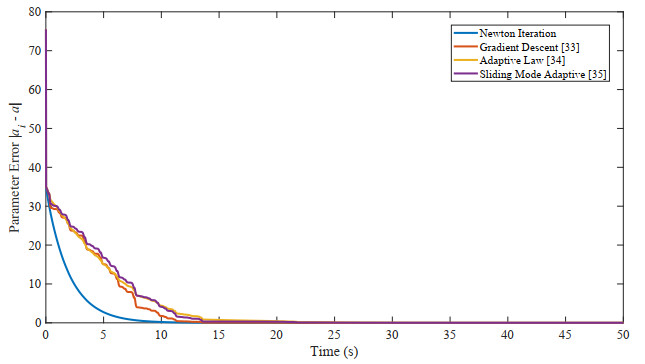
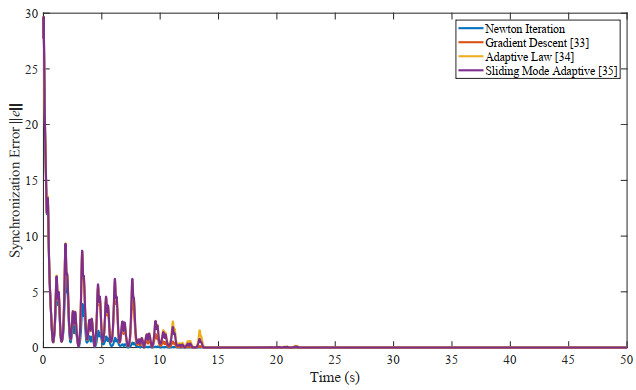
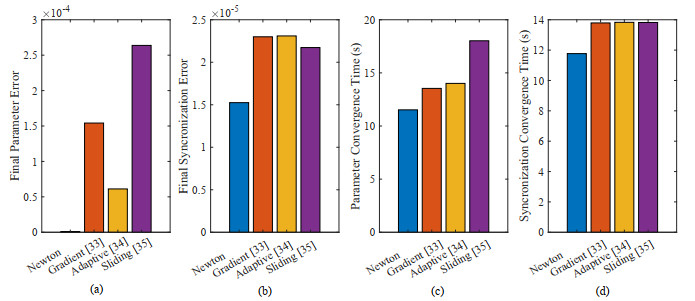
This study addresses finite-time synchronization of coupled neural networks under uncertain switching topologies. A hybrid impulsive controller with Newton-based parameter identification is proposed to achieve rapid synchronization in randomly switching networks. The controller integrates linear control, nonlinear power-law feedback, and impulsive actions, while Newton iteration enables accelerated parameter estimation via second-order gradient information. The key innovation lies in decoupling the parameter identification from the synchronization dynamics, allowing precise estimation without topological constraints. Numerical simulations demonstrate superior convergence speed and accuracy compared with gradient descent, adaptive law, and sliding mode methods, with over $ 85\% $ of tested parameter combinations achieving successful convergence, attributed to Newton's superlinear convergence and adaptive step adjustment. The framework shows strong robustness under dynamic topological changes, offering a reliable solution for time-sensitive applications in medical diagnostics and neural analysis.
Citation: Yongwei Yang, Chengye Zou, Hao Zhang. Finite-time synchronization in uncertain switched coupled neural networks via Newton iterative hybrid control[J]. AIMS Mathematics, 2026, 11(8): 27264-27303. doi: 10.3934/math.20261091
This study addresses finite-time synchronization of coupled neural networks under uncertain switching topologies. A hybrid impulsive controller with Newton-based parameter identification is proposed to achieve rapid synchronization in randomly switching networks. The controller integrates linear control, nonlinear power-law feedback, and impulsive actions, while Newton iteration enables accelerated parameter estimation via second-order gradient information. The key innovation lies in decoupling the parameter identification from the synchronization dynamics, allowing precise estimation without topological constraints. Numerical simulations demonstrate superior convergence speed and accuracy compared with gradient descent, adaptive law, and sliding mode methods, with over $ 85\% $ of tested parameter combinations achieving successful convergence, attributed to Newton's superlinear convergence and adaptive step adjustment. The framework shows strong robustness under dynamic topological changes, offering a reliable solution for time-sensitive applications in medical diagnostics and neural analysis.

| [1] |
O. Shobayo, R. Saatchi, Developments in deep learning artificial neural network techniques for medical image analysis and interpretation, Diagnostics, 15 (2025), 1072. https://doi.org/10.3390/diagnostics15091072 doi: 10.3390/diagnostics15091072

|
| [2] |
V. D. Vuong, L. H. Nguyen, J. A. Goulet, Coupling LSTM neural networks and state-space models through analytically tractable inference, Int. J. Forecast., 41 (2025), 128–140. https://doi.org/10.1016/j.ijforecast.2024.04.002 doi: 10.1016/j.ijforecast.2024.04.002
|
| [3] |
H. Mohammadi, W. Karwowski, Graph neural networks in brain connectivity studies: methods, challenges, and future directions, Brain Sci., 15 (2025), 17. https://doi.org/10.3390/brainsci15010017 doi: 10.3390/brainsci15010017
|
| [4] |
W. B. Subait, N. Ahmad, M. S. A. Alzaidi, M. Alqahtani, A. A. Alhashmi, N. O. Aljehane, et al., Unveiling Arabic named entity recognition using natural language processing with artificial intelligence approach on Moroccan dialect, Sci. Rep., 15 (2025), 30882. https://doi.org/10.1038/s41598-025-05940-y doi: 10.1038/s41598-025-05940-y
|
| [5] |
Y. Cao, L. Zhao, Q. Zhong, K. Shi, J. Xiao, S. Wen, Synchronization of coupled neural networks with multiple switching topologies via adaptive control techniques, Int. J. Robust Nonlinear Control, 34 (2024), 8661–8675. https://doi.org/10.1002/rnc.7409 doi: 10.1002/rnc.7409
|
| [6] |
J. Wang, H. Wu, T. Huang, S. Ren, Finite-time synchronization and $H_\infty$ synchronization for coupled neural networks with multistate or multiderivative couplings, IEEE Trans. Neural Netw. Learn. Syst., 35 (2022), 1628–1638. https://doi.org/10.1109/TNNLS.2022.3184487 doi: 10.1109/TNNLS.2022.3184487
|
| [7] |
S. Tang, J. Li, H. Jiang, H. Jiang, Fixed-time aperiodic intermittent control for quasi-bipartite synchronization of competitive neural networks, Entropy, 26 (2024), 199. https://doi.org/10.3390/e26030199 doi: 10.3390/e26030199
|
| [8] |
Y. Huang, Y. Gao, L. Su, T. Wong, Predefined-time synchronization of coupled competitive neural networks, Int. J. Adapt. Control Signal Process., 39 (2025), 609–621. https://doi.org/10.1002/acs.3961 doi: 10.1002/acs.3961
|
| [9] |
A. Aili, S. Chen, S. Zhang, Event-triggered synchronization of coupled neural networks with reaction-diffusion terms, Mathematics, 12 (2024), 1409. https://doi.org/10.3390/math12091409 doi: 10.3390/math12091409
|
| [10] |
X. Zheng, J. Wang, K. Shi, X. Cai, Y. Tang, Intelligent hybrid event-triggered synchronization control of delayed neural networks with actuator failure via semi loop functional, Discrete Contin. Dyn. Syst. Ser. S, 18 (2025), 2429–2447. https://doi.org/10.3934/dcdss.2024139 doi: 10.3934/dcdss.2024139
|
| [11] |
C. Yi, J. Cai, R. Guo, Synchronization of a class of nonlinear multiple neural networks with delays via a dynamic event-triggered impulsive control strategy, Electron. Res. Arch., 32 (2024), 4581–4603. https://doi.org/10.3934/era.2024208 doi: 10.3934/era.2024208
|
| [12] |
C. Zheng, J. Yu, F. Kong, C. Hu, Fixed-time synchronization of discontinuous fuzzy competitive neural networks via quantized control, Fuzzy Sets Syst., 482 (2024), 108913. https://doi.org/10.1016/j.fss.2024.108913 doi: 10.1016/j.fss.2024.108913
|
| [13] |
W. Chen, H. Li, Complete synchronization of delayed discrete-time fractional-order competitive neural networks, Appl. Math. Comput., 479 (2024), 128872. https://doi.org/10.1016/j.amc.2024.128872 doi: 10.1016/j.amc.2024.128872
|
| [14] |
T. Li, H. Li, X. Fan, L. Zhang, Complete synchronization of discrete-time fractional-order Cohen–Grossberg networks with time delays via adaptive nonlinear controller, Math. Methods Appl. Sci., 48 (2024), 4708–4722. https://doi.org/10.1002/mma.10571 doi: 10.1002/mma.10571
|
| [15] |
Z. Wu, D. Yang, H. Li, Y. Yu, X. Liu, P. Cattani, et al. A novel event-dependent intermittent control for synchronization of fractional-order coupled neural networks with mixed delays and higher-order interactions, Fractal Fract., 9 (2025), 824. https://doi.org/10.3390/fractalfract9120824 doi: 10.3390/fractalfract9120824
|
| [16] |
X. Zhou, J. Cao, Z. Guan, X. Wang, F. Kong, Fast synchronization control and application for encryption-decryption of coupled neural networks with intermittent random disturbance, Neural Netw., 176 (2024), 106404. https://doi.org/10.1016/j.neunet.2024.106404 doi: 10.1016/j.neunet.2024.106404
|
| [17] |
Q. Chang, R. Wang, Y. Yang, Finite-time cluster synchronization of fractional-order complex-valued neural networks based on memristor with optimized control parameters, Fractal Fract., 9 (2025), 39. https://doi.org/10.3390/fractalfract9010039 doi: 10.3390/fractalfract9010039
|
| [18] |
L. Liu, H. Bao, J. Cao, Fixed-time event-triggered impulsive secure synchronization of quaternion-valued fuzzy neural networks subject to stochastic cyber-attacks, IEEE Trans. Fuzzy Syst., 33 (2025), 559–569. https://doi.org/10.1109/TFUZZ.2024.3485515 doi: 10.1109/TFUZZ.2024.3485515
|
| [19] |
X. Chen, T. Jia, Z. Wang, X. Xie, J. Qiu, Practical fixed-time bipartite synchronization of uncertain coupled neural networks subject to deception attacks via dual-channel event-triggered control, IEEE Trans. Cybern., 54 (2024), 3615–3625. https://doi.org/10.1109/TCYB.2023.3338165 doi: 10.1109/TCYB.2023.3338165
|
| [20] |
X. Si, Z. Wang, X. Huang, H. Shen, Resilient sampled-data control for bipartite synchronization of cooperation-competition neural networks against denial-of-service attacks, IEEE Trans. Autom. Sci. Eng., 22 (2025), 17778–17789. https://doi.org/10.1109/TASE.2025.3585403 doi: 10.1109/TASE.2025.3585403
|
| [21] |
J. Han, Finite-time passivity and synchronization for a class of fuzzy inertial complex-valued neural networks with time-varying delays, Axioms, 13 (2024), 39. https://doi.org/10.3390/axioms13010039 doi: 10.3390/axioms13010039
|
| [22] |
Q. Cui, J. Cao, M. Abdel-Aty, A. Kashkynbayev, Global practical finite-time synchronization of disturbed inertial neural networks by delayed impulsive control, Neural Netw., 181 (2025), 106873. https://doi.org/10.1016/j.neunet.2024.106873 doi: 10.1016/j.neunet.2024.106873
|
| [23] |
J. Ran, T. Zhang, Fixed-time synchronization control of fuzzy inertial neural networks with mismatched parameters and structures, AIMS Math., 9 (2024), 31721–31739. https://doi.org/10.3934/math.20241525 doi: 10.3934/math.20241525
|
| [24] |
C. Chenthamarakshan, S. Ganesan, K. Sivakumar, A. Kashkynbayev, Quasi-bipartite synchronization for delayed coupled inertial neural networks having cooperative and competitive communication via pinning control strategy, IET Control Theory Appl., 19 (2025), e12780. https://doi.org/10.1049/cth2.12780 doi: 10.1049/cth2.12780
|
| [25] |
P. B. Dhivakaran, A. Vinodkumar, S. Vijay, S. Lakshmanan, J. Alzabut, R. A. El-Nabulsi, et al., Bipartite synchronization of fractional order multiple memristor coupled delayed neural networks with event triggered pinning control, Neural Process. Lett., 56 (2024), 50. https://doi.org/10.1007/s11063-024-11507-1 doi: 10.1007/s11063-024-11507-1
|
| [26] |
S. Dong, K. Shi, S. Wen, Y. Shen, S. Zhong, Almost surely synchronization of directed coupled neural networks via stochastic distributed delayed impulsive control, Chaos Solitons Fract., 174 (2023), 113742. https://doi.org/10.1016/j.chaos.2023.113742 doi: 10.1016/j.chaos.2023.113742
|
| [27] |
H. Q. Wu, X. Q. Zhao, L. Y. Wang, J. D. Cao, Observer-based fixed-time topology identification and synchronization for complex networks via quantized pinning control strategy, Appl. Math. Comput., 507 (2025), 129568. https://doi.org/10.1016/j.amc.2025.129568 doi: 10.1016/j.amc.2025.129568
|
| [28] |
Y. Li, Q. M. Zhu, J. H. Zhang, Adaptive fixed-time neural networks control for pure-feedback non-affine nonlinear systems with state constraints, Entropy, 24 (2022), 737. https://doi.org/10.3390/e24050737 doi: 10.3390/e24050737
|
| [29] |
G. Zhang, S. Wen, New approximate results of fixed-time stabilization for delayed inertial memristive neural networks, IEEE Trans. Circuits Syst. II Express Briefs, 71 (2024), 3428–3432. https://doi.org/10.1109/TCSII.2024.3361670 doi: 10.1109/TCSII.2024.3361670
|
| [30] |
X. Ma, C. Hu, J. Yu, S. Wen, L. Wang, Y. Sheng, Hyperbolic function-based limited-time stability and limited-time synchronization for fuzzy switched Cohen-Grossberg neural networks, Nonlinear Dyn., 114 (2026), 597. https://doi.org/10.1007/s11071-026-12469-w doi: 10.1007/s11071-026-12469-w
|
| [31] |
K. Xiong, C. Hu, J. Yu, L. Wang, Special function-based limited-time synchronization of multilayered coupled quaternion networks, Commun. Nonlinear Sci. Numer. Simul., 145 (2025), 108694. https://doi.org/10.1016/j.cnsns.2025.108694 doi: 10.1016/j.cnsns.2025.108694
|
| [32] |
Q. Xi, X. Z. Liu, X. D. Li, Finite-time synchronization of complex dynamical networks via a novel hybrid controller, IEEE Trans. Neural Netw. Learn. Syst., 35 (2024), 1040–1049. https://doi.org/10.1109/TNNLS.2022.3185490 doi: 10.1109/TNNLS.2022.3185490
|
| [33] |
J. Fang, N. N. Yin, D. Wei, H. Liu, W. Deng, Improved finite-time synchronization of coupled discontinuous neural networks under adaptive sliding mode control, Int. J. Dyn. Control, 12 (2024), 396–408. https://doi.org/10.1007/s40435-023-01202-9 doi: 10.1007/s40435-023-01202-9
|
| [34] |
L. Dai, Z. Liu, H. Xu, Y. Zhang, Novel finite-time convergent neural dynamics for practical synchronization of diverse chaotic systems, Commun. Nonlinear Sci. Numer. Simul., 151 (2025), 109122. https://doi.org/10.1016/j.cnsns.2025.109122 doi: 10.1016/j.cnsns.2025.109122
|
| [35] |
Q. Cui, J. D. Cao, M. Abdel-Aty, Finite-time bipartite synchronization for coupled neural networks: An aperiodically intermittent and impulsive control approach, Expert Syst. Appl., 290 (2025), 128433. https://doi.org/10.1016/j.eswa.2025.128433 doi: 10.1016/j.eswa.2025.128433
|
| [36] |
C. Hu, J. Yu, Z. Chen, H. Jiang, T. Huang, Fixed-time stability of dynamical systems and fixed-time synchronization of coupled discontinuous neural networks, Neural Netw., 89 (2017), 74–83. https://doi.org/10.1016/j.neunet.2017.02.001 doi: 10.1016/j.neunet.2017.02.001
|
| [37] | R. A. Horn and C. R. Johnson, Matrix analysis, Cambridge: Cambridge University Press, 2012. https://doi.org/10.1017/CBO9780511750922.006 |
| [38] |
X. D. Li, D. W. C. Ho, J. D. Cao, Finite-time stability and settling-time estimation of nonlinear impulsive systems, Automatica, 99 (2019), 361–368. https://doi.org/10.1016/j.automatica.2018.10.024 doi: 10.1016/j.automatica.2018.10.024
|
| [39] |
D. E. Rumelhart, G. E. Hinton, R. J. Williams, Learning representations by back-propagating errors, Nature, 323 (1986), 533–536. https://doi.org/10.1038/323533a0 doi: 10.1038/323533a0
|
| [40] | J. J. E. Slotine, W. Li, Applied nonlinear control, Englewood Cliffs, NJ: Prentice hall, 1991. |
| [41] |
V. I. Utkin, Sliding mode control design principles and applications to electric drives, IEEE Trans. Ind. Electron., 40 (1993), 23–36. https://doi.org/10.1109/41.184818 doi: 10.1109/41.184818
|
Figures(17) / Tables(1)

Yongwei Yang, Chengye Zou, Hao Zhang. Finite-time synchronization in uncertain switched coupled neural networks via Newton iterative hybrid control[J]. AIMS Mathematics, 2026, 11(8): 27264-27303. doi: 10.3934/math.20261091





 DownLoad: