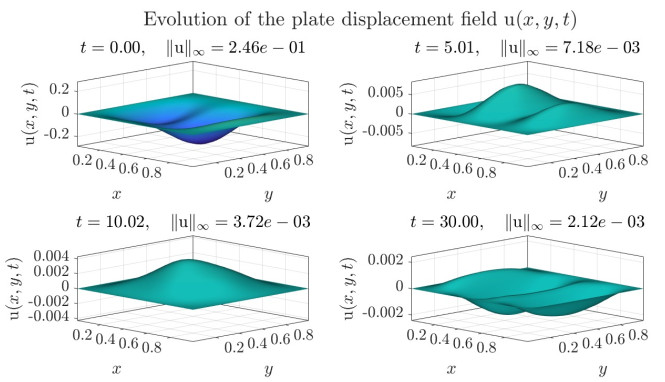
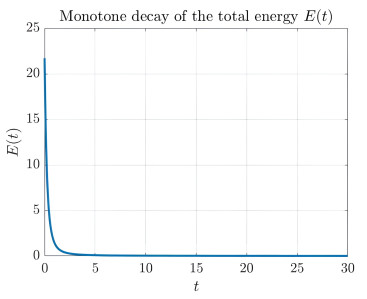
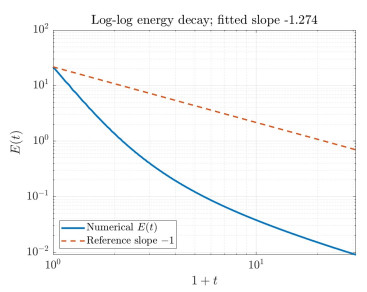
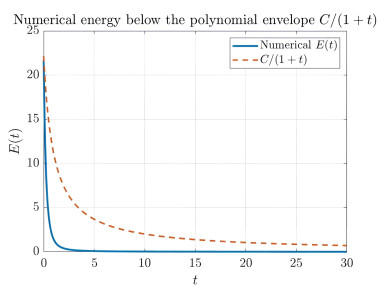
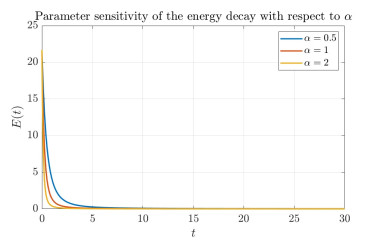
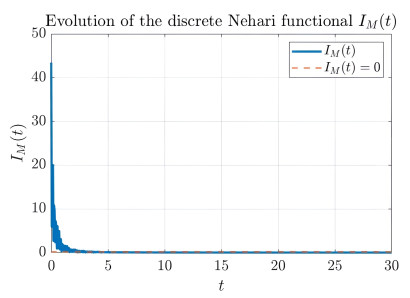
This paper investigates a nonlinear clamped plate equation with logarithmic velocity damping and a polynomial source. The model combines the biharmonic operator, a nonstandard logarithmic damping mechanism and an energy-producing source term. Since the logarithmic damping is weak near the origin and the source may destabilize the system, the analysis requires a combination of monotonicity, potential well, and multiplier techniques. We first establish the local well-posedness of weak solutions by the Faedo–Galerkin method and compactness arguments. We then prove global existence for the initial data in the stable set. Finally, using logarithmic dissipation estimates and a Haraux-type integral inequality, we derive a polynomial decay estimate for the energy. To demonstrate the theoretical decay behavior and the impact of the damping and source factors on the plate's energy, numerical simulations are also provided.
Citation: Iqra Kanwal, Jianghao Hao, Muhammad Fahim Aslam, Mohamed Balegh, Zayd Hajjej. Global existence and polynomial stability for a nonlinear clamped plate equation with logarithmic velocity damping[J]. AIMS Mathematics, 2026, 11(8): 26943-26985. doi: 10.3934/math.20261081
This paper investigates a nonlinear clamped plate equation with logarithmic velocity damping and a polynomial source. The model combines the biharmonic operator, a nonstandard logarithmic damping mechanism and an energy-producing source term. Since the logarithmic damping is weak near the origin and the source may destabilize the system, the analysis requires a combination of monotonicity, potential well, and multiplier techniques. We first establish the local well-posedness of weak solutions by the Faedo–Galerkin method and compactness arguments. We then prove global existence for the initial data in the stable set. Finally, using logarithmic dissipation estimates and a Haraux-type integral inequality, we derive a polynomial decay estimate for the energy. To demonstrate the theoretical decay behavior and the impact of the damping and source factors on the plate's energy, numerical simulations are also provided.

| [1] |
M. F. Aslam, J. Hao, S. Boulaaras, L. Bashir, Global existence and exponential stability of a fractionally damped plate equation with past history, Electron. Res. Arch., 33 (2025), 4363–4381. https://doi.org/10.3934/era.2025199 doi: 10.3934/era.2025199

|
| [2] |
I. Kanwal, J. Hao, L. Bashir, M. F. Aslam, A. Bchatnia, Exponential stability in a fractionally delayed and strongly damped logarithmic plate equation: theoretical and numerical analysis, Arab. J. Math., 15 (2026), 1197–1214. https://doi.org/10.1007/s40065-026-00630-7 doi: 10.1007/s40065-026-00630-7
|
| [3] | H. A. Levine, Some nonexistence and instability theorems for solutions of formally parabolic equations of the form $ Pu_t = -Au+F(u) $, 51 (1973), 371–386. https://doi.org/10.1007/BF00263041 |
| [4] |
H. A. Levine, Instability and nonexistence of global solutions to nonlinear wave equations of the form $ Pu_tt\! = \!-Au+F(u) $, Trans. Amer. Math. Soc., 192 (1974), 1–21. https://doi.org/10.2307/1996814 doi: 10.2307/1996814
|
| [5] |
V. Georgiev, G. Todorova, Existence of solutions of the wave equation with nonlinear damping and source terms, J. Differ. Equ., 109 (1994), 295–308. https://doi.org/10.1006/jdeq.1994.1051 doi: 10.1006/jdeq.1994.1051
|
| [6] |
M. Kafini, S. A. Messaoudi, On the decay and global nonexistence of solutions to a damped wave equation with variable-exponent nonlinearity and delay, Ann. Polon. Math., 122 (2019), 49–70. https://doi.org/10.4064/ap180524-31-10 doi: 10.4064/ap180524-31-10
|
| [7] | S. A. Messaoudi, Blow-up in a nonlinearly damped wave equation, Math. Nachr., 231 (2001), 105–111. |
| [8] |
E. Vitillaro, Global nonexistence theorems for a class of evolution equations with dissipation, Arch. Ration. Mech. Anal., 149 (1999), 155–182. https://doi.org/10.1007/s002050050171 doi: 10.1007/s002050050171
|
| [9] | J. E. Lagnese, Boundary stabilization of thin plates, Philadelphia: SIAM, 1989. |
| [10] | V. Komornik, Exact controllability and stabilization: the multiplier method, Paris: Masson-John Wiley, 1994. |
| [11] | I. Lasiecka, R. Triggiani, Control theory for partial differential equations: continuous and approximation theories, Cambridge: Cambridge University Press, 2000. |
| [12] |
I. Chueshov, I. Lasiecka, Long-time behavior of second order evolution equations with nonlinear damping, Mem. Amer. Math. Soc., 195 (2008), 1–183. https://doi.org/10.1090/MEMO/0912 doi: 10.1090/MEMO/0912
|
| [13] |
D. Li, C. Zhang, H. Zhang, Energy decay estimates for the wave equation with logarithmic feedback, Math. Methods Appl. Sci., 48 (2025), 10110–10113. https://doi.org/10.1002/mma.10871 doi: 10.1002/mma.10871
|
| [14] |
D. Li, G. Liu, H. Zhang, Decay estimates and blow-up of solutions to the wave equation with logarithmic damping, Discrete Contin. Dyn. Syst. Ser. S, 29 (2026), 418-435. https://doi.org/10.3934/dcdss.2026015 doi: 10.3934/dcdss.2026015
|
| [15] | S. A. Messaoudi, M. Kafini, M. Zahri, On the wave equation with logarithmic damping: well-posedness, blow-up and numerical analysis, 2026, In press. |
| [16] |
A. M. Al-Mahdi, M. M. Al-Gharabli, On the well-posedness and stability of piezoelectric beams with magnetic effects, logarithmic damping, and Fourier-type thermal conduction, J. Therm. Stresses, 49 (2026), 712–727. https://doi.org/10.1080/01495739.2025.2603426 doi: 10.1080/01495739.2025.2603426
|
| [17] |
S. A. Messaoudi, A. Al-Mahdi, Well-posedness and asymptotic stability of a one-dimensional Timoshenko system with a logarithmic damping, Discrete Contin. Dyn. Syst. Ser. S, 21 (2026), 1–16. https://doi.org/10.3934/dcdss.2025155 doi: 10.3934/dcdss.2025155
|
| [18] | J. L. Lions, Quelques méthodes de résolution des problèmes aux limites non linéaires, Paris: Dunod, 1969. |
| [19] |
J. Simon, Compact sets in the space $ L^p(0, T;B) $, Ann. Mat. Pura Appl., 146 (1987), 65–96. https://doi.org/10.1007/BF01762360 doi: 10.1007/BF01762360
|
| [20] |
I. Kanwal, J. Hao, M. F. Aslam, M. Sepúlveda-Cortés, Stability and finite-time blow-up for a fractionally damped nonlinear plate equation: numerical and analytical insights, Commun. Nonlinear Sci. Numer. Simul., 162 (2026), 110269. https://doi.org/10.1016/j.cnsns.2026.110269 doi: 10.1016/j.cnsns.2026.110269
|
Figures(6) / Tables(4)

Iqra Kanwal, Jianghao Hao, Muhammad Fahim Aslam, Mohamed Balegh, Zayd Hajjej. Global existence and polynomial stability for a nonlinear clamped plate equation with logarithmic velocity damping[J]. AIMS Mathematics, 2026, 11(8): 26943-26985. doi: 10.3934/math.20261081





 DownLoad: