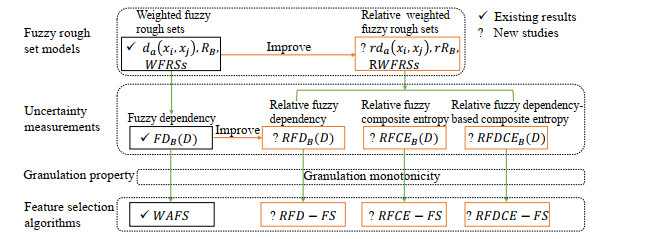
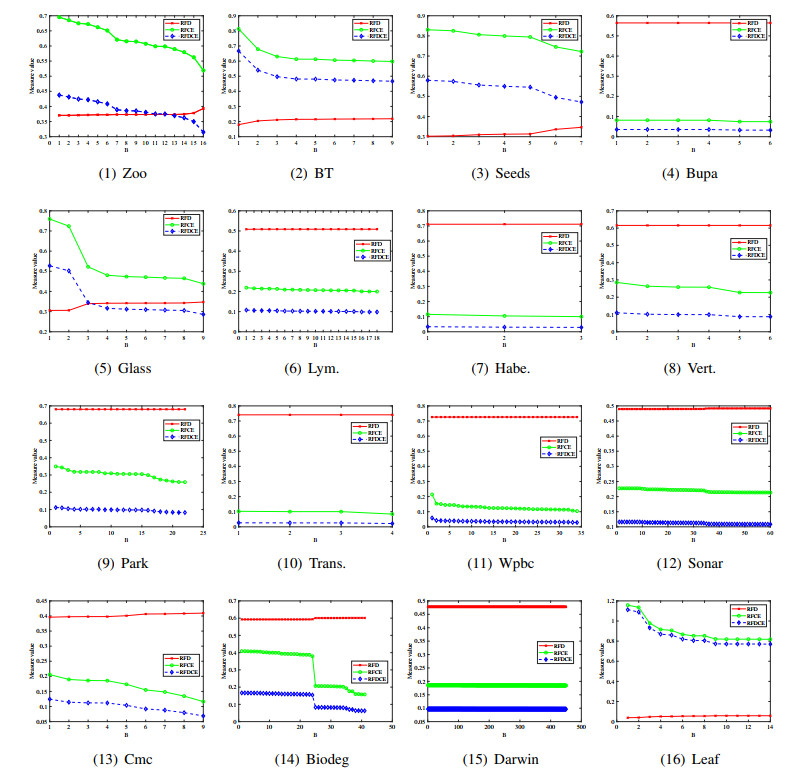
Feature selection is strongly influenced by the appropriateness of distance modeling and the reliability of uncertainty evaluation. Existing fuzzy rough set-based approaches often suffer from insufficient sensitivity to data dispersion and limited ability to reflect class discrimination. To overcome these issues, this paper proposes a two-dimensional enhanced fuzzy rough set framework that refines distance measurement and uncertainty quantification. Feature variability is quantified via statistical dispersion. A relative distance scheme and a knowledge-granulation weighted fuzzy rough model are developed accordingly. Furthermore, the correlation information between samples and class centers is incorporated to enhance the discrimination capability of similarity evaluation. On this basis, three novel uncertainty measurements, namely relative fuzzy dependency degree (RFD), relative fuzzy composite entropy (RFCE), and relative fuzzy dependency-based composite entropy (RFDCE), are developed, together with their corresponding quantification principles and granulation-monotonicity properties. Corresponding feature selection algorithms are then designed. Experimental results demonstrate that the proposed methods achieve superior feature selection capability and classification accuracy compared with fuzzy rough set models and competing techniques.
Citation: Hongyuan Gou, Meng Chen, Benwei Chen. Composite uncertainty measurements in relative weighted fuzzy rough sets for feature selection[J]. AIMS Mathematics, 2026, 11(8): 26186-26223. doi: 10.3934/math.20261049
Feature selection is strongly influenced by the appropriateness of distance modeling and the reliability of uncertainty evaluation. Existing fuzzy rough set-based approaches often suffer from insufficient sensitivity to data dispersion and limited ability to reflect class discrimination. To overcome these issues, this paper proposes a two-dimensional enhanced fuzzy rough set framework that refines distance measurement and uncertainty quantification. Feature variability is quantified via statistical dispersion. A relative distance scheme and a knowledge-granulation weighted fuzzy rough model are developed accordingly. Furthermore, the correlation information between samples and class centers is incorporated to enhance the discrimination capability of similarity evaluation. On this basis, three novel uncertainty measurements, namely relative fuzzy dependency degree (RFD), relative fuzzy composite entropy (RFCE), and relative fuzzy dependency-based composite entropy (RFDCE), are developed, together with their corresponding quantification principles and granulation-monotonicity properties. Corresponding feature selection algorithms are then designed. Experimental results demonstrate that the proposed methods achieve superior feature selection capability and classification accuracy compared with fuzzy rough set models and competing techniques.

| [1] |
J. H. Wan, H. M. Chen, T. R. Li, B. B. Sang, Z. Yuan, Feature grouping and selection with graph theory in robust fuzzy rough approximation space, IEEE Trans. Fuzzy Syst., 31 (2023), 213–225. https://doi.org/10.1109/TFUZZ.2022.3185285 doi: 10.1109/TFUZZ.2022.3185285

|
| [2] |
Z. Yuan, B. Y. Chen, J. Liu, H. M. Chen, D. Z. Peng, P. L. Li, Anomaly detection based on weighted fuzzy-rough density, Appl. Soft Comput., 134 (2023), 109995. https://doi.org/10.1016/j.asoc.2023.109995 doi: 10.1016/j.asoc.2023.109995
|
| [3] |
B. Yu, Z. Zheng, M. Cai, W. Pedrycz, W. Ding, FRCM: a fuzzy rough c-means clustering method, Fuzzy Sets Syst., 480 (2024), 108860. https://doi.org/10.1016/j.fss.2024.108860 doi: 10.1016/j.fss.2024.108860
|
| [4] |
W. C. Yu, W. Yao, Logical distance-based fuzzy rough set model and its application in feature selection, Fuzzy Sets Syst., 519 (2025), 109543. https://doi.org/10.1016/j.fss.2025.109543 doi: 10.1016/j.fss.2025.109543
|
| [5] |
N. Gehlot, A. Jena, A. Vijayvargiya, R. Kumar, Surface electromyography based explainable artificial intelligence fusion framework for feature selection of hand gesture recognition, Eng. Appl. Artif. Intel., 137 (2024), 109119. https://doi.org/10.1016/j.engappai.2024.109119 doi: 10.1016/j.engappai.2024.109119
|
| [6] |
X. Y. Zhang, J. H. Wang, J. L. Hou, Matrix-based approximation dynamic update approach to multi-granulation neighborhood rough sets for intuitionistic fuzzy ordered datasets, Appl. Soft Comput., 163 (2024), 111915. https://doi.org/10.1016/j.asoc.2024.111915 doi: 10.1016/j.asoc.2024.111915
|
| [7] |
R. Shang, J. Song, L. Gao, M. Lu, L. Jiao, S. Xu, et al., Double-dictionary learning unsupervised feature selection cooperating with low-rank and sparsity, Knowl.-Based Syst., 304 (2024), 112566. https://doi.org/10.1016/j.knosys.2024.112566 doi: 10.1016/j.knosys.2024.112566
|
| [8] |
L. P. Deng, M. Q. Xiao, Hyperparameter recommendation via automated meta-feature selection embedded with kernel group Lasso learning, Knowl.-Based Syst., 306 (2024), 112706. https://doi.org/10.1016/j.knosys.2024.112706 doi: 10.1016/j.knosys.2024.112706
|
| [9] |
T. Bhadra, S. Mallik, A. Sohel, Z. Zhao, Unsupervised feature selection using an integrated strategy of hierarchical clustering with singular value decomposition: an integrative biomarker discovery method with application to acute myeloid leukemia, IEEE/ACM Trans. Comput. Biol. Bioinform., 19 (2022), 1354–1364. https://doi.org/10.1109/TCBB.2021.3110989 doi: 10.1109/TCBB.2021.3110989
|
| [10] |
Y. J. Cai, H. Yang, J. Y. Zhu, F. P. Nie, Multi-subspace graph clustering joint dimensionality reduction and feature selection, Pattern Recogn., 172 (2026), 112557. https://doi.org/10.1016/j.patcog.2025.112557 doi: 10.1016/j.patcog.2025.112557
|
| [11] |
Q. Li, Z. Liu, J. Dai, Online multi-label streaming feature selection by label semantic categorization considering label structure unevenness and local label interaction, Eur. J. Oper. Res., 329 (2026), 629–640. https://doi.org/10.1016/j.ejor.2025.10.037 doi: 10.1016/j.ejor.2025.10.037
|
| [12] |
J. Yang, X. Qin, G. Y. Wang, Q. H. Zhang, S. Li, D. Wu, Attribute reduction for hierarchical classification based on improved fuzzy rough set, Inf. Sci., 677 (2024), 120900. https://doi.org/10.1016/j.ins.2024.120900 doi: 10.1016/j.ins.2024.120900
|
| [13] |
A. Osborne, A. A. Soladoye, K. O. Usani, A. I. Adekoya, O. Z. Wada, D. B. Olawade, Machine learning prediction of kangaroo mother care in Sierra Leone: a comparative study of feature selection techniques and classification algorithms, Int. J. Med. Inform., 206 (2026), 106166. https://doi.org/10.1016/j.ijmedinf.2025.106166 doi: 10.1016/j.ijmedinf.2025.106166
|
| [14] |
N. Taheri, L. Karttunen, S. Jouttijärvi, A. Piazzi, M. Tucci, K. Miettunen, Enhancing residential load forecasting accuracy through dynamic feature selection and ensemble machine learning models: a real-world scenario in Southern Finland, Energ. Buildings, 349 (2025), 116589. https://doi.org/10.1016/j.enbuild.2025.116589 doi: 10.1016/j.enbuild.2025.116589
|
| [15] |
A. Saha, N. R. Pal, Group-feature (Sensor) selection with controlled redundancy using neural networks, Neurocomputing, 610 (2024), 128596. https://doi.org/10.1016/j.neucom.2024.128596 doi: 10.1016/j.neucom.2024.128596
|
| [16] |
R. Karmakar, A. K. Das, S. K. Biswas, A. Mandal, A. Bhattacharya, D. Saha, et al., Intelligent breast cancer diagnosis: K-means-based oversampling and comparative feature selection for enhanced classification, Eng. Appl. Artif. Intel., 163 (2026), 113109. https://doi.org/10.1016/j.engappai.2025.113109 doi: 10.1016/j.engappai.2025.113109
|
| [17] |
D. Yadav, D. Rani, O. P. Verma, Impact of feature selection and feature engineering in prediction of cardiovascular diseases, Comput. Biol. Med., 197 (2025), 111027. https://doi.org/10.1016/j.compbiomed.2025.111027 doi: 10.1016/j.compbiomed.2025.111027
|
| [18] |
C. Gao, Q. Wang, Y. P. Chen, Q. Q. Pei, Z. M. Wang, A novel mixed-attribute data anomaly detection method based on granular-ball multi-kernel fuzzy rough sets, Neurocomputing, 656 (2025), 131486. https://doi.org/10.1016/j.neucom.2025.131486 doi: 10.1016/j.neucom.2025.131486
|
| [19] |
J. Q. Wang, X. H. Zhang, L. L. Mao, An OWA-based multi-granulation fuzzy rough set model using Choquet integrals and its applications, Fuzzy Sets Syst., 521 (2025), 109595. https://doi.org/10.1016/j.fss.2025.109595 doi: 10.1016/j.fss.2025.109595
|
| [20] |
X. Y. Zhang, B. W. Chen, D. Q. Miao, Systematic feature selection based on three-level improvements of fuzzy dominance three-way neighborhood rough sets, IEEE Trans. Fuzzy Syst., 32 (2024), 5060–5072. https://doi.org/10.1109/TFUZZ.2024.3437367 doi: 10.1109/TFUZZ.2024.3437367
|
| [21] |
W. T. Li, C. J. Deng, W. Pedrycz, W. P. Ding, X. C. Hu, C. Zhang, et al., Dominance-based feature selection approach to interval-valued ordered intuitionistic fuzzy data, Appl. Soft Comput., 186 (2026), 114228. https://doi.org/10.1016/j.asoc.2025.114228 doi: 10.1016/j.asoc.2025.114228
|
| [22] |
X. T. Zou, J. H. Dai, Fuzzy rough feature selection via stripped decision $\beta$-neighborhood set and misclassification ratio, Fuzzy Sets Syst., 520 (2025), 109544. https://doi.org/10.1016/j.fss.2025.109544 doi: 10.1016/j.fss.2025.109544
|
| [23] |
C. Z. Wang, Y. Zhang, S. An, T. Q. Deng, Adaptive feature selection based on fuzzy rough set fusion model with class variance, Pattern Recogn., 170 (2026), 112014. https://doi.org/10.1016/j.patcog.2025.112014 doi: 10.1016/j.patcog.2025.112014
|
| [24] |
J. W. Xie, L. Q. Li, Combined variable precision fuzzy rough set and its application in medical diagnosis, Appl. Soft Comput., 184 (2025), 113797. https://doi.org/10.1016/j.asoc.2025.113797 doi: 10.1016/j.asoc.2025.113797
|
| [25] |
S. D. Xian, N. Xu, M. M. Feng, F. Y. Tu, Game pythagorean hesitant fuzzy rough set model and its application in medical decision-making problems, Commun. Nonlinear Sci. Numer. Simul., 152 (2026), 109463. https://doi.org/10.1016/j.cnsns.2025.109463 doi: 10.1016/j.cnsns.2025.109463
|
| [26] |
Y. Y. Fan, X. H. Zhang, J. Liu, J. Q. Wang, Parameterized fuzzy $\beta$-covering relations-based fuzzy rough set models and their applications to three-way decision and attribute reduction, Fuzzy Sets Syst., 521 (2025), 109596. https://doi.org/10.1016/j.fss.2025.109596 doi: 10.1016/j.fss.2025.109596
|
| [27] |
B. Xu, C. Z. Wang, S. An, Y. Huang, Feature selection driven by maximum likelihood estimation and fuzzy similarity relation learning, Fuzzy Sets Syst., 527 (2026), 109673. https://doi.org/10.1016/j.fss.2025.109673 doi: 10.1016/j.fss.2025.109673
|
| [28] |
X. A. Ma, H. Xu, Y. Liu, J. Z. Zhang, Class-specific feature selection using fuzzy information-theoretic metrics, Eng. Appl. Artif. Intel., 136 (2024), 109035. https://doi.org/10.1016/j.engappai.2024.109035 doi: 10.1016/j.engappai.2024.109035
|
| [29] |
H. Y. Gou, X. Y. Zhang, Feature selection based on double-hierarchical and multiplication-optimal fusion measurement in fuzzy rough sets, Inform. Sciences, 618 (2022), 437–467. https://doi.org/10.1016/j.ins.2022.10.133 doi: 10.1016/j.ins.2022.10.133
|
| [30] |
J. C. Xu, X. R. Meng, K. L. Qu, Y. H. Sun, Q. C. Hou, Feature selection using relative dependency complement mutual information in fitting fuzzy rough set model, Appl. Intell., 53 (2023), 18239–18262. https://doi.org/10.1007/s10489-022-04445-9 doi: 10.1007/s10489-022-04445-9
|
| [31] |
C. Long, B. Li, J. H. Wen, A state of charge feature selection method for electric buses via fuzzy information measures, Appl. Soft Comput., 186 (2026), 114190. https://doi.org/10.1016/j.asoc.2025.114190 doi: 10.1016/j.asoc.2025.114190
|
| [32] |
Y. Yang, J. H. Wan, X. P. Li, X. L. Yang, H. M. Chen, K. C. Tan, et al., Rational linear kernelized weighted fuzzy rough attribute selection with class separability, Fuzzy Sets Syst., 521 (2025), 109600. https://doi.org/10.1016/j.fss.2025.109600 doi: 10.1016/j.fss.2025.109600
|
| [33] |
J. H. Wan, X. P. Li, J. Zhao, M. Li, Z. X. Deng, H. M. Chen, Joint uncertainty model and metric for robust feature selection: a bi-level distribution consideration and feature evaluation approach, Fuzzy Sets Syst., 523 (2026), 109615. https://doi.org/10.1016/j.fss.2025.109615 doi: 10.1016/j.fss.2025.109615
|
| [34] |
X. Xie, X. Y. Zhang, X. L. Yang, J. L. Yang, Noise-tolerant feature selections based on two-type weight-fuzzy granulations and three-view uncertainty measures, IEEE Trans. Knowl. Data Eng., 37 (2025), 6535–6549. https://doi.org/10.1109/TKDE.2025.3604005 doi: 10.1109/TKDE.2025.3604005
|
| [35] |
C. Z. Wang, C. Y. Wang, Y. H. Qian, Q. K. Leng, Feature selection based on weighted fuzzy rough sets, IEEE Trans. Fuzzy Syst., 32 (2024), 4027–4037. https://doi.org/10.1109/TFUZZ.2024.3387571 doi: 10.1109/TFUZZ.2024.3387571
|
| [36] |
X. R. Li, L. Q. Li, C. Z. Jia, Weighted multi-granularity fuzzy probabilistic rough set based on semi-overlapping function and its application in three-way decision, Eng. Appl. Artif. Intel., 161 (2025), 112023. https://doi.org/10.1016/j.engappai.2025.112023 doi: 10.1016/j.engappai.2025.112023
|
| [37] |
Q. T. Bui, T. N. Nguyen, H. S. Nguyen, B. Vo, A novel framework for handling uncertainty: intuitionistic fuzzy rough soft sets, Inform. Sciences, 722 (2026), 122592. https://doi.org/10.1016/j.ins.2025.122592 doi: 10.1016/j.ins.2025.122592
|
| [38] |
C. Z. Wang, Y. Huang, W. P. Ding, Z. H. Cao, Attribute reduction with fuzzy rough self-information measures, Inform. Sciences, 549 (2021), 68–86. https://doi.org/10.1016/j.ins.2020.11.021 doi: 10.1016/j.ins.2020.11.021
|
| [39] |
W. H. Xu, K. H. Yuan, W. T. Li, W. P. Ding, An emerging fuzzy feature selection method using composite entropy-based uncertainty measure and data distribution, IEEE Trans. Emerg. Top. Comput. Intel., 7 (2023), 76–88. https://doi.org/10.1109/TETCI.2022.3171784 doi: 10.1109/TETCI.2022.3171784
|
| [40] | D. Dua, C. Graff, UCI machine learning repository, University of California, Irvine, 2019. Available from: http://archive.ics.uci.edu/ml. |
| [41] |
C. Z. Wang, Y. L. Qi, M. W. Shao, Q. H. Hu, D. G. Chen, Y. H. Qian, et al., A fitting model for feature selection with fuzzy rough sets, IEEE Trans. Fuzzy Syst., 25 (2017), 741–753. https://doi.org/10.1109/TFUZZ.2016.2574918 doi: 10.1109/TFUZZ.2016.2574918
|
| [42] |
C. Z. Wang, Y. Huang, M. W. Shao, X. D. Fan, Fuzzy rough set-based attribute reduction using distance measures, Knowl.-Based Syst., 164 (2019), 205–212. https://doi.org/10.1016/j.knosys.2018.10.038 doi: 10.1016/j.knosys.2018.10.038
|
| [43] |
M. Friedman, A comparison of alternative tests of significance for the problem of $m$ ranking, Ann. Math. Statist., 11 (1940), 86–92. https://doi.org/10.1214/aoms/1177731944 doi: 10.1214/aoms/1177731944
|
| [44] | J. Demsar, Statistical comparison of classifiers over multiple data sets, J. Mach. Learn. Res., 7 (2006), 1–30. |
| [45] | F. Wilcoxon, Individual comparisons by ranking methods, Biom. Bull., 1 (1945), 80–83. |
| [46] |
J. Yang, L. Y. Xiaodiao, G. Y. Wang, W. Pedrycz, S. Y. Xia, Q. H. Zhang, et al., A robust three-way classifier with shadowed granular balls based on justifiable granularity, IEEE Trans. Neur. Net. Lear., 36 (2025), 16534–16548. https://doi.org/10.1109/TNNLS.2025.3563889 doi: 10.1109/TNNLS.2025.3563889
|
| [47] |
J. Yang, F. Zhao, G. Y. Wang, W. Pedrycz, S. Y. Xia, Y. M. Liu, et al., CS3W-GBG: a cost-sensitive three-way granular-ball generation method, IEEE Trans. Fuzzy Syst., 33 (2025), 3681–3694. https://doi.org/10.1109/TFUZZ.2025.3596066 doi: 10.1109/TFUZZ.2025.3596066
|
Figures(5) / Tables(16)

Hongyuan Gou, Meng Chen, Benwei Chen. Composite uncertainty measurements in relative weighted fuzzy rough sets for feature selection[J]. AIMS Mathematics, 2026, 11(8): 26186-26223. doi: 10.3934/math.20261049





 DownLoad: