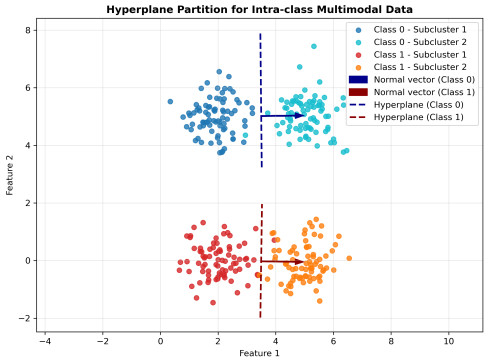
Multimodal linear discriminant analysis(LDA), as an important method for cross-modal dimensionality reduction and feature fusion, has been extensively studied and applied in the field of pattern recognition. In this paper, a geometric partitioning-based multimodal linear discriminant analysis (GMLDA) method is proposed. The hyperplanes are constructed to partition the multimodal data within each class. The kernel principal component directions are used to determine the normal vectors of the hyperplanes, and they are served as the intra-class partitioning directions. The key point of the proposed method is the combination of hyperplanes, which makes the sample distribution within each modality more compact while increasing the separation between different modalities. Numerical results demonstrate the efficiency of the proposed GMLDA method by comparison with other multimodal LDA methods.
Citation: Xinyi Han, Chaojie Wang. Geometric partitioning-based multimodal linear discriminant analysis[J]. AIMS Mathematics, 2026, 11(8): 26168-26185. doi: 10.3934/math.20261048
Multimodal linear discriminant analysis(LDA), as an important method for cross-modal dimensionality reduction and feature fusion, has been extensively studied and applied in the field of pattern recognition. In this paper, a geometric partitioning-based multimodal linear discriminant analysis (GMLDA) method is proposed. The hyperplanes are constructed to partition the multimodal data within each class. The kernel principal component directions are used to determine the normal vectors of the hyperplanes, and they are served as the intra-class partitioning directions. The key point of the proposed method is the combination of hyperplanes, which makes the sample distribution within each modality more compact while increasing the separation between different modalities. Numerical results demonstrate the efficiency of the proposed GMLDA method by comparison with other multimodal LDA methods.

| [1] |
R. A. Fisher, The use of multiple measurements in taxonomic problems, Annals of Eugenics, 7 (1936), 179–188. https://doi.org/10.1111/j.1469-1809.1936.tb02137.x doi: 10.1111/j.1469-1809.1936.tb02137.x

|
| [2] |
J. Wen, X. Z. Fang, J. R. Cui, L. K. Fei, K. Yan, Y. Chen, et al., Robust sparse linear discriminant analysis, IEEE T. Circ. Syst. Vid., 29 (2019), 390–403. https://doi.org/10.1109/TCSVT.2018.2799214 doi: 10.1109/TCSVT.2018.2799214
|
| [3] |
J. Y. Wang, L. Wang, F. P. Nie, X. L. Li, A novel formulation of trace ratio linear discriminant analysis, IEEE T. Neur. Net. Lear., 33 (2022), 5568–5578. https://doi.org/10.1109/tnnls.2021.3071030 doi: 10.1109/tnnls.2021.3071030
|
| [4] |
Y. W. Pang, S. Wang, Y. Yuan, Learning regularized LDA by clustering, IEEE T. Neur. Net. Lear., 25 (2014), 2191–2201. https://doi.org/10.1109/tnnls.2014.2306844 doi: 10.1109/tnnls.2014.2306844
|
| [5] |
S. Boutemedjet, N. Bouguila, D. Ziou, A hybrid feature extraction selection approach for high-dimensional non-Gaussian data clustering, IEEE T. Pattern Anal., 31 (2009), 1429–1443. https://doi.org/10.1109/tpami.2008.155 doi: 10.1109/tpami.2008.155
|
| [6] | M. Sugiyama, Dimensionality reduction of multimodal labeled data by local fisher discriminant analysis, J. Mach. Learn. Res., 8 (2007), 1027–1061. |
| [7] |
F. Zhu, J. B. Gao, J. Yang, N. Ye, Neighborhood linear discriminant analysis, Pattern Recogn., 123 (2022), 108422. https://doi.org/10.1016/j.patcog.2021.108422 doi: 10.1016/j.patcog.2021.108422
|
| [8] |
Y. Zhou, S. L. Sun, Manifold partition discriminant analysis, IEEE T. Cybernetics, 47 (2017), 830–840. https://doi.org/10.1109/tcyb.2016.2529299 doi: 10.1109/tcyb.2016.2529299
|
| [9] |
T. Hastie, R. Tibshirani, Discriminant analysis by Gaussian mixtures, J. R. Stat. Soc. B, 58 (1996), 155–176. https://doi.org/10.1111/j.2517-6161.1996.tb02073.x doi: 10.1111/j.2517-6161.1996.tb02073.x
|
| [10] |
M. L. Zhu, A. M. Martinez, Subclass discriminant analysis, IEEE T. Pattern Anal., 28 (2006), 1274–1286. https://doi.org/10.1109/tpami.2006.172 doi: 10.1109/tpami.2006.172
|
| [11] |
N. Gkalelis, V. Mezaris, I. Kompatsiaris, T. Stathaki, Mixture subclass discriminant analysis link to restricted gaussian model and other generalizations, IEEE T. Neur. Net. Lear., 24 (2013), 8–21. https://doi.org/10.1109/tnnls.2012.2216545 doi: 10.1109/tnnls.2012.2216545
|
| [12] |
Y. T. Tao, J. Yang, H. Y. Chang, Enhanced iterative projection for subclass discriminant analysis under EM-alike framework, Pattern Recogn., 47 (2014), 1113–1125. https://doi.org/10.1016/j.patcog.2013.07.001 doi: 10.1016/j.patcog.2013.07.001
|
| [13] |
K. Chumachenko, J. Raitoharju, A. Iosifidis, M. Gabbouj, Speed-up and multi-view extensions to subclass discriminant analysis, Pattern Recogn., 111 (2021), 107660. https://doi.org/10.1016/j.patcog.2020.107660 doi: 10.1016/j.patcog.2020.107660
|
| [14] |
H. F. Zhang, K. Liu, Y. H. Zhang, J. H. Lin, TRANS-CNN-based gesture recognition for mmWave radar, Sensors, 24 (2024), 1800. https://doi.org/10.3390/s24061800 doi: 10.3390/s24061800
|
| [15] |
R. X. Lu, Y. J. Cai, J. Y. Zhu, F. P. Nie, H. Yang, Dimension reduction of multimodal data by auto-weighted local discriminant analysis, Neurocomputing, 461 (2021), 27–40. https://doi.org/10.1016/j.neucom.2021.06.035 doi: 10.1016/j.neucom.2021.06.035
|
| [16] |
H. Wan, H. Wang, G. D. Guo, X. Wei, Separability-oriented subclass discriminant analysis, IEEE T. Pattern Anal., 40 (2018), 409–422. https://doi.org/10.1109/tpami.2017.2672557 doi: 10.1109/tpami.2017.2672557
|
| [17] |
Y. Zeng, Z. D. Jia, W. Liang, S. F. Gu, Fault diagnosis based on variable-weighted separability-oriented subclass discriminant analysis, Comput. Chem. Eng., 129 (2019), 106514. https://doi.org/10.1016/j.compchemeng.2019.106514 doi: 10.1016/j.compchemeng.2019.106514
|
| [18] |
B. Schölkopf, A. Smola, K.-R. Müller, Nonlinear component analysis as a kernel eigenvalue problem, Neural Comput., 10 (1998), 1299–1319. https://doi.org/10.1162/089976698300017467 doi: 10.1162/089976698300017467
|
| [19] |
J. H. Friedman, Regularized discriminant analysis, J. Am. Stat. Assoc., 84 (1989), 165–175. https://doi.org/10.1080/01621459.1989.10478752 doi: 10.1080/01621459.1989.10478752
|
Figures(2) / Tables(7)

Xinyi Han, Chaojie Wang. Geometric partitioning-based multimodal linear discriminant analysis[J]. AIMS Mathematics, 2026, 11(8): 26168-26185. doi: 10.3934/math.20261048





 DownLoad: