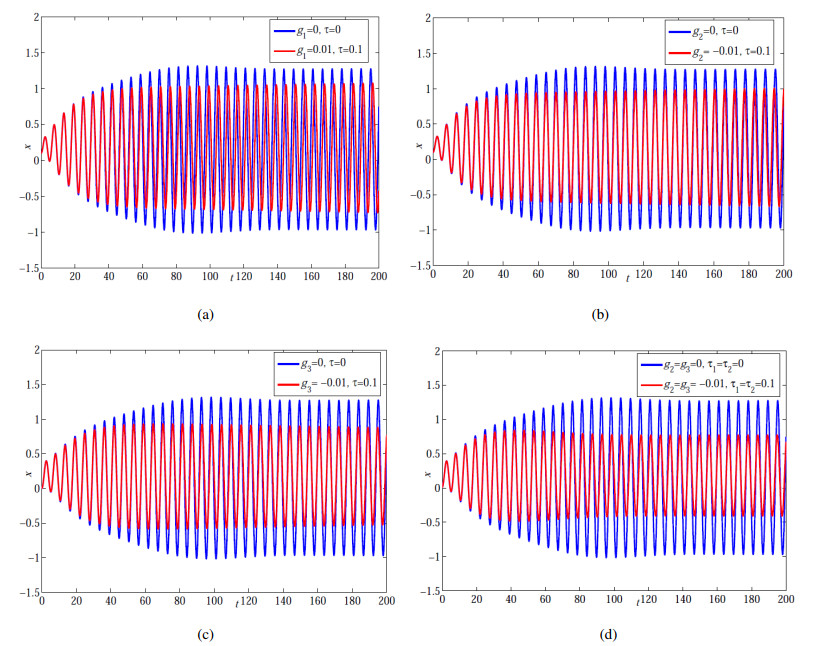
Fractional-order modeling has become a standard approach to characterize long-memory and hereditary behaviors in macroeconomic and financial fluctuation systems. This paper constructed a fractional-order Duffing-Holmes economic fluctuation model subjected to constant and periodic compound excitations. Constant excitation characterized long-term fiscal inertia and steady investment trends, whereas periodic excitation represented business cycles and seasonal economic shocks. The multiple scale method was adopted to derive the primary resonance amplitude-frequency relation. The influences of fractional order, damping, and stiffness parameters on resonant intensity and system stability were systematically examined. To suppress the excessive oscillation, jump, and hysteresis of economic cycles, four nonlinear time-delayed feedback schemes including displacement, velocity, acceleration, and hybrid velocity-acceleration feedback were proposed. Analytical amplitude-frequency solutions under each control strategy were derived. Numerical results from amplitude-frequency curves and time-domain trajectories demonstrated that all controllers can effectively reduce resonance magnitude and eliminate multivalued bifurcation. In particular, the hybrid feedback scheme exhibited the strongest suppression effect. The findings provided theoretical support and policy reference for countercyclical regulation of fractional-order macroeconomic fluctuation systems.
Citation: Xiaorong Zhang, Lihan Jia, Zhoujin Cui. Primary resonance and multi-strategy time-delayed feedback control for fractional-order economic fluctuation systems[J]. AIMS Mathematics, 2026, 11(7): 23282-23307. doi: 10.3934/math.2026939
Fractional-order modeling has become a standard approach to characterize long-memory and hereditary behaviors in macroeconomic and financial fluctuation systems. This paper constructed a fractional-order Duffing-Holmes economic fluctuation model subjected to constant and periodic compound excitations. Constant excitation characterized long-term fiscal inertia and steady investment trends, whereas periodic excitation represented business cycles and seasonal economic shocks. The multiple scale method was adopted to derive the primary resonance amplitude-frequency relation. The influences of fractional order, damping, and stiffness parameters on resonant intensity and system stability were systematically examined. To suppress the excessive oscillation, jump, and hysteresis of economic cycles, four nonlinear time-delayed feedback schemes including displacement, velocity, acceleration, and hybrid velocity-acceleration feedback were proposed. Analytical amplitude-frequency solutions under each control strategy were derived. Numerical results from amplitude-frequency curves and time-domain trajectories demonstrated that all controllers can effectively reduce resonance magnitude and eliminate multivalued bifurcation. In particular, the hybrid feedback scheme exhibited the strongest suppression effect. The findings provided theoretical support and policy reference for countercyclical regulation of fractional-order macroeconomic fluctuation systems.

| [1] |
R. M. Goodwin, A non-linear theory of the cycle, Rev. Econ. Stat., 32 (1950), 316–320. https://doi.org/10.1007/978-1-349-05504-3_5 doi: 10.1007/978-1-349-05504-3_5

|
| [2] |
M. Kalecki, A macrodynamic theory of business cycles, Econometrica, 3 (1935), 327–344. https://doi.org/10.2307/1905325 doi: 10.2307/1905325
|
| [3] |
N. Kaldor, A model of the trade cycle, Econ. J., 50 (1940), 78–92. https://doi.org/10.2307/2225740 doi: 10.2307/2225740
|
| [4] |
R. M. Goodwin, The nonlinear accelerator and the persistence of business cycles, Econometrica: J. Economet. Soc., 19 (1951), 1–17. https://doi.org/10.2307/1907905 doi: 10.2307/1907905
|
| [5] | G. Gabisch, H. W. Lorenz, Business cycle theory: A survey of methods and concepts, Springer Science & Business Media, 1989. https://doi.org/10.1007/978-3-642-74715-1 |
| [6] | T. Puu, Nonlinear economic dynamics, Berlin: Springer, 1993. https://doi.org/10.1007/978-3-642-97450-2 |
| [7] |
T. Puu, I. Sushko, A business cycle model with cubic nonlinearity, Chaos Soliton. Fract., 19 (2004), 597–612. https://doi.org/10.1016/S0960-0779(03)00132-2 doi: 10.1016/S0960-0779(03)00132-2
|
| [8] |
Y. Takeuchi, T. Yamamura, Stability analysis of the Kaldor model with time delays: Monetary policy and government budget constraint, Nonlinear Anal.-Real, 5 (2004), 277–308. https://doi.org/10.1016/s1468-1218(03)00039-7 doi: 10.1016/s1468-1218(03)00039-7
|
| [9] |
R. Franke, P. Flaschel, C. R. Proano, Wage-price dynamics and income distribution in a semi-structural Keynes-Goodwin model, Struct. Change Econ. D., 17 (2006), 452–465. https://doi.org/10.1016/j.strueco.2006.08.001 doi: 10.1016/j.strueco.2006.08.001
|
| [10] |
J. Hartwig, Semi-endogenous growth dynamics in a macroeconomic model with delays, Struct. Change Econ. D., 62 (2022), 538–551. https://doi.org/10.1016/J.STRUECO.2022.06.009 doi: 10.1016/J.STRUECO.2022.06.009
|
| [11] |
Z. F. Lin, W. Xu, Q. Han, Stability analysis of economic fluctuation model with fractional derivative, J. Dynam. Control, 15 (2017), 242–249. https://doi.org/ 10.6052/1672-6553-2017-029 doi: 10.6052/1672-6553-2017-029
|
| [12] |
Z. Yao, K. Sun, S. He, Dynamics of fractional-order chaotic rocard relaxation econometric system, Int. J. Bifurcat. Chaos, 32 (2022), 2250195. https://doi.org/10.1142/s0218127422501954 doi: 10.1142/s0218127422501954
|
| [13] |
N. Laskin, Fractional market dynamics, Physica A, 287 (2000), 482–492. https://doi.org/10.1016/S0378-4371(00)00387-3 doi: 10.1016/S0378-4371(00)00387-3
|
| [14] |
W. C. Chen, Nonlinear dynamics and chaos in a fractional-order financial system, Chaos Soliton. Fract., 36 (2008), 1305–1314. https://doi.org/10.1016/j.chaos.2006.07.051 doi: 10.1016/j.chaos.2006.07.051
|
| [15] |
S. A. Ganiyu, M. Ngungu, R. Bottey, S. D. Mensah, Modeling cross-market capital flows using fractional competition dynamics, Front. Appl. Math. Stat., 12 (2026), 1790416. https://doi.org/10.3389/fams.2026.1790416 doi: 10.3389/fams.2026.1790416
|
| [16] |
M. F. Danca, R. Garrappa, W. K. S. Tang, G. Chen, Sustaining stable dynamics of a fractional-order chaotic financial system by parameter switching, Comput. Math. Appl., 66 (2013), 702–716. https://doi.org/ 10.1016/j.camwa.2013.01.028 doi: 10.1016/j.camwa.2013.01.028
|
| [17] |
K. Zhou, Z. H. Wang, L. K. Gao, Y. Sun, T. D. Ma, Robust sliding mode control for fractional-order chaotic economical system with parameter uncertainty and external disturbance, Chinese Phys. B, 24 (2015), 030504. https://doi.org/10.1088/1674-1056/24/3/030504 doi: 10.1088/1674-1056/24/3/030504
|
| [18] |
A. Al-Khedhairi, Dynamical analysis and chaos synchronization of a fractional-order novel financial model based on Caputo-Fabrizio derivative, Eu. Phys. J. Plus, 134 (2019), 532. https://doi.org/10.1140/epjp/i2019-12878-4 doi: 10.1140/epjp/i2019-12878-4
|
| [19] | H. J. Yu, Dynamic analysis, stabilization, and synchronization of an improved fractional-order chaotic financial system with external disturbances, Eng. Lett., 33 (2025), 3809–3817. |
| [20] |
Z. Xu, K. Sun, H. Wang, Dynamics and function projection synchronization for the fractional-order financial risk system, Chaos Soliton. Fract., 188 (2024), 115599. https://doi.org/10.1016/j.chaos.2024.115599 doi: 10.1016/j.chaos.2024.115599
|
| [21] | P. Chen, Trends, shocks, persistent cycles in evolving economy: Business cycle measurement in time-frequency representation, Nonlinear Dynamics and Economics: Proceedings of the Tenth International Symposium in Economic Theory and Econometrics, Cambridge University Press, 1996,307–331. |
| [22] |
V. Zarnowitz, A. Ozyildirim, Time series decomposition and measurement of business cycles, trends and growth cycles, J. Monetary Econ., 53 (2006), 1717–1739. https://doi.org/10.1016/j.jmoneco.2005.03.015 doi: 10.1016/j.jmoneco.2005.03.015
|
| [23] |
A. Bar-Ilan, W. C. Strange, Investment lags, Am. Econ. Rev., 86 (1996), 610–622. https://doi.org/10.2307/3502659 doi: 10.2307/3502659
|
| [24] |
T. Havranek, M. Rusnak, Transmission lags of monetary policy: A meta-analysis, Soc. Sci. Electron. Publishing, 9 (2012), 39–75. https://doi.org/ 10.2139/ssrn.2188438 doi: 10.2139/ssrn.2188438
|
| [25] |
J. A. Holyst, K. Urbanowicz, Chaos control in economical model by time-delayed feedback method, Physica A, 287 (2000), 587–598. https://doi.org/10.1016/S0378-4371(00)00395-2 doi: 10.1016/S0378-4371(00)00395-2
|
| [26] |
L. Borah, K. Dehingia, H. K. Sarmah, A. Phukan, F. A. Rihan, E. Hincal, Stability and bifurcation analysis of a financial dynamical system with time delay, Eur. Phys. J.-Spec. Top., 234 (2025), 1607–1622. https://doi.org/10.1140/epjs/s11734-025-01575-2 doi: 10.1140/epjs/s11734-025-01575-2
|
| [27] |
A. Phukan, K. Dehingia, H. K. Sarmah, L. Borah, Dynamical analysis of a time-delayed financial system with synchronization strategies, Sci. Prog., 109 (2026), 413–418. https://doi.org/10.1177/00368504261423737 doi: 10.1177/00368504261423737
|
| [28] |
Z. Wang, H. Hu, Q. Xu, G. Stepan, Effect of delay combinations on stability and Hopf bifurcation of an oscillator with acceleration-derivative feedback, Int. J. Nonlin. Mech., 94 (2017), 392–399. https://doi.org/10.1016/j.ijnonlinmec.2016.10.008 doi: 10.1016/j.ijnonlinmec.2016.10.008
|
| [29] |
Z. Cui, X. Zhang, W. Zong, Superharmonic resonance analysis and time-delay feedback controllability of a forced fractional Mathieu-Duffing equation, Mediterr. J. Math., 22 (2025), 219. https://doi.org/ 10.1007/s00009-025-02989-x doi: 10.1007/s00009-025-02989-x
|
| [30] |
M. Wang, J. Zhao, R. Wang, C. Qin, P. Liu, Dynamical characterisation of fractional-order Duffing-Holmes systems containing nonlinear damping under constant simple harmonic excitation, Chaos Soliton. Fract., 190 (2025), 115745. https://doi.org/10.1016/j.chaos.2024.115745 doi: 10.1016/j.chaos.2024.115745
|
| [31] |
L. He, X. Wang, Parameters estimation and stability analysis of nonlinear fractional-order economic system based on empirical data, Abstr. Appl. Anal., 2014, 130548. https://doi.org/10.1155/2014/130548 doi: 10.1155/2014/130548
|
| [32] | A. H. Nayfeh, Perturbation method, New York: John Wiley & Sons, 2000. https://doi.org/10.1002/9783527617609 |
| [33] | A. H. Nayfeh, D. T. Mook, Nonlinear oscillations, New York: Wiley-Interscience, 1995. https://doi.org/10.1002/9783527617586 |
| [34] |
Z. Cui, Z. Wang, Primary resonance of a nonlinear fractional model for cerebral aneurysm at the circle of Willis, Nonlinear Dyn., 108 (2022), 4301–4314. https://doi.org/10.1007/s11071-022-07445-z doi: 10.1007/s11071-022-07445-z
|
| [35] | T. Evek, The Fractional-order Goodwin accelerator model, EDAMBA 2021: COVID-19 Recovery: The Need for Speed: Conference Proceedings, 2022,476–486. https://doi.org/10.53465/edamba.2021.9788022549301.476-486 |
| [36] | R. Caponetto, G. Dongola, L. Fortuna, I. Petras, Fractional order systems: Modeling and control applications, New Jersey: World Scientific, 2010. https://doi.org/10.1142/7709 |
| [37] | I. Petras, Fractional-order nonlinear systems: Modeling, analysis and simulation, Beijing: Higher Education Press, 2011. https://doi.org/10.1007/978-3-642-18101-6 |
Figures(5) / Tables(1)

Xiaorong Zhang, Lihan Jia, Zhoujin Cui. Primary resonance and multi-strategy time-delayed feedback control for fractional-order economic fluctuation systems[J]. AIMS Mathematics, 2026, 11(7): 23282-23307. doi: 10.3934/math.2026939





 DownLoad: