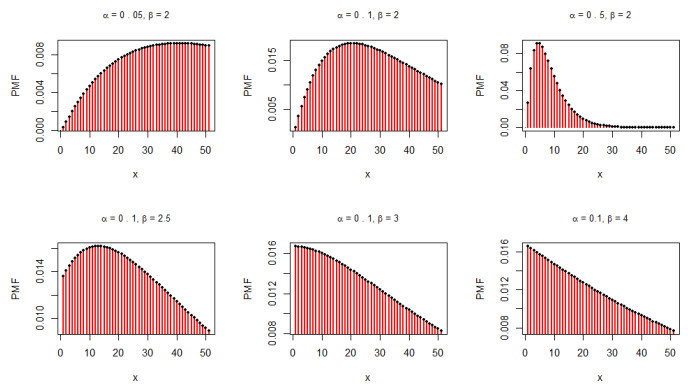
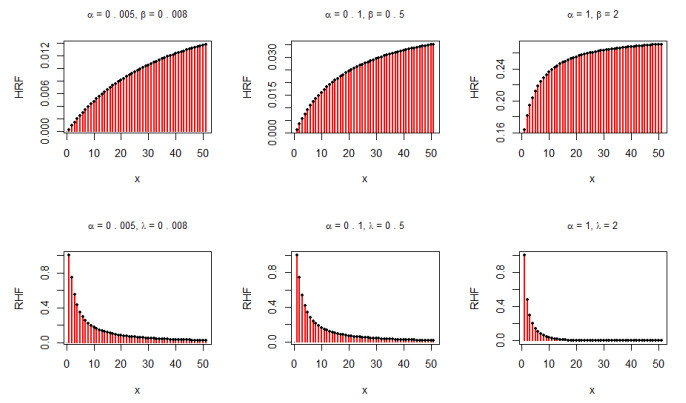
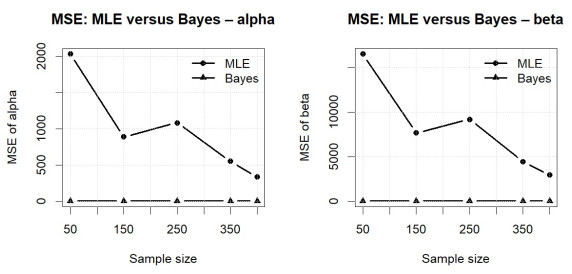
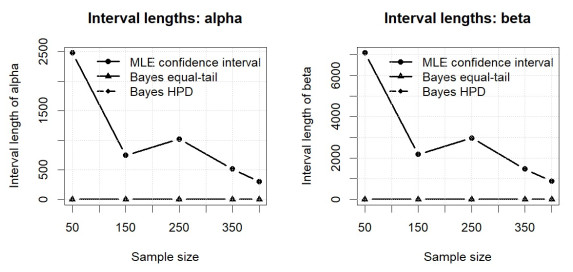
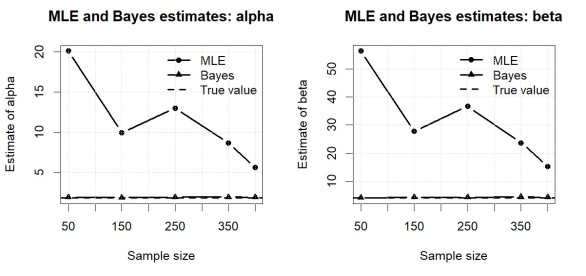
In this study, we introduced a novel discrete probability model, the discrete Ramos–Louzada exponential distribution, obtained by discretizing the survival function of its continuous counterpart. With a flexible two-parameter structure, the model captured diverse behaviors observed in count data. Core distributional properties, including the probability mass function, cumulative distribution function, survival function, hazard rate, and moment-generating function, were derived analytically. Log-concavity and an increasing hazard rate are established, supporting suitability for reliability and lifetime-type counts. Parameters were estimated using the maximum likelihood and Bayesian approaches, and finite-sample performance was evaluated through extensive simulation studies. Practical applicability was illustrated using European corn-borer larvae counts and daily COVID-19 mortality data from South Korea. Comparative goodness-of-fit results against established discrete models demonstrated superior performance, highlighting effectiveness.
Citation: Ahood Abdalrahman Alazwari, Ayşe Metin Karakaş, Fatma Bulut, Eslam Hussam, Muhammad Ahsan-ul-Haq, Samirah Alzubaidi, Amani Alrumayh, M. E. Sobh. New discrete Ramos–Louzada exponential–type distribution with applications to biological and COVID-19 data[J]. AIMS Mathematics, 2026, 11(8): 27018-27055. doi: 10.3934/math.20261083
In this study, we introduced a novel discrete probability model, the discrete Ramos–Louzada exponential distribution, obtained by discretizing the survival function of its continuous counterpart. With a flexible two-parameter structure, the model captured diverse behaviors observed in count data. Core distributional properties, including the probability mass function, cumulative distribution function, survival function, hazard rate, and moment-generating function, were derived analytically. Log-concavity and an increasing hazard rate are established, supporting suitability for reliability and lifetime-type counts. Parameters were estimated using the maximum likelihood and Bayesian approaches, and finite-sample performance was evaluated through extensive simulation studies. Practical applicability was illustrated using European corn-borer larvae counts and daily COVID-19 mortality data from South Korea. Comparative goodness-of-fit results against established discrete models demonstrated superior performance, highlighting effectiveness.

| [1] |
A. Z. Afify, M. Ahsan-ul-Haq, H. M. Aljohani, A. S. Alghamdi, A. Babar, H. W. Gómez, A new one-parameter discrete exponential distribution: properties, inference, and applications to COVID-19 data, J. King Saud Univ.-Sci., 34 (2022), 102199. http://dx.doi.org/10.1016/j.jksus.2022.102199 doi: 10.1016/j.jksus.2022.102199

|
| [2] |
M. Ahsan-ul-Haq, On Poisson moment exponential distribution with applications, Ann. Data Sci., 11 (2024), 137–158. http://dx.doi.org/10.1007/s40745-022-00400-0 doi: 10.1007/s40745-022-00400-0
|
| [3] |
K. Al-Harbi, A. Fayomi, H. Baaqeel, A. Alsuraihi, A novel discrete linear-exponential distribution for modeling physical and medical data, Symmetry, 16 (2024), 1123. http://dx.doi.org/10.3390/sym16091123 doi: 10.3390/sym16091123
|
| [4] |
H. M. Aljohani, F. M. Zaghdoun, M. A. Meraou, A. S. Alharthi, W. A. J. Almohri, Z. I. Kalantan, et al., A novel extension of the exponential distribution with application in modeling complex lifetime and environmental data, Sci. Rep., 15 (2025), 33581. http://dx.doi.org/10.1038/s41598-025-18711-6 doi: 10.1038/s41598-025-18711-6
|
| [5] |
I. Alkhairy, Classical and Bayesian inference for the discrete Poisson Ramos-Louzada distribution with application to COVID-19 data, Math. Biosci. Eng., 20 (2023), 14061–14080. http://dx.doi.org/10.3934/mbe.2023628 doi: 10.3934/mbe.2023628
|
| [6] |
A. Balubaid, H. Klakattawi, D. Alsulami, On the discretization of the Weibull-G family of distributions: properties, parameter estimates, and applications of a new discrete distribution, Symmetry, 16 (2024), 1519. http://dx.doi.org/10.3390/sym16111519 doi: 10.3390/sym16111519
|
| [7] | J. M. Bernardo, A. F. M. Smith, Bayesian theory, John Wiley and Sons, 2000. |
| [8] | W. Bodhisuwan, S. Sangpoom, The discrete weighted Lindley distribution, 2016 12th International Conference on Mathematics, Statistics, and Their Applications (ICMSA), IEEE, 2016, 99–103. http://dx.doi.org/10.1109/ICMSA.2016.7954317 |
| [9] |
B. P. Carlin, T. A. Louis, Bayes and empirical Bayes methods for data analysis, Stat. Comput., 7 (1997), 153–154. http://dx.doi.org/10.1023/A:1018577817064 doi: 10.1023/A:1018577817064
|
| [10] |
A. S. Eldeeb, M. Ahsan-ul-Haq, M. S. Eliwa, A discrete Ramos–Louzada distribution for asymmetric and over-dispersed data with leptokurtic-shaped: properties and various estimation techniques with inference, AIMS Math., 7 (2022), 1726–1741. http://dx.doi.org/10.3934/math.2022099 doi: 10.3934/math.2022099
|
| [11] |
M. El-Morshedy, M. S. Eliwa, H. Nagy, A new two-parameter exponentiated discrete Lindley distribution: properties, estimation and applications, J. Appl. Stat., 47 (2020), 354–375. http://dx.doi.org/10.1080/02664763.2019.1638893 doi: 10.1080/02664763.2019.1638893
|
| [12] |
M. El-Morshedy, M. S. Eliwa, E. Altun, Discrete Burr-Hatke distribution with properties, estimation methods and regression model, IEEE Access, 8 (2020), 74359–74370. http://dx.doi.org/10.1109/ACCESS.2020.2988431 doi: 10.1109/ACCESS.2020.2988431
|
| [13] | J. K. Ghosh, R. V. Ramamoorthi, Bayesian nonparametrics, Springer, 2003. http://dx.doi.org/10.1007/b97842 |
| [14] |
A. M. Karakaş, F. Bulut, The new Gompertz distribution model and applications, Symmetry, 17 (2025), 843. http://dx.doi.org/10.3390/sym17060843 doi: 10.3390/sym17060843
|
| [15] |
A. M. Karakaş, F. Bulut, The half-logistic generalized power Lindley distribution: theory and applications, Symmetry, 17 (2025), 1936. http://dx.doi.org/10.3390/sym17111936 doi: 10.3390/sym17111936
|
| [16] |
T. Nakagawa, S. Osaki, The discrete Weibull distribution, IEEE Trans. Reliab., 24 (1975), 300–301. http://dx.doi.org/10.1109/TR.1975.5214915. doi: 10.1109/TR.1975.5214915
|
| [17] | S. D. Poisson, Recherches sur la probabilité des jugements en matière criminelle et en matière civile: précédées des règles générales du calcul des probabilités, Bachelier, Paris, 1837. |
| [18] | C. P. Robert, G. Casella, Monte Carlo statistical methods, 2 Eds., Springer, 2004. http://dx.doi.org/10.1007/978-1-4757-4145-2 |
| [19] |
D. Roy, Discrete Rayleigh distribution, IEEE Trans. Reliab., 53 (2004), 255–260. http://dx.doi.org/10.1109/TR.2004.829161 doi: 10.1109/TR.2004.829161
|
Figures(20) / Tables(20)

Ahood Abdalrahman Alazwari, Ayşe Metin Karakaş, Fatma Bulut, Eslam Hussam, Muhammad Ahsan-ul-Haq, Samirah Alzubaidi, Amani Alrumayh, M. E. Sobh. New discrete Ramos–Louzada exponential–type distribution with applications to biological and COVID-19 data[J]. AIMS Mathematics, 2026, 11(8): 27018-27055. doi: 10.3934/math.20261083





 DownLoad: