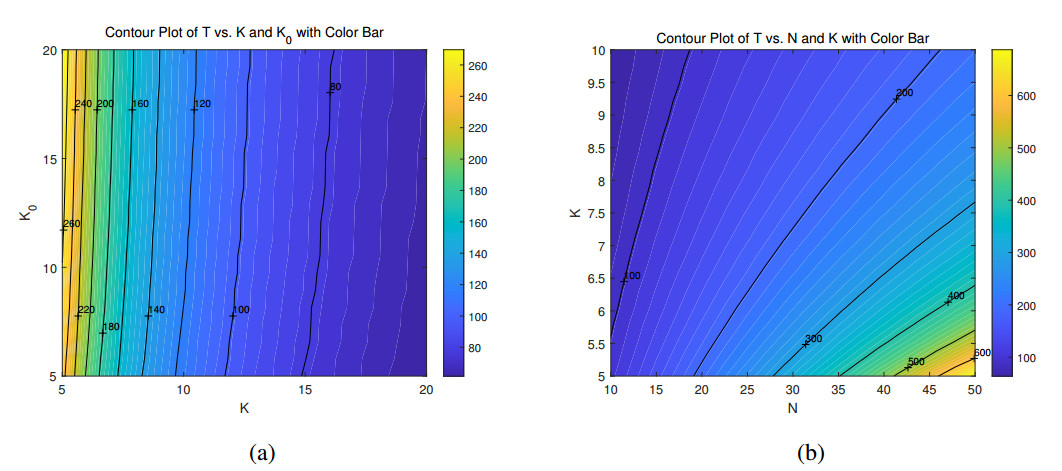
This study presents a modified Cucker-Smale system with external perturbation and intermittent control. First, a new finite-time stability lemma is developed, in which the settling time is determined only by the control interval's duration. Second, by imposing an assumption on external perturbation, the system can achieve collision-avoidance flocking. Third, finite-time flocking is achieved without the sign function, which effectively avoids the undesirable chattering phenomenon in the system. Finally, numerical simulations validate the theoretical analysis, and parameter sensitivity analysis offers important guidance for practical applications such as unmanned aerial vehicle (UAV) formations.
Citation: Qiming Liu, Jianlong Ren, Shihua Zhang. Finite-time flocking of a Cucker-Smale system with external perturbation and intermittent control[J]. AIMS Mathematics, 2025, 10(3): 6406-6428. doi: 10.3934/math.2025292
This study presents a modified Cucker-Smale system with external perturbation and intermittent control. First, a new finite-time stability lemma is developed, in which the settling time is determined only by the control interval's duration. Second, by imposing an assumption on external perturbation, the system can achieve collision-avoidance flocking. Third, finite-time flocking is achieved without the sign function, which effectively avoids the undesirable chattering phenomenon in the system. Finally, numerical simulations validate the theoretical analysis, and parameter sensitivity analysis offers important guidance for practical applications such as unmanned aerial vehicle (UAV) formations.

| [1] |
P. Berthold, A. J. Helbig, G. Mohr, U. Querner, Rapid microevolution of migratory behaviour in a wild bird species, Nature, 360 (1992), 668–670. https://doi.org/10.1038/360668a0 doi: 10.1038/360668a0

|
| [2] | B. L. Partridge, The structure and function of fish schools, Sci. Am., 246 (1982), 114–123. |
| [3] |
X. Dong, B. Yu, Z. Shi, Y. Zhong, Time-varying formation control for unmanned aerial vehicles: Theories and applications, IEEE T. Contr. Syst. T., 23 (2015), 340–348. http://dx.doi.org/10.1109/TCST.2014.2314460 doi: 10.1109/TCST.2014.2314460
|
| [4] | C. W. Reynolds, Flocks, herds and schools: A distributed behavioral model, Proceedings of the 14th annual conference on Computer graphics and interactive techniques, 21 (1987), 25–34. https://doi.org/10.1145/37402.37406 |
| [5] |
T. Vicsek, A. Czirók, E. B. Jacob, I. Cohen, O. Shochet, Novel type of phase transition in a system of self-driven particles, Phys. Rev. Lett., 75 (1995), 1226–1229. https://doi.org/10.1103/PhysRevLett.75.1226 doi: 10.1103/PhysRevLett.75.1226
|
| [6] |
F. Cucker, S. Smale, Emergent behavior in flocks, IEEE T. Automat. Contr., 52 (2007), 852–862. http://dx.doi.org/10.1109/TAC.2007.895842 doi: 10.1109/TAC.2007.895842
|
| [7] |
J. Cho, S. Y. Ha, F. Huang, C. Jin, D. Ko, Emergence of bi-cluster flocking for the Cucker-Smale model, Math. Mod. Meth. Appl. S., 26 (2016), 1191–1218. https://doi.org/10.1142/S0218202516500287 doi: 10.1142/S0218202516500287
|
| [8] |
D. Fang, S. Y. Ha, S. Jin, Emergent behaviors of the Cucker-Smale ensemble under attractive-repulsive couplings and Rayleigh frictions, Math. Mod. Meth. Appl. S., 29 (2019), 1349–1385. https://doi.org/10.1142/S0218202519500234 doi: 10.1142/S0218202519500234
|
| [9] |
C. B. Lian, G. L. Hou, B. Ge, K. Zhou, Multi-cluster flocking behavior for a class of Cucker-Smale model with a perturbation, J. Appl. Anal. Comput., 11 (2021), 1825–1851. http://dx.doi.org/10.11948/20200234 doi: 10.11948/20200234
|
| [10] |
J. Wu, Y. Liu, Flocking behaviours of a delayed collective model with local rule and critical neighbourhood situation, Math. Comput. Simulat., 179 (2021), 238–252. https://doi.org/10.1016/j.matcom.2020.08.015 doi: 10.1016/j.matcom.2020.08.015
|
| [11] |
J. Haskovec, Flocking in the Cucker-Smale model with self-delay and nonsymmetric interaction weights, J. Math. Anal. Appl., 514 (2022), 126261. https://doi.org/10.1016/j.jmaa.2022.126261 doi: 10.1016/j.jmaa.2022.126261
|
| [12] |
Z. Zhang, X. Yin, Z. Gao, Non-flocking and flocking for the Cucker-Smale model with distributed time delays, J. Franklin I., 360 (2023), 8788–8805. https://doi.org/10.1016/j.jfranklin.2022.03.028 doi: 10.1016/j.jfranklin.2022.03.028
|
| [13] |
X. Li, Y. Liu, J. Wu, Flocking and pattern motion in a modified Cucker-Smale model, B. Korean. Math. Soc., 53 (2016), 1327–1339. https://doi.org/10.4134/BKMS.b150629 doi: 10.4134/BKMS.b150629
|
| [14] |
H. Liu, X. Wang, Y. Liu, X. Li, On non-collision flocking and line-shaped spatial configuration for a modified singular Cucker-Smale model, Nonlinear Sci. Num. Simulat., 75 (2019), 280–301. https://doi.org/10.1016/j.cnsns.2019.04.006 doi: 10.1016/j.cnsns.2019.04.006
|
| [15] |
Y. P. Choi, D. Kalise, J. Peszek, A. A. Peters, A collisionless singular Cucker-Smale model with decentralized formation control, SIAM J. Appl. Dyn. Syst., 18 (2019), 1954–1981. https://doi.org/10.1137/19M1241799 doi: 10.1137/19M1241799
|
| [16] |
S. Y. Ha, T. Ha, J. H. Kim, Emergent behavior of a Cucker-Smale type particle model with nonlinear velocity couplings, IEEE T. Automat. Contr., 55 (2010), 1679–1683. http://dx.doi.org/10.1109/TAC.2010.2046113 doi: 10.1109/TAC.2010.2046113
|
| [17] |
I. Markou, Collision-avoiding in the singular Cucker-Smale model with nonlinear velocity couplings, Discrete Cont. Dyn.-A., 38 (2018), 5245–5260. http://dx.doi.org/10.3934/dcds.2018232 doi: 10.3934/dcds.2018232
|
| [18] |
X. Yin, D. Yue, Q. L. Han, The Cucker-Smale model with nonlinear velocity couplings and power-law attractive potentials, IEEE T. Automat. Contr., 68 (2023), 5752–5758. http://dx.doi.org/10.1109/TAC.2022.3226714 doi: 10.1109/TAC.2022.3226714
|
| [19] |
D. Chen, W. Li, X. Liu, W. Yu, Y. Sun, Effects of measurement noise on flocking dynamics of Cucker-Smale systems, IEEE T. Circuits-II, 67 (2020), 2064–2068. http://dx.doi.org/10.1109/TCSII.2019.2947788 doi: 10.1109/TCSII.2019.2947788
|
| [20] |
R. Zhao, Q. Liu, H. Zhang, Flocking and collision avoidance problem of a singular Cucker–Smale model with external perturbations, Phys. A, 590 (2022), 126718. https://doi.org/10.1016/j.physa.2021.126718 doi: 10.1016/j.physa.2021.126718
|
| [21] |
L. Shi, Z. Ma, S. Yan, Y. Zhou, Cucker-Smale flocking behavior for multiagent networks with coopetition interactions and communication delays, IEEE T. Syst. Man Cy.-S., 54 (2024), 5824–5833. http://dx.doi.org/10.1109/TSMC.2024.3409700 doi: 10.1109/TSMC.2024.3409700
|
| [22] |
L. Shi, Z. Ma, S. Yan, T. Ao, Flocking dynamics for cooperation-antagonism multi-agent networks subject to limited communication resources, IEEE T. Circuits-I, 71 (2024), 1396–1405. http://dx.doi.org/10.1109/TCSI.2023.3347073 doi: 10.1109/TCSI.2023.3347073
|
| [23] |
Y. Han, D. Zhao, Y. Sun, Finite-time flocking problem of a Cucker-smale-type self-propelled particle model, Complexity, 21 (2016), 354–361. https://doi.org/10.1002/cplx.21747 doi: 10.1002/cplx.21747
|
| [24] |
H. Liu, X. Wang, X. Li, Y. Liu, Finite-time flocking and collision avoidance for second-order multi-agent systems, Int. J. Syst. Sci., 51 (2020), 102–115. https://doi.org/10.1080/00207721.2019.1701133 doi: 10.1080/00207721.2019.1701133
|
| [25] |
H. Zhang, P. Nie, Y. Sun, Y. Shi, Fixed-time flocking problem of a Cucker-Smale type self-propelled particle model, J. Franklin I., 357 (2020), 7054–7068. https://doi.org/10.1016/j.jfranklin.2020.05.012 doi: 10.1016/j.jfranklin.2020.05.012
|
| [26] |
Q. Xiao, H. Liu, Z. Xu, Z. Ouyang, On collision avoiding fixed-time flocking with measurable diameter to a Cucker-Smale-type self-propelled particle model, Complexity, 2020 (2020), 1–12. https://doi.org/10.1155/2020/1094950 doi: 10.1155/2020/1094950
|
| [27] |
Q. Huang, X. Zhang, On the stochastic singular Cucker-Smale model: Well-posedness, collision-avoidance and flocking, Math. Mod. Meth. Appl. S., 32 (2022), 43–99. https://doi.org/10.1142/S0218202522500026 doi: 10.1142/S0218202522500026
|
| [28] |
M. Friesen, O. Kutoviy, Stochastic Cucker-Smale flocking dynamics of jump-type, Kinet. Relat. Mod., 13 (2020), 211–247. http://dx.doi.org/10.3934/krm.2020008 doi: 10.3934/krm.2020008
|
| [29] |
L. Ru, X. Li, Y. Liu, X. Wang, Finite-time flocking of Cucker-Smale model with unknown intrinsic dynamics, Discrete Cont. Dyn.-B, 28 (2023), 3680–3696. http://dx.doi.org/10.3934/dcdsb.2022237 doi: 10.3934/dcdsb.2022237
|
| [30] |
Q. Liu, H. Zhang, X. Shi, Collision-avoiding fixed-time flocking of a singular cucker-smale system with periodic intermittent control, J. Franklin I., 361 (2024), 106617. https://doi.org/10.1016/j.jfranklin.2024.01.018 doi: 10.1016/j.jfranklin.2024.01.018
|
| [31] |
M. Hui, J. Zhang, H. H. C. Iu, R. Yao, L. Bai, A novel intermittent sliding mode control approach to finite-time synchronization of complex-valued neural networks, Neurocomputing, 513 (2022), 181–193. https://doi.org/10.1016/j.neucom.2022.09.111 doi: 10.1016/j.neucom.2022.09.111
|
| [32] |
Y. Dong, J. Chen, J. Cao, Fixed-time pinning synchronization for delayed complex networks under completely intermittent control, J. Franklin I., 359 (2022), 7708–7732. https://doi.org/10.1016/j.jfranklin.2022.08.010 doi: 10.1016/j.jfranklin.2022.08.010
|
| [33] | E. F. Beckenbach, R. Bellman, Inequalities, Springer, 1961. https://doi.org/10.1007/978-3-642-64971-4 |
| [34] |
L. Ru, X. Xue, Flocking of cucker-smale model with intrinsic dynamics, Discrete Cont. Dyn.-B, 22 (2017), 1–19. http://dx.doi.org/10.3934/dcdsb.2019168 doi: 10.3934/dcdsb.2019168
|
| [35] |
R. Zhao, Y. Liu, X. Wang, X. Xiong, Strong stochastic flocking with noise under long-range fat tail communication, J. Appl. Math. Comput., 70 (2024), 4219–4247. https://doi.org/10.1007/s12190-024-02128-x doi: 10.1007/s12190-024-02128-x
|

Figures(10) / Tables(1)

Qiming Liu, Jianlong Ren, Shihua Zhang. Finite-time flocking of a Cucker-Smale system with external perturbation and intermittent control[J]. AIMS Mathematics, 2025, 10(3): 6406-6428. doi: 10.3934/math.2025292





 DownLoad: