Oily effluent treatment is a critical service for the safe, compliant and sustainable operation of petrochemical complexes. This work presents the diagnosis and recovery program of the oily wastewater treatment plant (locally designated "OILY") of a petrochemical complex in the south of the province of Buenos Aires, Argentina, a two-train physical–mechanical system (gravity/centrifugal primary separation, sand–anthracite coalescing filtration, and gas-stripping tertiary separation) with a nominal capacity of 25 m3/h per train. At the start of the study, the unit operated well below design, with recurrent out-of-specification inlet events, premature filter saturation, high differential pressure across the coalescing beds, chronic failures of the on-line total organic carbon (TOC) analyzer, a control-logic flaw in the distributed control system that could trigger relief-device activation, and weak operational discipline. A structured methodology combining historical trend analysis, field surveys, expert interviews, and review of computerized maintenance management records was applied to identify root causes and to prioritize corrective actions. Implemented measures included reinforced sampling routines and operational discipline, correction of the control logic, a prioritized equipment-reliability list, internal steam cleaning of plugged equipment and lines, and updated operating procedures; additional structural actions (coalescing-media replacement and TOC-analyzer upgrade) are in progress. In 2025, the mass of oily water sent to external treatment was 24.2% lower for Cracker 1 and 4.4% lower for Cracker 2 than in 2024, with an associated realized saving of approximately USD 3,588. Under restored design operation, the projected gross avoided-disposal benefit is nearly USD 21,100 per year; capital and incremental internal operating costs are not included in this screening estimate. The case illustrates how a diagnosis-driven recovery program can improve the operational and environmental performance of existing industrial treatment assets and contribute to more sustainable and resilient operation, consistent with key Industry 5.0 principles.
Citation: Rocío Iampolsky, Diego Rossit, Roberto A. Castaño. Diagnosis-driven recovery of an oily wastewater treatment plant: Cutting external disposal and improving operational performance in a petrochemical complex[J]. Clean Technologies and Recycling, 2026, 6(3): 289-312. doi: 10.3934/ctr.2026012
Oily effluent treatment is a critical service for the safe, compliant and sustainable operation of petrochemical complexes. This work presents the diagnosis and recovery program of the oily wastewater treatment plant (locally designated "OILY") of a petrochemical complex in the south of the province of Buenos Aires, Argentina, a two-train physical–mechanical system (gravity/centrifugal primary separation, sand–anthracite coalescing filtration, and gas-stripping tertiary separation) with a nominal capacity of 25 m3/h per train. At the start of the study, the unit operated well below design, with recurrent out-of-specification inlet events, premature filter saturation, high differential pressure across the coalescing beds, chronic failures of the on-line total organic carbon (TOC) analyzer, a control-logic flaw in the distributed control system that could trigger relief-device activation, and weak operational discipline. A structured methodology combining historical trend analysis, field surveys, expert interviews, and review of computerized maintenance management records was applied to identify root causes and to prioritize corrective actions. Implemented measures included reinforced sampling routines and operational discipline, correction of the control logic, a prioritized equipment-reliability list, internal steam cleaning of plugged equipment and lines, and updated operating procedures; additional structural actions (coalescing-media replacement and TOC-analyzer upgrade) are in progress. In 2025, the mass of oily water sent to external treatment was 24.2% lower for Cracker 1 and 4.4% lower for Cracker 2 than in 2024, with an associated realized saving of approximately USD 3,588. Under restored design operation, the projected gross avoided-disposal benefit is nearly USD 21,100 per year; capital and incremental internal operating costs are not included in this screening estimate. The case illustrates how a diagnosis-driven recovery program can improve the operational and environmental performance of existing industrial treatment assets and contribute to more sustainable and resilient operation, consistent with key Industry 5.0 principles.

| [1] |
American Public Health Association (APHA), American Water Works Association (AWWA), Water Environment Federation (WEF) (2017) Standard Methods for the Examination of Water and Wastewater, 23rd Ed. Washington, DC: American Public Health Association. |
| [2] |
Tchobanoglous G, Stensel HD, Tsuchihashi R, Burton FL (Metcalf & Eddy) (2014) Wastewater Engineering: Treatment and Resource Recovery, 5th Ed. New York: McGraw-Hill Education. |
| [3] |
Breque M, De Nul L, Petridis A (2021) Industry 5.0: Towards a Sustainable, Human-centric and Resilient European Industry. Luxembourg: Publications Office of the European Union. |
| [4] |
Nahavandi S (2019) Industry 5.0—A human-centric solution. Sustainability 11: 4371. https://doi.org/10.3390/su11164371 doi: 10.3390/su11164371
|
| [5] |
Xu X, Lu Y, Vogel-Heuser B, et al. (2021) Industry 4.0 and Industry 5.0—inception, conception and perception. J Manuf Syst 61: 530–535. https://doi.org/10.1016/j.jmsy.2021.10.006 doi: 10.1016/j.jmsy.2021.10.006
|
| [6] |
Kalantari M, Sadri Moghaddam S, Vafaei F (2023) Global research trends in petrochemical wastewater treatment from 2000 to 2021. Environ Sci Pollut Res 30: 9369–9388. https://doi.org/10.1007/s11356-022-24553-w doi: 10.1007/s11356-022-24553-w
|
| [7] |
Varjani S, Joshi R, Srivastava VK, et al. (2020) Treatment of wastewater from petroleum industry: Current practices and perspectives. Environ Sci Pollut Res 27: 27172–27180. https://doi.org/10.1007/s11356-019-04725-x doi: 10.1007/s11356-019-04725-x
|
| [8] |
Crittenden JC, Trussell RR, Hand DW, et al. (2012) MWH's Water Treatment: Principles and Design, 3rd Ed. Hoboken, NJ: John Wiley & Sons. https://doi.org/10.1002/9781118131473 |
| [9] |
Caro F, Rossit D, Santiviago C, et al. (2026) Cost-performance trade-off analysis of physicochemical phosphorus removal systems for wastewater treatment: A bi-objective optimization approach. Math Biosci Eng 23: 124–147. https://doi.org/10.3934/mbe.2026006 doi: 10.3934/mbe.2026006
|
| [10] |
Moubray J (2001) Reliability-Centred Maintenance, 2nd Ed. New York: Industrial Press. |
| [11] |
Smith R, Hawkins B (2004) Lean Maintenance: Reduce Costs, Improve Quality, and Increase Market Share. Amsterdam: Elsevier Butterworth-Heinemann. https://doi.org/10.1016/B978-0-7506-7779-0.X5000-6 |
| [12] |
Viveros P, Miqueles L, Mena R, et al. (2021) Opportunistic strategy for maintenance interventions planning: A case study in a wastewater treatment plant. Appl Sci 11: 10853. https://doi.org/10.3390/app112210853 doi: 10.3390/app112210853
|
| [13] |
Kristjanpoller F, Cárdenas-Pantoja N, Viveros P, et al. (2021) Criticality analysis based on reliability and failure propagation effect for a complex wastewater treatment plant. Appl Sci 11: 10836. https://doi.org/10.3390/app112210836 doi: 10.3390/app112210836
|
| [14] |
Mena R, Viveros P, Zio E, et al. (2021) An optimization framework for opportunistic planning of preventive maintenance activities. Reliab Eng Syst Saf 215: 107801. https://doi.org/10.1016/j.ress.2021.107801 doi: 10.1016/j.ress.2021.107801
|
| [15] |
Grasso J, Rossit D, Sivori L (2026) A Random Forest algorithm for time prediction in tank inspection in a service company. Rev Fac Ing-Univ Ant 121: e60506. https://doi.org/10.17533/udea.redin.20260506 doi: 10.17533/udea.redin.20260506
|
| [16] |
Peralta-Abarca JdC, Moreno P, Nesmachnow S, et al. (2026) Integrating Lean and Digital Traceability to Reduce Work-in-Process Inventory and Defects in Automotive Support Operations. Oper Res Forum 7: 71. https://doi.org/10.1007/s43069-026-00654-x doi: 10.1007/s43069-026-00654-x
|
| [17] |
Rossit D, Rossit D, Nesmachnow S (2021) Explicit multiobjective evolutionary algorithms for flow shop scheduling with missing operations. Program Comput Soft 47: 615–630. https://doi.org/10.1134/S0361768821080223 doi: 10.1134/S0361768821080223
|
| [18] |
Seader J, Henley E, Roper D (2011) Separation Process Principles: Chemical and Biochemical Operations, 3rd Ed. Hoboken, NJ: John Wiley & Sons. |
| [19] |
Green DW, Perry RH (2008) Perry's Chemical Engineers' Handbook, 8th Ed. New York: McGraw-Hill. |
| [20] |
Sinnott R, Towler G (2020) Chemical Engineering Design, 6th Ed. Oxford: Butterworth-Heinemann. |
| [21] |
Fogler HS (2016) Elements of Chemical Reaction Engineering, 5th Ed. Boston, MA: Prentice Hall. |
| [22] |
U. S. Environmental Protection Agency (2010) Method 1664, Revision B: n-Hexane Extractable Material (HEM; Oil and Grease) and Silica Gel Treated n-Hexane Extractable Material (SGT-HEM) by Extraction and Gravimetry. Washington, DC: U. S. EPA. Available from: https://www.epa.gov/sites/default/files/2015-08/documents/method_1664b_2010.pdf |
| [23] |
Wojnárovits L, Homlok R, Kovács K, et al. (2024) Wastewater characterization: chemical oxygen demand or total organic carbon content measurement? Molecules 29: 405. https://doi.org/10.3390/molecules29020405 doi: 10.3390/molecules29020405
|
| [24] |
Concawe (2022) Assessment of Chemical Oxygen Demand/Total Organic Carbon (COD/TOC) ratios in refinery effluents. Report no. 22/16. Brussels: Concawe. Available from: https://www.concawe.eu/wp-content/uploads/Rpt_22-16.pdf |
| [25] |
Speight JG (2014) The Chemistry and Technology of Petroleum, 5th Ed. Boca Raton, FL: CRC Press. |
| [26] |
Center for Chemical Process Safety (CCPS) (2001) Layers of Protection Analysis: Simplified Process Risk Assessment. New York: American Institute of Chemical Engineers (AIChE). |
| [27] |
Autoridad del Agua de la Provincia de Buenos Aires (ADA), Normativa de vertido para efluentes líquidos industriales. Available from: https://www.gba.gob.ar/ada |
| [28] |
Hach (2025) Water quality analytics: General brochure. Hach. Hach – Water Quality Analytics brochure |
| [29] |
McLeroy LK (2011) Determination of total organic carbons in difficult sample matrices utilizing the supercritical water-oxidation TOC procedure. Texas Engineering Extension Service, Texas A & M University. En Proceedings of the Technical Workshops for the Hydraulic Fracturing Study: Chemical and Analytical Methods. U. S. Environmental Protection Agency. EPA – Technical workshop document. |
Figures(6) / Tables(5)
Rocío Iampolsky, Diego Rossit, Roberto A. Castaño. Diagnosis-driven recovery of an oily wastewater treatment plant: Cutting external disposal and improving operational performance in a petrochemical complex[J]. Clean Technologies and Recycling, 2026, 6(3): 289-312. doi: 10.3934/ctr.2026012

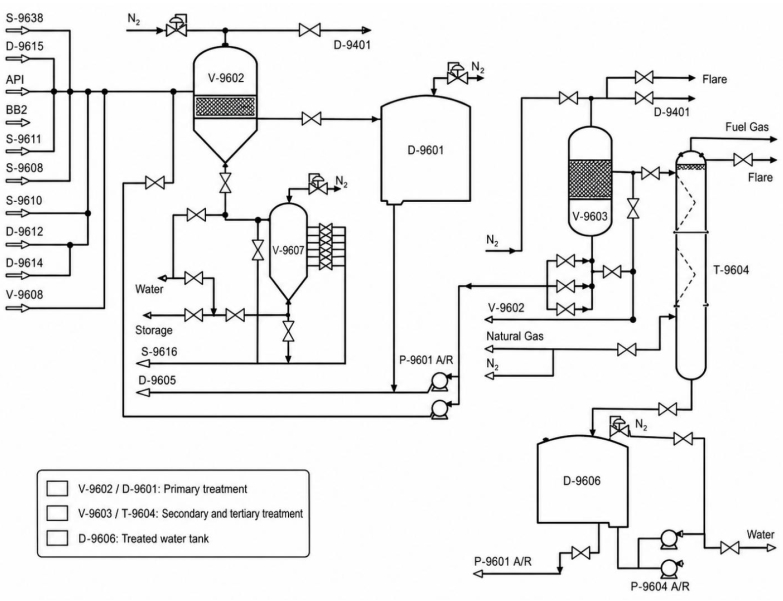
Schematic of one OILY treatment train (primary, secondary and tertiary separation)
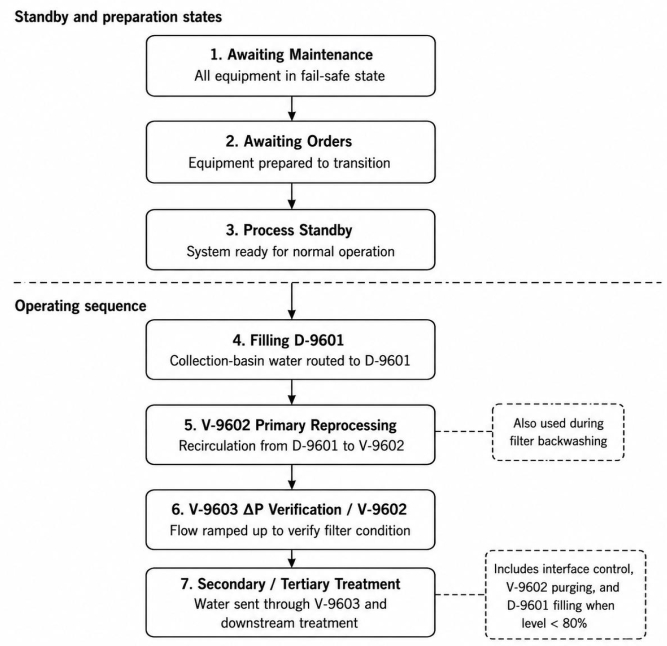
Simplified MOD5 control sequence for the OILY plant, showing the standby/preparation states and the main operating stages of the treatment process. Dashed boxes indicate complementary actions associated with filter backwashing and secondary/tertiary treatment
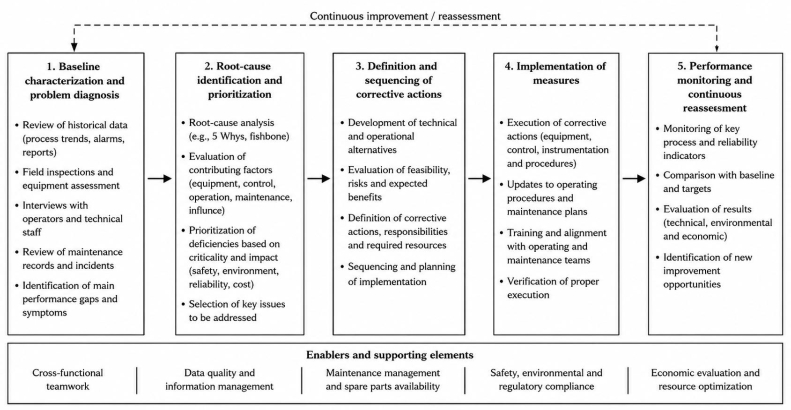
Diagnosis-driven recovery framework applied in this study. The dashed arrow represents the feedback loop for continuous improvement and reassessment
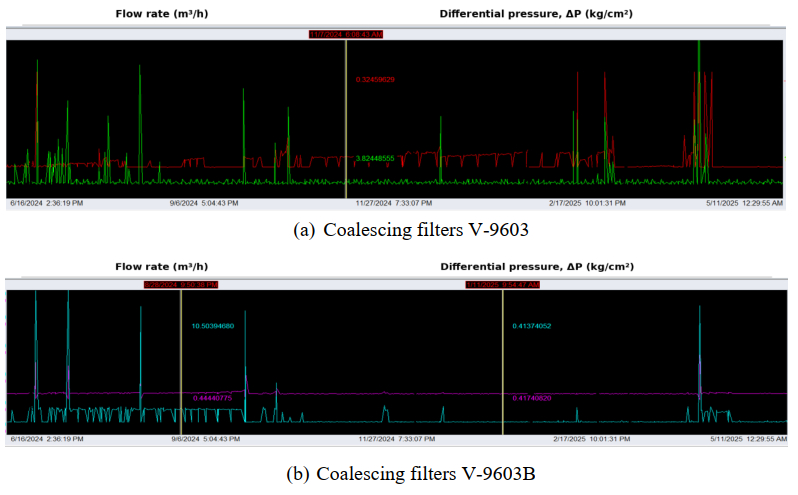
Inlet flow versus differential pressure (ΔP) trends across the coalescing filters of the two trains, (a) V-9603 and (b) V-9603B, showing high ΔP at sub-design flow
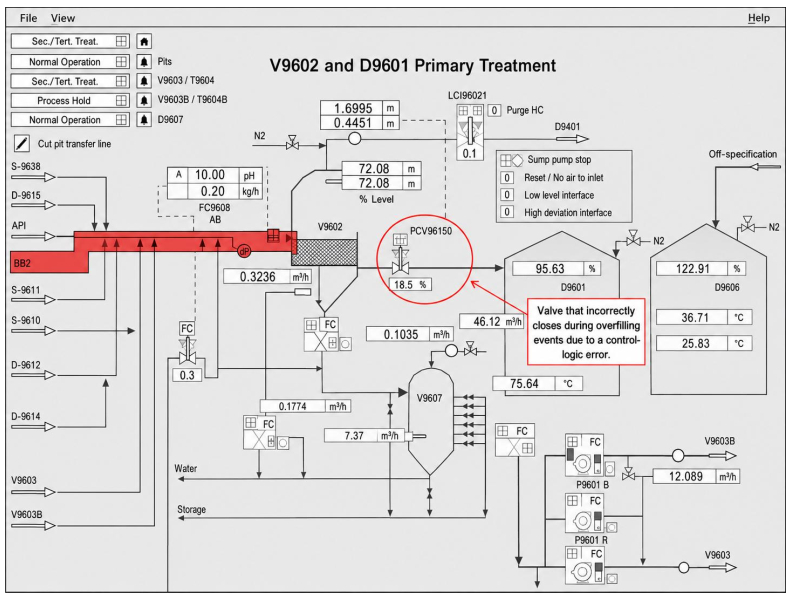
DCS control screen showing the overpressure/relief event associated with the original V-9602 logic
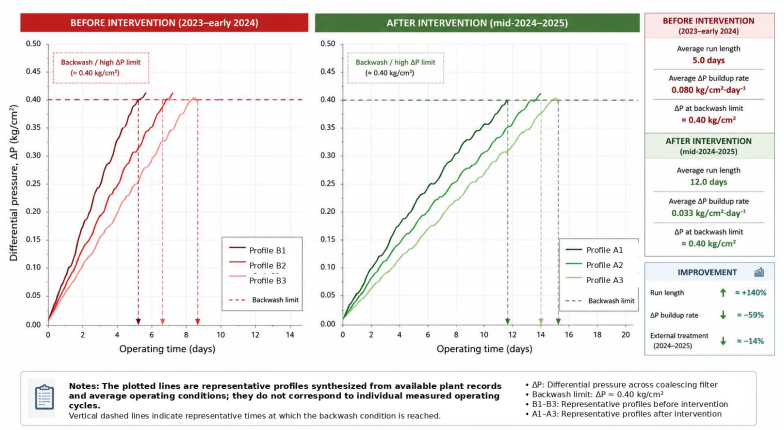
Representative hydraulic behavior of the coalescing filtration system before (2023–early 2024) and after (mid-2024–2025) the operational recovery actions, based on available plant historian trends and operating records. The plotted lines are representative profiles synthesized from the available records and are not individual experimental replicates




 DownLoad: