One of the primary challenges that hinders organizational effectiveness and prosperity is organizational cynicism. Organizational cynicism is defined as a general or specific attitude of disappointment, insecurity, burnout, and mistrust towards individuals or groups. Paradoxical leadership, as applied by nurse managers, involves acknowledging and navigating the inherent tensions and contradictions within healthcare organizations, which enables managers to sustain balance in the workplace.
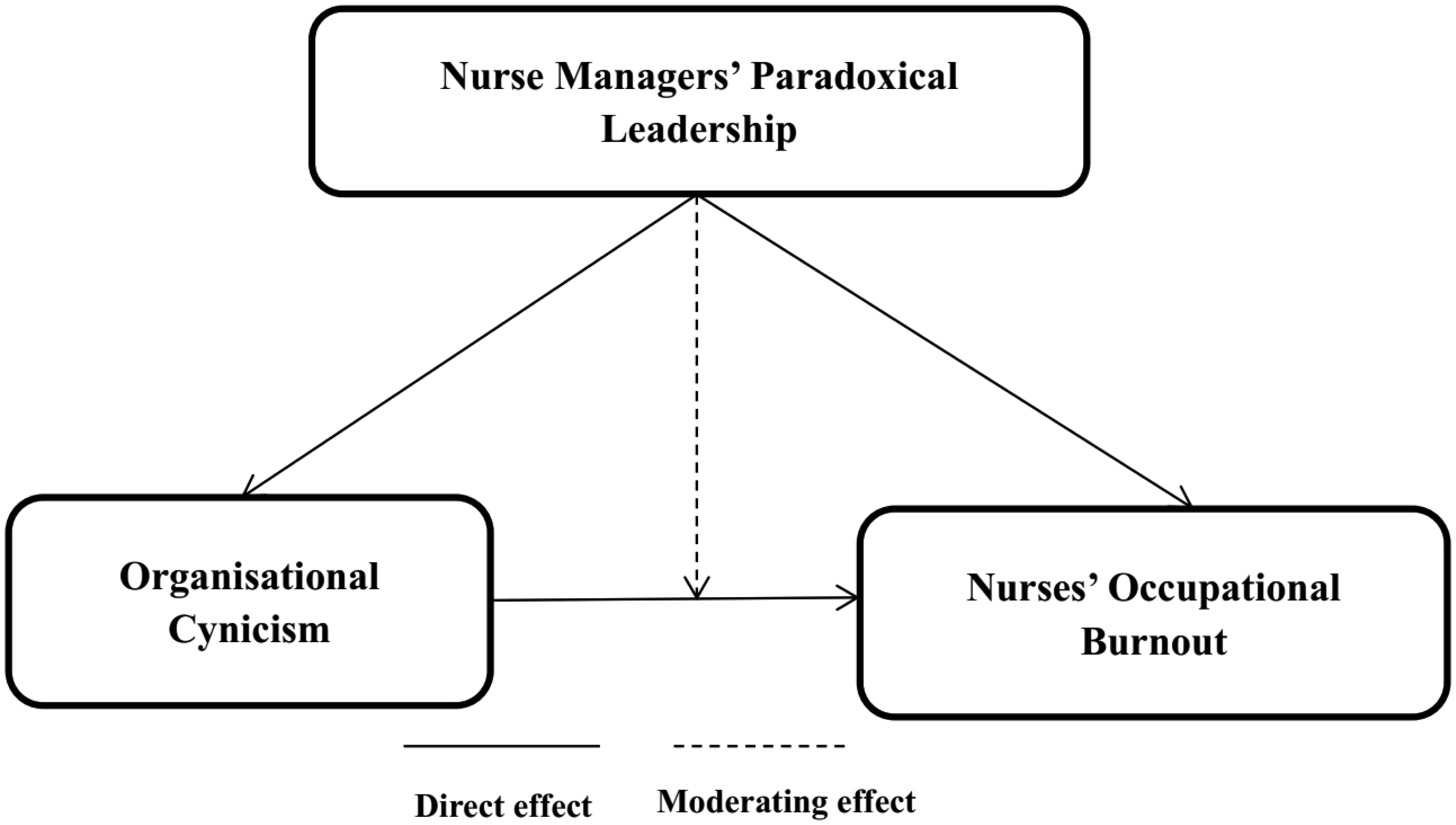
This study aims to investigate the relation between organizational cynicism and a nurses' occupational burnout (testing nurse managers' paradoxical leadership moderation effects).
A non-experimental cross-sectional prospective design was employed for this study.
A stratified random sample of 314 nurses participated in the study.
The study was conducted at Main Tanta University Hospital, which is affiliated with the Ministry of Higher Education and Scientific Research.
Three tools were used for data collection: the Organizational Cynicism Scale, the Nurse Managers' Paradoxical Leadership Scale, and the Maslach Burnout Inventory (MBI).
A statistically significant positive correlation was found between organizational cynicism and occupational burnout. Additionally, a statistically significant negative correlation was observed between the nurse managers' paradoxical leadership and both organizational cynicism and occupational burnout.
Healthcare leaders should take proactive measures to address organizational cynicism to mitigate a nurses' occupational burnout, which can contribute to the nursing shortage.
Citation: Wagih Mohamed Salama, Hazem Ahmed Khairy, Mohammad Gouda, Marwa Samir Sorour. Organizational cynicism and its relation to nurses' occupational burnout: Testing nurse managers' paradoxical leadership moderation effects[J]. AIMS Public Health, 2025, 12(2): 275-289. doi: 10.3934/publichealth.2025017
One of the primary challenges that hinders organizational effectiveness and prosperity is organizational cynicism. Organizational cynicism is defined as a general or specific attitude of disappointment, insecurity, burnout, and mistrust towards individuals or groups. Paradoxical leadership, as applied by nurse managers, involves acknowledging and navigating the inherent tensions and contradictions within healthcare organizations, which enables managers to sustain balance in the workplace.
This study aims to investigate the relation between organizational cynicism and a nurses' occupational burnout (testing nurse managers' paradoxical leadership moderation effects).
A non-experimental cross-sectional prospective design was employed for this study.
A stratified random sample of 314 nurses participated in the study.
The study was conducted at Main Tanta University Hospital, which is affiliated with the Ministry of Higher Education and Scientific Research.
Three tools were used for data collection: the Organizational Cynicism Scale, the Nurse Managers' Paradoxical Leadership Scale, and the Maslach Burnout Inventory (MBI).
A statistically significant positive correlation was found between organizational cynicism and occupational burnout. Additionally, a statistically significant negative correlation was observed between the nurse managers' paradoxical leadership and both organizational cynicism and occupational burnout.
Healthcare leaders should take proactive measures to address organizational cynicism to mitigate a nurses' occupational burnout, which can contribute to the nursing shortage.

| [1] |
Rosen MA, DiazGranados D, Dietz AS, et al. (2018) Teamwork in healthcare: Key discoveries enabling safer, high-quality care. Am Psychol 73: 433-450. https://doi.org/10.1037/amp0000298 
|
| [2] |
Marshall JC, Boscon NK (2020) What is an intensive care unit? A report of the task force of the world federation of societies of intensive and critical care medicine. J Crit Care 37: 270-276. https://doi.org/10.1016/j.jcrc.2016.07.015
|
| [3] | Adenusi B (2018) The importance of vigilance in promoting patient safety in nurse anesthesia practice. A correlational study. Nurs Crit Care J 23: 715-727. |
| [4] | Argon T, Ekinci S (2019) Primary and secondary school teachers opinions related with their organizational identification and organizational cynicism levels. Abant İzzet Baysal Üniversitesi Eğitim Fakültesi Dergisi 16: 1. https://doi.org/10.17240/aibuefd.2016.16.1-5000182908 |
| [5] | Shaharruddina S, Ahmad F (2018) The influence of job autonomy on organizational cynicism: The reliability test. Int J Res Bus Stud Manag 2: 91-100. |
| [6] | Peter B, Chima OB (2018) Organizational cynicism and employees' intention to quit. Int J Manag Sci 5: 6-9. |
| [7] | Hafez Mahmoud Gharib R, Ahmed Khairy H (2019) An examination of the relationships among organizational cynicism, organizational commitment, and psychological contract in the hotel industry. Int J Herit Tourism Hosp 13: 85-104. https://doi.org/10.21608/ijhth.2019.92755 |
| [8] |
Jiang Z, Hu X, Wang Z, et al. (2019) Knowledge hiding as a barrier to thriving: The mediating role of psychological safety and moderating role of organizational cynicism. J Organ Behav 40: 800-881. https://doi.org/10.1002/job.2358
|
| [9] | Mousa M (2018) The effect of cultural diversity challenges on organizational cynicism dimensions: A study from Egypt. J Glob Responsib 9: 288-230. https://doi.org/10.1108/JGR-06-2017-0037 |
| [10] | Ozler E, Derya A, Ceren AG (2018) A research to determine the relationship between organizational cynicism and burnout levels of employees in Health Sector. Bus Manag Rev 1: 26-38. |
| [11] |
Rapp D, Hughey M, Kreiner G (2021) Boundary work as a buffer against burnout: Evidence from healthcare workers during the COVID-19 pandemic. J Appl Psychol 106: 1169-1187. https://doi.org/10.1037/apl0000951
|
| [12] |
Salomonsson S, Santoft F, Lindsäter E, et al. (2020) Effects of cognitive behavioural therapy and return-to-work intervention for patients on sick leave due to stress-related disorders: Results from a randomized trial. Scand J Psychol 61: 281-289. https://doi.org/10.1111/sjop.12590
|
| [13] |
Schonfeld IS, Verkuilen J, Bianchi R (2019) An exploratory structural equation modeling bi-factor analytic approach to uncovering what burnout, depression, and anxiety scales measure. Psychol Assess 31: 1073-1079. https://doi.org/10.1037/pas0000721
|
| [14] | Bianchi R, Verkuilen J, Schonfeld IS, et al. (2021) Is burnout a depressive condition? A 14-sample meta-analytic and bifactor analytic study. Clin Psychol Sci 24: 603-616. https://doi.org/10.1177/2167702620979597 |
| [15] |
Ahmad M, Barattucci M, Ramayah T, et al. (2022) Organizational support and perceived environment impact on quality of care and job satisfaction: A study with Pakistani nurses. Int J Workplace Health Manag 15: 677-693. https://doi.org/10.1108/IJWHM-09-2021-0179
|
| [16] |
Ahmed M, Moustafa A (2021) First Line Nurse Managers' managerial competency and its relationship with their staff nurses' work engagement at main Mansoura university hospital. Egyptian J Health Care 12: 471-485. https://doi.org/10.21608/ejhc.2021.142700
|
| [17] |
Zhang W, Liao S, Liao J, et al. (2021) Paradoxical leadership and employee task performance: A sense-making perspective. Front Psychol 12: 753116. https://doi.org/10.3389/fpsyg.2021.753116
|
| [18] |
Bolden R, Kars-Unluoglu S, Jarvis C, et al. (2023) Paradoxes of multi-level leadership: Insights from an integrated care system. J Change Manag 9: 337-357. https://doi.org/10.1080/14697017.2023.2234388
|
| [19] |
Fürstenberg N, Alfes K, Kearney E (2021) How and when paradoxical leadership benefits work engagement: The role of goal clarity and work autonomy. J Occup Organ Psych 94: 672-705. https://doi.org/10.1111/joop.12344
|
| [20] | Zaghini F, Fiorini J, Piredda M, et al. (2020) The relationship between nurse managers' leadership style and patients' perception of the quality of the care provided by nurses: Cross sectional survey. Int J Nurs Stud 10: 103-116. https://doi.org/10.1016/j.ijnurstu.2019.103446 |
| [21] |
Zhang M, Zhang Y, Law K (2022) Paradoxical leadership and innovation in work teams: The multilevel mediating role of ambidexterity and leader vision as a boundary condition. Acad Manag J 65: 1652-1679. https://doi.org/10.5465/amj.2017.1265
|
| [22] |
Sipos D, Goyal R, Zapata T (2024) Addressing burnout in the healthcare workforce: Current realities and mitigation strategies. Lancet Reg Health Eur 42: 100961. https://doi.org/10.1016/j.lanepe.2024.100961
|
| [23] |
Sipos D, Jenei T, Kövesdi OL, et al. (2023) Burnout and occupational stress among Hungarian radiographers working in emergency and non-emergency departments during COVID-19 pandemic. Radiography (Lond) 29: 466-472. https://doi.org/10.1016/j.radi.2023.02.013
|
| [24] |
Sipos D, Kunstár O, Kovács A, et al. (2023) Burnout among oncologists, nurses, and radiographers working in oncology patient care during the COVID-19 pandemic. Radiography (Lond) 29: 503-508. https://doi.org/10.1016/j.radi.2023.02.008
|
| [25] |
Dean Jr, James W, Brandes P, et al. (1998) Organizational cynicism. Acad Manag Rev 23: 341-352. https://doi.org/10.2307/259378
|
| [26] | Brandes P, Dharwadkar R, Dean Jr, et al. (1999) Does organizational cynicism matter? Employee and supervisor perspectives on work outcomes. Eastern Acad Manag Proc Phila 11: 150-153. |
| [27] |
Zhang Y, Waldman D, Han L, et al. (2015) Paradoxical leader behaviors in people management: Antecedents and consequences. Acad Manag J 58: 538-566. https://doi.org/10.5465/amj.2012.0995
|
| [28] | Maslach C, Jackson SE, Leiter MP (1997) Maslach burnout inventory: Third edition. Evaluating stress: A book of resources . Scarecrow Education 191-218. |
| [29] |
Birkinshaw J, Morrison A, Hulland J (1995) Structural and competitive determinants of a global integration strategy. Strategic Manage J 16: 637-655. https://doi.org/10.1002/smj.4250160805
|
| [30] |
Acedo FJ, Jones MV (2007) Speed of internationalization and entrepreneurial cognition: Insights and a comparison between international new ventures, exporters and domestic firms. J World Bus 42: 236-252. https://doi.org/10.1016/j.jwb.2007.04.012
|
| [31] | Kock N (2021) WarpPLS User Manual: Version 7.0. Laredo, TX: ScriptWarp Systems. |
| [32] |
Simha A, F Elloy D, Huang HC (2014) The moderated relationship between job burnout and organizational cynicism. Manage Decis 52: 482-504. https://doi.org/10.1108/MD-08-2013-0422
|
| [33] | Alsubaie FA, Nasaani A (2021) Why so cynical? The effect of job burnout as a mediator on the relationship between perceived organizational support and organizational cynicism. Eur J Bus Manag 13: 1-12. |
| [34] |
Pan Z (2021) Paradoxical leadership and organizational citizenship behaviour: The serial mediating effect of a paradoxical mindset and personal service orientation. Leadership Org Dev J 42: 869-881. https://doi.org/10.1108/LODJ-08-2020-0351
|
| [35] |
Sulphey MM, Jasim KM (2022) Paradoxical leadership as a moderating factor in the relationship between organizational silence and employee voice: An examination using SEM. Leadership Org Dev J 43: 457-481. https://doi.org/10.1108/LODJ-02-2021-0075
|
| [36] | Chen X, Yang B (2023) A review of paradoxical leadership research. A review of paradoxical leadership research. J Human Res Sust Stud 11: 871-886. 10.4236/jhrss.2023.114050 |
| [37] |
Hu X, Jiang L, Willis S, et al. (2024) Paradoxical safety leadership: Conceptualization and measurement. J Org Behave 46: 66-89. https://doi.org/10.1002/job.2826
|
| [38] |
Silva V, Duarte V, Simões L (2024) The impact of paradoxical leadership on employee knowledge-sharing behavior: The role of trust in the leader and employee promotive voice behavior. J Adm Sci 14: 221. https://doi.org/10.3390/admsci14090221
|
 publichealth-12-02-017-s001.pdf publichealth-12-02-017-s001.pdf |
 |

Figures(2) / Tables(3)

Wagih Mohamed Salama, Hazem Ahmed Khairy, Mohammad Gouda, Marwa Samir Sorour. Organizational cynicism and its relation to nurses' occupational burnout: Testing nurse managers' paradoxical leadership moderation effects[J]. AIMS Public Health, 2025, 12(2): 275-289. doi: 10.3934/publichealth.2025017





 DownLoad: