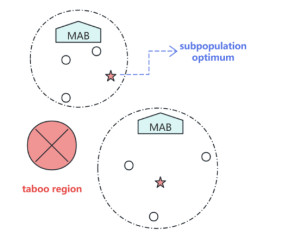
High-dimensional optimization problems face challenges from exponentially expanding search spaces and deceptive local optima resisting metaheuristics. In order to address these issues, a reinforcement learning-guided Animated Oat Optimization Algorithm with a dynamic niching strategy, called RLDN-AOO, is proposed in this research. RLDN-AOO offers the following major novelties: i) a mathematically formulated three-state dynamic niching mechanism that adaptively partitions the population, preserves diversity, and enhances the algorithm's ability to escape local optima, and ii) a reinforcement learning strategy selection mechanism is proposed to address the issue of the algorithm's inadequate dynamic adaptability. We compared it with state-of-the-art algorithms (CEC2017, Dim = 50, 100, 200, 500), including LSHADE-SPACMA, CMA-ES variants, and RL-based optimizers. In addition, we applied it in the optimization of BP neural networks. Experimental results showed that RLDN-AOO achieves competitive performance across most benchmarks and, in some cases, performs comparably to LSHADE-SPACMA variants. The source code of RLDN-AOO is openly accessible via https://github.com/robingit77/RLDN-AOO.
Citation: Jia-Lin Yang, Hao-Ran Sun, Chai-Rui Chen, Ruo-Bin Wang, Lin Xu, Jeng-Shyang Pan, Shu-Chuan Chu. Reinforcement learning-guided Animated Oat Optimization Algorithm with dynamic niching for high-dimensional optimization problems[J]. Electronic Research Archive, 2025, 33(9): 5536-5590. doi: 10.3934/era.2025248
High-dimensional optimization problems face challenges from exponentially expanding search spaces and deceptive local optima resisting metaheuristics. In order to address these issues, a reinforcement learning-guided Animated Oat Optimization Algorithm with a dynamic niching strategy, called RLDN-AOO, is proposed in this research. RLDN-AOO offers the following major novelties: i) a mathematically formulated three-state dynamic niching mechanism that adaptively partitions the population, preserves diversity, and enhances the algorithm's ability to escape local optima, and ii) a reinforcement learning strategy selection mechanism is proposed to address the issue of the algorithm's inadequate dynamic adaptability. We compared it with state-of-the-art algorithms (CEC2017, Dim = 50, 100, 200, 500), including LSHADE-SPACMA, CMA-ES variants, and RL-based optimizers. In addition, we applied it in the optimization of BP neural networks. Experimental results showed that RLDN-AOO achieves competitive performance across most benchmarks and, in some cases, performs comparably to LSHADE-SPACMA variants. The source code of RLDN-AOO is openly accessible via https://github.com/robingit77/RLDN-AOO.

| [1] |
R. Wang, W. Wang, L. Xu, J. S. Pan, S. C. Chu, An adaptive parallel arithmetic optimization algorithm for robot path planning, J. Adv. Transp. , 2021 (2021), 1-22. https://doi.org/10.1155/2021/3606895 doi: 10.1155/2021/3606895

|
| [2] |
J. Zhang, H. Tran, G. Zhang, Accelerating reinforcement learning with a Directional-Gaussian-Smoothing evolution strategy, Electron. Res. Arch. , 29 (2021), 4119-4135. https://doi.org/10.3934/era.2021075 doi: 10.3934/era.2021075
|
| [3] |
H. Xu, An adaptive initialization and reproduction-based evolutionary algorithm for tackling Bi-objective feature selection in classification, Symmetry, 17 (2025), 671. https://doi.org/10.3390/sym17050671 doi: 10.3390/sym17050671
|
| [4] |
Z. Zhang, Z. Wei, B. Nie, Y. Li, Discontinuous maneuver trajectory prediction based on HOA-GRU method for the UAVs, Electron. Res. Arch. , 30 (2022), 3111-3129. https://doi.org/10.3934/era.2022158 doi: 10.3934/era.2022158
|
| [5] |
K. Liu, Z. He, H. Zhang, X. Yang, A Crank-Nicolson ADI compact difference scheme for the three-dimensional nonlocal evolution problem with a weakly singular kernel, Comput. Appl. Math. , 44 (2025), 164. https://doi.org/10.1007/s40314-025-03125-x doi: 10.1007/s40314-025-03125-x
|
| [6] | F. Caraffini, F. Neri, G. Iacca, Large scale problems in practice: the effect of dimensionality on the interaction among variables, in Applications of Evolutionary Computation, (2017), 636-652. https://doi.org/10.1007/978-3-319-55849-3_58 |
| [7] |
S. Mahdavi, M. E. Shiri, S. Rahnamayan, Metaheuristics in large-scale global continues optimization: A survey, Inf. Sci. , 295 (2015), 407-428. https://doi.org/10.1016/j.ins.2014.10.042 doi: 10.1016/j.ins.2014.10.042
|
| [8] |
Q. Yang, W. N. Chen, Z. Yu, T. Gu, Y. Li, H. Zhang, Adaptive multimodal continuous ant colony optimization, IEEE Trans. Evol. Comput. , 21 (2017), 191-205. https://doi.org/10.1109/TEVC.2016.2591064 doi: 10.1109/TEVC.2016.2591064
|
| [9] |
W. Zhang, J. Zhao, H. Liu, L. Tu, Cleaner fish optimization algorithm: a new bio-inspired meta-heuristic optimization algorithm, J. Supercomput. , 80 (2024), 17338-17376. https://doi.org/10.1007/s11227-024-06105-w doi: 10.1007/s11227-024-06105-w
|
| [10] |
J. Bai, H. Nguyen-Xuan, E. Atroshchenko, G. Kosec, L. Wang, M. Abdel Wahab, Blood-sucking leech optimizer, Adv. Eng. Software, 195 (2024), 103696. https://doi.org/10.1016/j.advengsoft.2024.103696 doi: 10.1016/j.advengsoft.2024.103696
|
| [11] |
Y. Fu, D. Liu, J. Chen, L. He, Secretary bird optimization algorithm: a new metaheuristic for solving global optimization problems, Artif. Intell. Rev. , 57 (2024), 123. https://doi.org/10.1007/s10462-024-10729-y doi: 10.1007/s10462-024-10729-y
|
| [12] |
J. Jian, Z. Zhan, J. Zhang, Large-scale evolutionary optimization: a survey and experimental comparative study, Int. J. Mach. Learn. Cybern. , 11 (2020), 729-745. https://doi.org/10.1007/s13042-019-01030-4 doi: 10.1007/s13042-019-01030-4
|
| [13] |
R. Wang, R. Hu, F. Geng, L. Xu, S. C. Chu, J. S. Pan, et al., The Animated Oat Optimization Algorithm: A nature-inspired metaheuristic for engineering optimization and a case study on Wireless Sensor Networks, Knowledge-Based Syst. , 318 (2025), 113589. https://doi.org/10.1016/j.knosys.2025.113589 doi: 10.1016/j.knosys.2025.113589
|
| [14] | J. Kennedy, R. Eberhart, Particle swarm optimization, in Proceedings of ICNN'95 - International Conference on Neural Networks, (1995), 1942-1948. https://doi.org/10.1109/ICNN.1995.488968 |
| [15] |
S. Fu, C. Ma, K. Li, C. Xie, Q. Fan, H. Huang, et al., Modified LSHADE-SPACMA with new mutation strategy and external archive mechanism for numerical optimization and point cloud registration, Artif. Intell. Rev. , 58 (2025), 72. https://doi.org/10.1007/s10462-024-11053-1 doi: 10.1007/s10462-024-11053-1
|
| [16] | H. Nakagawa, Y. Yamada, K. Uchida, S. Shirakawa, Learning rate adaptation CMA-ES for multimodal and noisy problems with low effective dimensionality, in GECCO '25 Companion: Proceedings of the Genetic and Evolutionary Computation Conference Companion, (2025), 491-494. https://doi.org/10.1145/3712255.3726725 |
| [17] |
M. I. Jordan, T. M. Mitchell, Machine learning: Trends, perspectives, and prospects, Science, 349 (2015), 255-260. https://doi.org/10.1126/science.aaa8415 doi: 10.1126/science.aaa8415
|
| [18] |
Y. Zhang, Neural network algorithm with reinforcement learning for parameters extraction of photovoltaic models, IEEE Trans. Neural Networks Learn. Syst. , 34 (2023), 2806-2816. https://doi.org/10.1109/TNNLS.2021.3109565 doi: 10.1109/TNNLS.2021.3109565
|
| [19] |
D. Wu, S. Wang, Q. Liu, L. Abualigah, H. Jia, An improved teaching-learning-based optimization algorithm with reinforcement learning strategy for solving optimization problems, Comput. Intell. Neurosci. , 2022 (2022), 1535957. https://doi.org/10.1155/2022/1535957 doi: 10.1155/2022/1535957
|
| [20] |
R. S. Sutton, A. G. Barto, Reinforcement learning: An introduction, IEEE Trans. Neural Networks, 9 (1998), 1054-1054. https://doi.org/10.1109/TNN.1998.712192 doi: 10.1109/TNN.1998.712192
|
| [21] |
S. Ding, W. Du, X. Zhao, L. Wang, W. Jia, A new asynchronous reinforcement learning algorithm based on improved parallel PSO, Appl. Intell. , 49 (2019), 4211-4222. https://doi.org/10.1007/s10489-019-01487-4 doi: 10.1007/s10489-019-01487-4
|
| [22] |
K. Jiao, J. Chen, B. Xin, L. Li, A reference vector based multiobjective evolutionary algorithm with Q-learning for operator adaptation, Swarm Evol. Comput. , 76 (2023), 101225. https://doi.org/10.1016/j.swevo.2022.101225 doi: 10.1016/j.swevo.2022.101225
|
| [23] |
H. P. Chan, The multi-armed bandit problem: An efficient nonparametric solution, Ann. Stat. , 48 (2020), 346-373. https://doi.org/10.1214/19-AOS1809 doi: 10.1214/19-AOS1809
|
| [24] |
H. Flynn, D. Reeb, M. Kandemir, J. Peters, PAC-Bayesian lifelong learning for multi-armed bandits, Data Min. Knowl. Discovery, 36 (2022), 841-876. https://doi.org/10.1007/s10618-022-00825-4 doi: 10.1007/s10618-022-00825-4
|
| [25] |
X. Zhang, Q. Kang, Q. Tu, J. Cheng, X. Wang, Efficient and merged biogeography-based optimization algorithm for global optimization problems, Soft Comput. , 23 (2019), 4483-4502. https://doi.org/10.1007/s00500-018-3113-1 doi: 10.1007/s00500-018-3113-1
|
| [26] |
L. Lyu, F. Yang, MMPA: A modified marine predator algorithm for 3D UAV path planning in complex environments with multiple threats, Expert Syst. Appl. , 257 (2024), 124955. https://doi.org/10.1016/j.eswa.2024.124955 doi: 10.1016/j.eswa.2024.124955
|
| [27] |
A. Faramarzi, M. Heidarinejad, S. Mirjalili, A. H. Gandomi, Marine Predators Algorithm: A nature-inspired metaheuristic, Expert Syst. Appl. , 152 (2020), 113377. https://doi.org/10.1016/j.eswa.2020.113377 doi: 10.1016/j.eswa.2020.113377
|
| [28] |
S. Mirjalili, A. Lewis, The Whale Optimization Algorithm, Adv. Eng. Software, 95 (2016), 51-67. https://doi.org/10.1016/j.advengsoft.2016.01.008 doi: 10.1016/j.advengsoft.2016.01.008
|
| [29] |
X. Zhang, S. Wen, Hybrid whale optimization algorithm with gathering strategies for high-dimensional problems, Expert Syst. Appl. , 179 (2021), 115032. https://doi.org/10.1016/j.eswa.2021.115032 doi: 10.1016/j.eswa.2021.115032
|
| [30] |
R. Storn, K. Price, Differential evolution - A simple and efficient heuristic for global optimization over continuous spaces, J. Global Optim. , 11 (1997), 341-359. https://doi.org/10.1023/A:1008202821328 doi: 10.1023/A:1008202821328
|
| [31] |
C. Li, Y. Zhai, V. Palade, W. Fang, H. Lu, L. Mao, et al., Diversity-based adaptive differential evolution algorithm for multimodal optimization problems, Swarm Evol. Comput. , 93 (2025), 101869. https://doi.org/10.1016/j.swevo.2025.101869 doi: 10.1016/j.swevo.2025.101869
|
| [32] |
C. Rim, S. Piao, G. Li, U. Pak, A niching chaos optimization algorithm for multimodal optimization, Soft Comput. , 22 (2018), 621-633. https://doi.org/10.1007/s00500-016-2360-2 doi: 10.1007/s00500-016-2360-2
|
| [33] |
X. Li, M. G. Epitropakis, K. Deb, A. Engelbrecht, Seeking multiple solutions: an updated survey on niching methods and their applications, IEEE Trans. Evol. Comput. , 21 (2017), 518-538. https://doi.org/10.1109/TEVC.2016.2638437 doi: 10.1109/TEVC.2016.2638437
|
| [34] |
K. A. Luong, M. A. Wahab, J. H. Lee, Simultaneous imposition of initial and boundary conditions via decoupled physics-informed neural networks for solving initial-boundary value problems, Appl. Math. Mech. , 46 (2025), 763-780. https://doi.org/10.1007/s10483-025-3240-7 doi: 10.1007/s10483-025-3240-7
|
| [35] |
Y. Guo, C. Wang, S. Han, G. Kosec, Y. Zhou, L. Wang, et al., A deep neural network model for parameter identification in deep drawing metal forming process, J. Manuf. Processes, 133 (2025), 380-394. https://doi.org/10.1016/j.jmapro.2024.11.067 doi: 10.1016/j.jmapro.2024.11.067
|
| [36] |
D. Q. Nguyen, K. Q. Tran, T. D. Le, M. A. Wahab, H. Nguyen-Xuan, A data-driven uncertainty quantification framework in probabilistic bio-inspired porous materials (Material-UQ): An investigation for RotTMPS plates, Comput. Methods Appl. Mech. Eng. , 435 (2025), 117603. https://doi.org/10.1016/j.cma.2024.117603 doi: 10.1016/j.cma.2024.117603
|
| [37] |
A. C. Kocabıçak, C. Wang, S. Han, H. Nguyen-Xuan, G. Kosec, L. Wang, et al., A deep neural network approach to predict dimensional accuracy of thin-walled tubes in backward flow forming plasticity process, J. Manuf. Processes, 141 (2025), 59-80. https://doi.org/10.1016/j.jmapro.2025.02.044 doi: 10.1016/j.jmapro.2025.02.044
|
| [38] |
L. Nguyen-Ngoc, Q. Nguyen-Huu, G. De Roeck, T. Bui-Tien, M. Abdel-Wahab, Deep neural network and evolved optimization algorithm for damage assessment in a truss bridge, Mathematics, 12 (2024), 2300. https://doi.org/10.3390/math12152300 doi: 10.3390/math12152300
|
| [39] |
Z. Wang, X. Huang, D. Zhu, S. Yan, Q. Li, W. Guo, Learning sparrow search algorithm of hybrids boundary processing mechanisms, J. Beijing Univ. Aeronaut. Astronaut. , 50 (2024), 286-298. https://doi.org/10.13700/j.bh.1001-5965.2022.0195 doi: 10.13700/j.bh.1001-5965.2022.0195
|
| [40] |
X. Yang, Z. Zhang, Superconvergence analysis of a robust orthogonal gauss collocation method for 2D fourth-order subdiffusion equations, J. Sci. Comput. , 100 (2024), 62. https://doi.org/10.1007/s10915-024-02616-z doi: 10.1007/s10915-024-02616-z
|


Figures(17) / Tables(19)
Jia-Lin Yang, Hao-Ran Sun, Chai-Rui Chen, Ruo-Bin Wang, Lin Xu, Jeng-Shyang Pan, Shu-Chuan Chu. Reinforcement learning-guided Animated Oat Optimization Algorithm with dynamic niching for high-dimensional optimization problems[J]. Electronic Research Archive, 2025, 33(9): 5536-5590. doi: 10.3934/era.2025248





 DownLoad: